
Picture two ads for the same product running side by side.
One is a $15,000 studio shoot: perfect lighting, a professional voiceover, a jib shot sweeping across the packaging. The other is 22 seconds of a real customer talking into their phone camera in their kitchen, slightly out of focus, saying “okay so I was skeptical about this but here’s what actually happened.” In market after market, the second ad wins. Not sometimes. Consistently.
That’s not an accident, and it’s not really about production value. It’s about who’s talking. This guide explains what UGC actually is, shows real user generated content examples across B2B and consumer brands, and gives you a system to source it, use it and stay compliant while you do. It builds on our pillar guide, The Extraction Protocol. If you’d rather have a team run this for you, see our social media management services.
What Are User Generated Content Examples, and Why Do They Outperform Brand Ads?
User generated content (UGC) is any content made by customers, clients or fans rather than your marketing team: a LinkedIn post about your results, a phone-shot testimonial, an unboxing clip, a before-and-after photo. It outperforms brand ads because Nielsen finds 88% of consumers trust recommendations from people they know above any paid ad format.
The rest of this guide shows you where to find that content, how to ask for more of it, and the rules that keep you out of trouble while you use it.
How Much Proof Are You Leaving Unused?
We audit your current customer base and social presence to find the UGC you already have but aren’t using.
UGC Meaning: The Types You’re Actually Choosing Between
The term gets used loosely, so it helps to separate what people mean by it.
| Type | What it is | Example |
|---|---|---|
| Organic UGC | Content someone creates on their own, unprompted | A client posts about their results on LinkedIn |
| Commissioned UGC | A paid creator makes native, testimonial-style content | A UGC creator films a product review-style video for your ad |
| Customer-provided content | Reviews, testimonials and stories you actively request | A short client video for your website |
| Employee or advocate content | Posts from your own team or partners | A consultant sharing a lesson from a project |
When people search “what is a UGC creator” or “UGC video meaning,” they usually mean the second row: someone who makes content that looks and feels like an organic customer post, often for use in your paid ads. Other types of content creators, like influencers, bring their own audience. UGC creators primarily bring style and credibility, and the content usually runs on your channels, not theirs.
The Trust Math Behind Why UGC Wins
The numbers here are consistent across more than a decade of research, which is unusual for marketing data.
Peer recommendations beat every paid format. Nielsen’s long-running Global Trust in Advertising research puts trust in recommendations from people you know at 88% to 92% across different survey years, consistently the single most trusted format measured, ahead of TV, branded websites and every kind of paid ad.
UGC reads as more authentic than brand content. Research firm Stackla found consumers rate user-generated content as 2.4 times more authentic than content created by brands.
Even influencer content trails behind. Nielsen’s data puts trust in influencer advertising at just 23%, and Stackla found only 8% of consumers say influencer content strongly affects what they buy. The person with the smallest audience but the most obvious lack of a paycheck often outperforms the person with the biggest one.
Put together, these numbers explain the opening example. The $15,000 shoot looks like an ad, and audiences have spent years learning to filter ads out. The shaky kitchen video looks like a friend, and that’s the one filter people don’t have up.
User Generated Content Examples by Category
For B2B and services:
- A client posting a LinkedIn update about the results they achieved
- A short video testimonial recorded on a phone after a successful project
- A screenshot of a client’s email or message praising the outcome, shared with permission
- A client speaking on a webinar or panel, clipped into short segments
- Employees sharing behind-the-scenes lessons from their work
For consumer and ecommerce brands:
- Unboxing and “first impressions” videos
- Before-and-after photos from customers
- Customers filming how they use the product in real life
- Reviews turned into short user generated commercials, where real customer clips are edited into an ad
For both:
- Comments and replies that answer prospects’ questions honestly
- Case study quotes and photos with client approval
How to Get More UGC: A System, Not a Hope
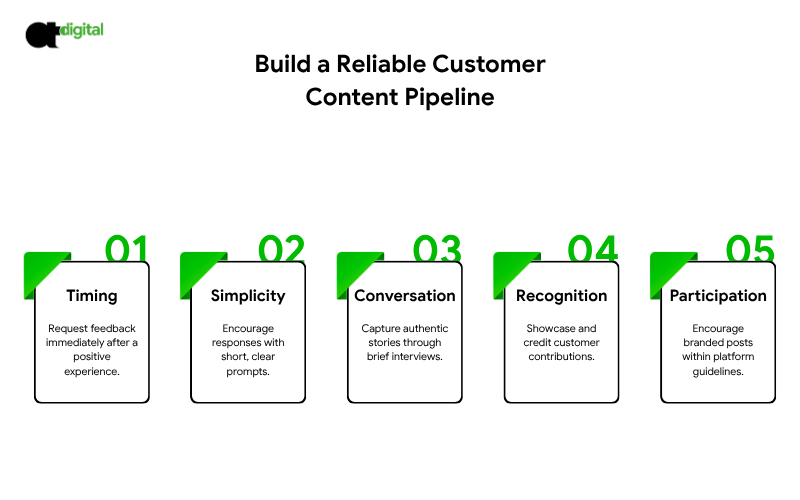
Ask at the Moment of Success
Most owners assume happy customers will review or post on their own. Mostly, they don’t, until asked. The best time to ask is right after you’ve delivered a win, when the customer is happiest.
Make It a Two-Sentence Task
Give a short prompt: “In two sentences, what was the problem and what changed?” A concrete starting point beats a blank page, and this doubles as one of the easiest content creation ideas you can repeat monthly.
Interview, Don’t Just Request
For B2B clients, a ten-minute recorded conversation produces better content than asking them to write something cold. You get better stories and better quotes with almost the same effort.
Feature Customers Publicly
Share and credit their posts. People make more content when they see others being recognized for it.
Use a Branded Hashtag or Prompt
This works well for consumer campaigns. Run contests only within each platform’s promotion rules.
Hiring UGC Creators
If organic content isn’t enough, you can hire UGC creators to produce testimonial-style content for your ads. This is now common, especially in consumer categories.
Where to find them: creator marketplaces, agencies specializing in UGC, social platforms, and content creation companies with a creator network. Review portfolios for the style you want before reaching out.
What to include in the brief:
- The audience and their main problem
- Three key points to cover, and any claims to avoid
- Format, length and platform
- Whether the creator posts it or only delivers files to you
- Usage rights: where, for how long, and in what paid contexts
What to ask before you hire:
- Can they show past work in your category?
- Do they understand disclosure requirements?
- Are usage terms clear in writing?
Commissioned UGC is legitimate work, but it isn’t the same as a spontaneous customer review, and the difference matters for the rule below.
The Rules You Cannot Skip
Get permission first. Reposting a customer’s content is not the same as having the rights to use it in your ads. Get written consent before reuse, especially anything paid.
Disclose paid relationships. The FTC’s Endorsement Guides, updated in 2023, require a clear and conspicuous disclosure whenever there’s a “material connection” between a brand and the person endorsing it, whether that’s payment, free products or any other benefit. A hashtag buried at the end of a caption isn’t considered adequate. Commissioned UGC used as an ad should be labeled as what it is.
Never fabricate proof. The FTC’s rule on fake reviews and testimonials, in effect since October 2024, bans buying or selling fake reviews, including AI-generated ones, and allows the agency to seek civil penalties. No invented customers, no fabricated endorsements.
Be careful with generative AI. Generative AI content creation tools are genuinely useful for editing, captioning, translation and brainstorming. They are not a substitute for a real customer. An AI-generated “customer” testimonial isn’t UGC. It’s the exact thing the FTC’s 2024 rule targets.
Moderate and respond. UGC is public and sometimes negative. Watching your social media reputation and responding quickly is part of running a UGC program, not a separate task.
Want a Compliant UGC Program, Not a Legal Headache?
We build the request system, manage disclosures correctly, and keep your social media reputation clean while it scales.
How to Test UGC Against Your Polished Ads
Don’t take our word, or anyone’s, that UGC will outperform your current creative. Test it.
- Pick one offer and one audience.
- Run two or three UGC-style ads against your current best polished ad, same budget, same targeting, same landing page.
- Let it run long enough to gather meaningful data, not just a day or two.
- Compare cost per lead or acquisition, not just clicks. A cheap click that doesn’t convert isn’t a win.
- Read the comments. They tell you which objections the content is answering, or missing.
For B2B, also watch whether sales conversations start with less skepticism once prospects have seen real customer proof.
A 30-Day UGC Starter Plan
Week 1: List your ten happiest customers. Draft a simple request and a two-sentence prompt.
Week 2: Collect three to five testimonials, using short recorded interviews where possible. Get written permission for reuse.
Week 3: Turn them into short clips, quote graphics and a case study. Publish some organically and use others in a small paid test.
Week 4: Compare results with your current creative. Keep what works, ask for the next round, and fold the request into your normal customer process.
The Verdict: Stop Polishing. Start Asking.
Here’s the uncomfortable math for anyone who’s spent heavily on production: an 88% trust rate for peer recommendations against a low-double-digit trust rate for the best paid formats isn’t a marginal gap. It’s the difference between an ad that gets skipped and a video that gets watched to the end.
That doesn’t mean throwing out your creative brand. It means your highest-leverage next move probably isn’t a bigger production budget. It’s ten happy customers you haven’t asked yet.
Somewhere in your customer list right now is a testimonial that would outperform your best-produced ad, and it’s sitting unrequested. Every week you don’t ask is a week your competitor might. Our UGC audit finds the proof you already have, builds the request system to get more of it, and keeps every piece of it compliant. Book it now, and let your customers close the sale your ads can’t.
See Your Untapped Social Proof
Engineering-grade analysis. Pure mathematics. Absolute market capture.