
Thornfield Consulting spent three weeks writing a 2,000-word guide on supply chain risk. It’s genuinely good. It gets 40 shares.
Meanwhile, a competing firm’s junior analyst posts a 38-second video filmed on a phone, no script, no edit beyond a few captions, and it outperforms Thornfield’s entire social reach in a single afternoon. That’s not an algorithm glitch. That’s the format buyers are actually watching, and it’s reshaping what “social media strategy” even means.
This guide breaks down what short-form video actually is, why it’s outperforming nearly everything else on the feed, and how to build a strategy around it that doesn’t collapse into chasing trends your brand has no business chasing. It’s the practical companion to our pillar guide, The Extraction Protocol, which explains why public platforms should work as a frontline, not a hobby.
What Is Short-Form Video Strategy, and Why Does It Drive Quick Engagement?
Short-form video strategy means planning, producing and distributing videos under 60 seconds to capture attention fast and drive a specific action. It works because it matches mobile consumption: brief, high-impact, over before the viewer scrolls away. Per HubSpot’s research, short-form video is the most-used format among B2B and B2C marketers, delivering the highest ROI of any content type.
The rest of this guide shows you how to build that strategy properly, instead of copying a trend that has nothing to do with your business.
Is Your Current Video Strategy Actually Converting?
We audit your social video output against what’s actually driving engagement and leads in your industry, then show you the gap.
Why Short-Form Video Is Winning Right Now
This isn’t a trend being hyped by agencies with video packages to sell. It’s a measurable shift in where attention and ROI are going. Per HubSpot’s research, short-form video (generally defined as under 60 seconds, with an optimal length of 31 to 60 seconds) is used by 30% of both B2B and B2C marketers, more than any other single format, and the majority of marketers surveyed say it delivers the highest ROI of any content type they produce. Completion data backs this up directly: Vidyard’s analysis of nearly a million B2B videos found clips under one minute hit a 65% completion rate, while videos over 20 minutes drop to just 20%, which is exactly why the short format wins attention it can actually keep.
The B2B-specific data matters even more for a company like yours. HubSpot’s own team reports that when they tested short-form video on LinkedIn specifically, it generated hundreds, sometimes thousands, more impressions than the same content performed on YouTube. And it’s not just HubSpot’s experience: LinkedIn’s video push reportedly drove a 34% year-over-year increase in video uploads in Q4 2024 and 36% year-over-year growth in total video viewership through 2025. If your prospects are B2B decision-makers, LinkedIn is where this shift is happening fastest, not TikTok.
What Counts as “Short-Form” Content?
What is short-form content and video, exactly? The working definition most marketers use is anything under 60 seconds, though platforms keep stretching that boundary, TikTok now allows uploads up to 10 minutes, and both YouTube Shorts and Instagram Reels have extended to 3 minutes. The practical guidance holds regardless: attention spans keep shrinking, so sticking to 60 seconds or fewer is still the safer target while you’re building a strategy.
Looking at short-form video trends heading into the next year, three patterns are worth building into your plan rather than chasing reactively: branded challenges and filters (which consistently outperform expectations when done well), smaller creator and micro-influencer partnerships over big-name endorsements, and authentic, values-driven content that doesn’t read as corporate marketing copy.
The major short form video platforms each behave differently, and knowing the difference changes what you post where:
- TikTok: skews younger, algorithm-driven discovery, highest content velocity
- Instagram Reels: broader age range, integrates with your existing feed and stories
- YouTube Shorts: massive built-in audience, strong for driving viewers to your longer content
- LinkedIn: the one most B2B companies underuse, and per the data above, currently one of the highest-opportunity platforms for this exact format
The B2B Trap: Why Most Short-Form Video Strategies Backfire
Here’s where most B2B companies get this wrong, and it’s worth being honest about both sides. The pros and cons of video marketing aren’t the same for every business.
What works: a specific, credible person addressing a specific, expensive problem your buyer actually has, delivered in under a minute, with no attempt to be funny or viral. This builds exactly the kind of authority our pillar guide describes.
What backfires: chasing a TikTok dance trend or a trending audio clip because “short-form video is working,” without asking whether that specific format fits an enterprise buyer’s mindset. Thornfield’s first attempt at video, after seeing their competitor’s success, was exactly this mistake: a trending-audio clip with a logo slapped on it, filmed because video was “supposed to work.” It got 200 views and zero inquiries. A finance executive scrolling LinkedIn during a commute is not in the same headspace as a teenager scrolling TikTok for entertainment, and content built for one audience rarely translates to the other. Forcing a B2B brand into consumer-style content usually damages credibility rather than building it.
The fix isn’t avoiding short-form video. It’s matching the format’s brevity to your actual audience’s actual problem, not to whatever trend is currently circulating.
How to Build a Video Content Marketing Strategy That Converts
A real video content marketing strategy needs structure, not just a camera and good intentions.
The Anatomy of a 45-Second Hook
The first three to five seconds decide whether anyone watches the rest. A strong structure for this format:
- The hook (seconds 1-5): state the specific problem or surprising fact immediately. No greeting, no warm-up.
- The diagnosis (seconds 6-35): explain exactly why the common approach to this problem fails, with enough specificity that the viewer recognizes their own situation.
- The next step (seconds 36-45): one clear, specific call to action. Not “follow for more.” A specific next step tied to what you just said.
Thornfield’s second attempt used exactly this structure: their supply chain lead, on camera, stating a specific number their clients kept getting wrong, in the first five seconds. Same topic as the 2,000-word guide. Forty-two seconds instead of 2,000 words. It outperformed every piece of content they’d posted that quarter, and unlike the trend-chasing clip, it generated real inbound inquiries.
Where to Publish: Platform by Platform
Don’t post the identical video everywhere and call it a video marketing strategy. Adapt for each platform:
- Instagram strategy should favor visually polished, punchy captions, and consistent posting; Reels integrate with your existing feed, so consistency compounds.
- Video marketing on Instagram benefits from smart use of trending audio, but your core message should never depend on the trend outliving your post.
- LinkedIn rewards a more direct, substantive tone, which is exactly why it outperforms for B2B, per the data above, and exactly where Thornfield’s video succeeded.
Video marketing examples worth studying (not copying) include brands using branded filters to drive organic try-on engagement, micro-influencer partnerships that trade reach for trust, and simple founder-to-camera diagnostics that lead with a specific number or result.
A simple video marketing checklist before you publish anything: does the first 3 seconds hook attention, is the message clear without sound (most viewers watch muted), is there one specific call to action, and is it formatted vertically for mobile.
Want a Video Strategy Built Around Your Actual Buyers?
We build the hook structure, the platform mix and the production workflow so your team isn’t guessing what to post next.
Social Media Videos in Practice: By Platform and Use Case
Social media videos and social media video marketing work differently depending on what you’re trying to achieve, and matching the use case to the platform matters more than posting volume:
- Top-of-funnel awareness: short diagnostic videos on LinkedIn and Instagram, built around a specific pain point
- Mid-funnel trust-building: client testimonials and case study clips, reused across platforms
- Bottom-funnel conversion: product or service walkthroughs, FAQ-style clips answering the objections your sales team hears most
A real social media marketing management services program coordinates all three, rather than posting whatever’s easiest that week.
Social Media Management Services: Why Video Needs a System, Not a Side Project
This is where most companies stall, Thornfield included. One good video is a lucky post. Video strategy without operational infrastructure behind it produces a burst of good content, then silence for two months while everyone goes back to their day jobs. Proper social media management services solve exactly this gap.
What a real system includes:
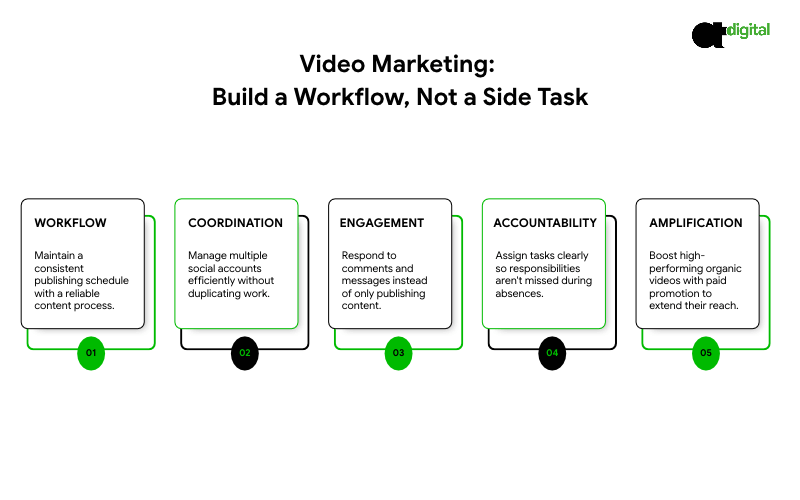
- A content calendar and workflow that doesn’t depend on one person remembering to post
- A process for managing multiple social media accounts across platforms without duplicating effort, often the specific challenge behind searches like “how to manage multiple social media accounts for business”
- Social media community management: actually responding to comments and messages, not just publishing and walking away
- Clear social media management tasks assigned to specific people, so nothing falls through when someone’s on leave
- Paid social media management layered on top of organic, so your best-performing organic videos get amplified with budget instead of relying on reach alone
What does social media management include, when it’s done properly? Strategy and calendar planning, content creation and editing, platform-specific posting and optimization, community management and response, performance analytics, and paid amplification, all working as one connected system rather than five disconnected tasks.
Social media management tips worth acting on immediately: batch-produce video content in single sessions rather than one-off shoots, repurpose every long recording into several short clips, and track engagement from the right people (decision-makers, not just volume) rather than vanity metrics.
Tired of One Good Post Followed by Two Months of Silence?
We build the calendar, the workflow and the production rhythm so momentum doesn’t depend on one person remembering to post.
Hiring Help: Agencies and What to Ask
If you’re evaluating a social media management agency or comparing a social media management service for a small business package against something built for a larger company, the question isn’t “do they post content.” It’s whether they understand video as a system, not a deliverable.
What to ask any social media manager services provider or social media ads management company before signing:
- Do they build platform-specific strategy, or repost the same content everywhere?
- How do they measure success: engagement volume, or leads and pipeline influence?
- Who actually produces the video: a dedicated short form strategist, or whoever’s available that week?
- Can they show real examples of B2B video that drove measurable results, not just view counts?
If you’re a smaller operation researching social media manager for small business options, or specifically social media management services usa, prioritize a provider who treats your LinkedIn presence as seriously as the more obvious platforms. Based on the data above, that’s where the opportunity currently sits for most B2B companies. For a team that builds and runs this as one connected system, see our social media marketing services.
The Verdict: The Format Has Already Won. The Question Is Execution.
Here’s what the data makes hard to ignore: short-form video is already the most-used format by marketers, already delivers the highest ROI of anything they produce, and LinkedIn specifically is seeing double-digit year-over-year growth in both uploads and viewership. This isn’t a bet on where attention might go next. It’s a description of where it already is.
Thornfield’s story is the whole guide in miniature: a good long-form guide that undersold itself, a trend-chasing flop that proved format alone isn’t the answer, and a structured 42-second video on the exact same topic that beat everything else they’d posted that quarter. The difference wasn’t the budget. It was structured.
The businesses losing this aren’t the ones without a video budget. They’re the ones posting inconsistently, copying consumer trends that don’t fit their buyer, or treating video as a one-off project instead of a system with a calendar, a workflow and a clear hook structure behind every piece.
Your competitors are already publishing short-form video to the exact buyers you’re trying to reach. Every week your team debates whether to “get into video” is a week that gap widens. Our video strategy audit looks at what you’re currently producing, benchmarks it against what’s actually working in your industry, and shows you exactly where the system is missing. Book it before your next quarter of content goes out without one.
Build a Video Strategy That Actually Converts
Engineering-grade analysis. Pure mathematics. Absolute market capture.