Build Your Growth Stack

Confirm or adjust your services and enter your details.

Please select at least one service.
First name is required.
Last name is required.
Please enter a valid email address.

Tag: thought leadership

  • The Silent CEO Tax: Why Executives Who Don’t Publish Lose Deals to Those Who Do

    The Silent CEO Tax: Why Executives Who Don’t Publish Lose Deals to Those Who Do

    Teresa has spent the last year publishing sharp, specific takes on the exact problem this buyer is facing: pricing-model breakdowns, a contrarian take on a popular framework, real numbers from real engagements. Raj has a polished website and nothing else. The buyer who found Teresa’s writing walks into her call already convinced. The buyer evaluating Raj walks in asking, “so, why you and not your competitor?”

    That question is the tax Raj pays for staying silent, and it’s a real, measurable one. This guide explains what the research actually shows about executive publishing, what separates real thought leadership from LinkedIn noise, and how to build it without turning your CEO into a full-time writer. It’s the practical companion to our pillar guide, The Pre-Sold Prospect, which explains why buyers who’ve read your thinking arrive at the call already sold.

    What Is Thought Leadership, and Why Do CEOs Need to Publish It?

    Thought leadership is published insight, backed by data or experience, that demonstrates genuine expertise rather than describing a product. CEOs need to publish it because buyers trust it more than marketing materials when judging capability. Per the Edelman-LinkedIn B2B Thought Leadership Impact Report, 73% of decision-makers call it a more trustworthy basis for assessing competence than product sheets.

    The rest of this guide breaks down what that trust actually converts into, and what separates thought leadership that works from the generic content that doesn’t.

    Is Your Executive Team’s Content Doing Any Real Work?

    We run a forensic audit of your current content and show you exactly where it’s failing to pre-sell your prospects.

    Get My Thought Leadership Audit →

    The Trust Gap: What B2B Buyers Actually Do With Thought Leadership

    This isn’t a soft, feel-good marketing claim. The Edelman-LinkedIn research, drawn from surveys of thousands of B2B decision-makers and C-suite executives, ties executive publishing directly to pipeline behavior:

    • 86% of decision-makers say they’d be moderately or very likely to invite an organization that consistently produces high-quality thought leadership into the RFP process, meaning you get considered for deals you’d otherwise never see. That’s precisely the mechanism that put Teresa in the room and left Raj fighting to get noticed.
    • 54% of decision-makers and 52% of C-level executives spend an hour or more every week reading thought leadership content, according to LinkedIn’s own research summary. Your prospects are already reading. The only question is whether they’re reading yours or a competitor’s.
    • 60% of decision-makers say strong thought leadership makes them willing to pay a premium for a vendor’s product or service.
    • 70% of C-suite leaders say a piece of thought leadership has at least occasionally led them to question whether they should keep working with an existing supplier, which cuts both ways: it’s a threat to vendors staying silent, and an opportunity for the one who speaks up.

    Here’s the honest caveat, and it matters: only 15% of decision-makers describe the overall quality of the thought leadership they currently read as very good or excellent. Most of what’s published is forgettable. That’s not a reason to skip publishing. It’s the actual opportunity: the bar for standing out is lower than most executives assume, because almost nobody is clearing it.

    Thought Leadership vs. Content Marketing: Why the Distinction Matters

    What is thought leadership content, exactly, and how is it different from the blog posts your marketing team already produces? Content marketing, broadly, is any content built to attract and engage an audience. Thought leadership is a specific, narrower category within that: content that stakes out a genuine, often contrarian position, backed by direct expertise or data, that only someone with real authority on the topic could credibly write.

    Thought leadership vs. content marketing, in practice:

    Content marketing Thought leadership
    “5 Tips for Better Email Open Rates” “Why Your Open Rate Metric Is Lying to You, and What to Track Instead”
    Summarizes known best practices Takes a specific, defensible position
    Can be written by anyone on the team Requires the expertise of the person whose name is on it
    Optimizes for search volume Optimizes for credibility and trust

    Both have a role. But only one of them is what moves a skeptical decision-maker, because only one of them proves you understand their problem better than the vendor they’re currently using.

    CEO Positioning: Why It Has to Come From the Top

    CEO positioning and executive branding aren’t vanity exercises. They’re a direct answer to a specific buyer behavior: decision-makers evaluating a vendor look for a credible individual behind the claims, not just a company logo.

    The Delegation Problem: Why Ghostwritten Fluff Gets Ignored

    Here’s where most executive thought leadership efforts quietly fail. A CEO hands the task to a junior marketer or an agency with no direct access to the executive’s actual thinking, and the result reads exactly like what it is: generic, safe, and interchangeable with a hundred other posts saying the same thing. Raj actually tried this route a year earlier, a freelancer producing two posts a month in his name, and quietly stopped after three months because nobody engaged with any of it. Experienced buyers can tell the difference between a founder’s real opinion and a ghostwriter’s guess at one, and the generic version does more damage than publishing nothing at all, because it signals the executive’s time is too valuable for the people reading it.

    The fix isn’t that the CEO has to write every word personally. It’s that the ideas, the specific position, the real experience, have to originate from them. A skilled writer can shape that into a published piece. No writer can manufacture a genuine opinion the executive doesn’t actually hold.

    How to Become a Thought Leader Without Becoming a Full-Time Writer

    How to become a thought leader starts with a reframe: you’re not becoming a content creator. You’re extracting knowledge you already have, in a format you’re already comfortable with. Teresa’s actual process is almost embarrassingly simple: a 20-minute recorded call once a month with someone who turns it into a published piece. That’s the entire time investment behind a year of content a competitor’s buyer found convincing enough to pre-sell the deal.

    • Talk, don’t type. A 20-minute recorded conversation about a problem you’ve solved produces more usable material than staring at a blank document.
    • Start from a real opinion, not a safe one. “Here are five trends” is forgettable. “Most companies are measuring this wrong, and here’s what to track instead” gets read.
    • Use your existing work as raw material. Client conversations, internal strategy debates, and problems you’ve personally solved are the actual source of thought leadership, not a brainstorm for blog topics.
    • Publish consistently, not constantly. One sharp, well-reasoned piece a month beats five generic posts a week.

    How Much Time Would Real Thought Leadership Actually Cost Your CEO?

    Less than you think. We scope the process around a single monthly conversation, not a content calendar nobody has time for.

    See the Time Commitment →

    What Separates Real Thought Leadership From Noise

    Given that 85% of current thought leadership fails to impress the people reading it, what does the other 15% actually do differently? The Edelman-LinkedIn data is specific about this: 55% of decision-makers cite strong, verifiable research and data as the top characteristic of high-quality thought leadership, and 62% say credibility comes from a prominent, genuinely expert individual being behind the content.

    In practice, that means every strong piece of thought leadership content needs three things working together:

    1. A specific, defensible position, not a survey of five options with no recommendation.
    2. Real evidence: a number, a case result, a pattern you’ve actually observed, not a borrowed statistic everyone else is already citing.
    3. A named, credible voice behind it, ideally the executive whose actual experience the piece draws from.

    Thought leadership examples that follow this pattern tend to share a structure: they name a specific, expensive problem the reader recognizes, explain exactly why the common approach to it fails, and back that explanation with something concrete the reader can verify, rather than take on faith. The piece that got Teresa into that RFP wasn’t a trend roundup. It was 900 words arguing that a popular pricing model in her industry quietly punishes the clients who need the most help, with her own engagement data to back it up.

    Want Your Executive’s Expertise Turned Into Published Assets?

    We extract your real expertise through short interviews and turn it into the data-backed, credible content buyers actually trust.

    Book My Content Strategy Session →

    Thought Leadership Content Marketing: Building the System, Not Just the Post

    One strong article doesn’t move the pipeline on its own. Thought leadership marketing that actually compounds needs a system behind it, not a one-off push:
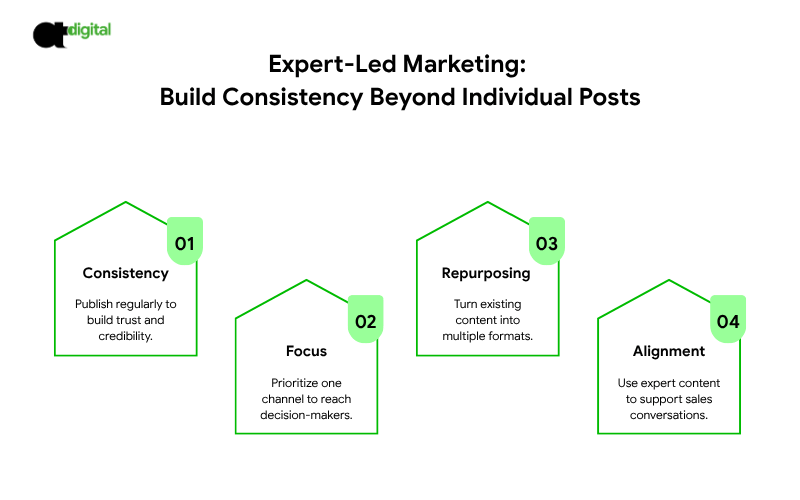
    • A consistent cadence. Sporadic publishing (one strong piece, then silence for four months) doesn’t build the trust the data above describes. Monthly, sustained output does.
    • One primary channel, built out properly. For most B2B companies, that’s a long-form piece on your own site paired with LinkedIn distribution, since that’s where the research shows decision-makers are actually reading.
    • Repurposing, not reinvention. A single strong interview or article can become several LinkedIn posts, a short video, and a sales-enablement one-pager, without demanding new executive time for each format.
    • A direct line to sales. The strongest b2b thought leadership programs feed directly into what sales teams send prospects before and after calls, not just what sits on a blog nobody on the sales team reads.

    Measuring Thought Leadership: The Honest Numbers

    Before you commit a budget here, it’s worth being straight about measurement, because the industry itself is honest about this being imperfect. Fewer than one in three decision-makers and marketers can cleanly trace a specific sale back to a specific piece of thought leadership. That’s not a reason to skip measurement. It’s a reason to track the right signals instead of expecting a clean, single-touch attribution line.

    What to actually track for thought leadership business impact:

    • Sales cycle length on deals where the prospect mentions having read your content before the call
    • RFP invitations or inbound requests to pitch, which the 86% figure above suggests should rise with consistent publishing
    • Direct prospect mentions of specific pieces during sales conversations, which your sales team should be logging
    • Engagement from the right people, not just volume: are decision-makers and executives engaging, or just your own industry peers

    DIY vs. Hiring a Content Strategy Agency

    You can run a lean version of this in-house if your executive has even an hour a month and someone to extract and shape that thinking into finished pieces. Consider bringing in outside help, whether a content strategy agency, a content marketing company, or a dedicated thought leadership agency, when:

    • Your executive has the expertise but genuinely no time to shape it into finished content
    • You need a consistent monthly cadence and nobody internally owns that process
    • Your current content reads generic and isn’t moving the trust and RFP-invitation numbers above

    If you’re comparing a content marketing service, content marketing consulting, or thought leadership consulting, ask three questions before signing anything: how do they extract your actual expertise (interviews and conversations, not a generic brief template), how do they maintain your specific voice instead of a generic agency tone, and how do they tie the content back to sales conversations rather than just publishing volume. For a team that handles the writing, formatting and distribution as one connected system, see our content creation services.

    The Verdict: Your Silence Is a Competitive Advantage, for Someone Else

    Here’s the math that should change how you think about this: 73% of your buyers trust published thinking over your marketing materials, 86% say they’d invite a consistent publisher into deals they’d otherwise never see, and only 15% think the content they’re currently reading is actually good. That’s not a crowded field you’re late to. It’s an open lane with almost nobody running in it well.

    Go back to Teresa and Raj. The difference between them wasn’t talent, price, or even track record, both were genuinely qualified for that deal. It was one recorded conversation a month, going back a year, that Raj never had. Every month your executive team stays silent, a competitor is building that exact gap, one RFP invitation at a time. The buyer who reads their thinking walks into the call already leaning their way. The buyer who’s only seen your homepage walks in asking you to justify your existence from zero.

    You don’t need your CEO to become a full-time writer. You need their real expertise extracted, shaped and published consistently enough to compound. Our thought leadership audit looks at what your executives are currently publishing, if anything, and shows you exactly where the gap between your silence and your competitor’s visibility is costing you deals. Book it before your next RFP goes to the vendor who showed up in the buyer’s reading list first.

    Stop Losing Deals to Executives Who Publish

    Engineering-grade analysis. Pure mathematics. Zero sales scripts.

    Secure My Forensic Audit Now →

  • Intellectual Dominance on LinkedIn: The Gatekeeper Bypass Protocol

    Intellectual Dominance on LinkedIn: The Gatekeeper Bypass Protocol

    THE LINKEDIN ENGAGEMENT DELUSION AND FAILED SOCIAL MEDIA MARKETING SERVICES

    (Funding Your Own Irrelevance)

    Right now, inside a private LinkedIn direct message, your most aggressive competitor is quietly finalizing a six figure enterprise contract.

    The exact contract you thought you were going to win.

    They did not secure that boardroom meeting by posting an inspiring morning quote. They did not win the procurement team over by publishing a colorful infographic about their corporate culture.

    They executed a silent, surgical extraction of the exact Chief Technology Officer you have been trying to reach for six months.

    The Financial Reality Check: Let that sink in for a moment. Whether you operate a massive global enterprise or require a dominant social media marketing agency for small business, you are currently paying a premium retainer to a team of marketers who actively measure your corporate success using three completely useless metrics:

    • Likes: Applause from junior employees.
    • Comments: Chatter from university students.
    • Algorithmic Reach: Visibility to industry spectators who cannot mathematically afford your services.

    Your standard LinkedIn marketing agency expects you to sit in a boardroom and celebrate visibility.

    Visibility is a trap. When the pipeline dries up, executives panic and search for generic social media marketing near me instead of auditing their structural failures.

    If your digital content is visible to ten thousand people who do not possess the legal authority to authorize a corporate wire transfer, your marketing budget is not an asset.

    It is a charitable donation to the LinkedIn platform.

    You are personally funding a free entertainment channel. The modern enterprise buyer does not scroll the public feed looking for a community. They are ghosts. They operate entirely in the shadows, actively hunting for strict mathematical solutions to their internal bleeding.

    If your social media strategy is designed to please the algorithm, you are purposely hiding from the boardroom.
    You do not need better engagement. You need to deploy the exact architecture outlined in our foundational master guide, The Extraction Protocol: Weaponizing Social Media to Capture the C Suite.

    THE ALGORITHMIC QUARANTINE OF STANDARD SOCIAL MEDIA MARKETING SERVICES

    (Why the C Suite Actively Ignores You)

    As we proved in our overarching macro thesis, Digital Darwinism 2026: The Mathematics of Survival in a Revenue Driven Economy, the modern market is a hostile environment. Let us talk about why hiring a traditional LinkedIn marketing company is a trap, and why your current LinkedIn strategy is actively insulating you from the boardroom. The algorithm is not a meritocracy.

    The algorithm is not a meritocracy.

    It is a highly engineered trap.

    The platform strictly rewards broad, frictionless engagement. It desperately wants your marketing team to post motivational stories, generic industry polls, and colorful corporate culture updates. Why? Because that keeps the average user scrolling.

    When you obey the algorithm, you attract the exact demographic that has the free time to participate in the noise.

    You attract the blockers.

    The Evolution of the Gatekeeper: In the modern enterprise landscape, the gatekeeper is no longer a receptionist. They are highly paid mid level managers.

    Their entire corporate function is to block you from reaching the economic buyer. They delete generic InMails. They ignore cold connection requests. They consume your colorful marketing fluff and immediately categorize your firm as a client suited only for a generic social media marketing agency for small business.

    The Myth of the Executive Applause: Even worse, your marketing team is fundamentally misunderstanding executive behavior on the platform.

    A Chief Executive Officer in a Top 20 GDP market does not hit the like button.

    LinkedIn marketing agency

    Elite buyers never engage publicly on a social timeline. They operate with strict discipline for three undeniable reasons:

    • Strategic Silence: They absolutely refuse to tip off their competitors that their internal infrastructure is bleeding capital.
    • Inbox Protection: They know that one single public comment will instantly invite a swarm of desperate sales representatives into their direct messages.
    • Intellectual Bandwidth: They do not log on to debate industry trends with junior marketers. They log on to quietly audit the competence of potential enterprise partners.

    The true executive buyer scrolls right past you in absolute silence. Simultaneously, the algorithm feeds your content directly to the mid level gatekeeper, who permanently filters you out of the procurement conversation.

    You are entirely quarantined from the capital, treated like a junior social media marketing consultant rather than a boardroom authority.

    WEAPONIZING THE FEED BEYOND THE STANDARD LINKEDIN MARKETING AGENCY

    (Engineering Executive Dwell Time)

    How exactly do you bypass a mid level manager who is literally paid a salary to ignore your sales pitches?

    You stop pitching. You start diagnosing.

    You must execute a forensic strike directly on the public LinkedIn timeline. Stop talking about corporate synergy. Burn the colorful infographics. Publish raw unit economics.

    The Death of the Like: A generic LinkedIn marketing company will tell you to post daily for likes. You are no longer optimizing for public applause. You are optimizing for algorithmic dwell time.

    You want the elite buyer to stop scrolling. You want them to open your document. You want them to read your entire financial diagnostic in absolute, uninterrupted silence.

    Here is the exact structural execution:

    The Black and White Document: Upload a highly technical, rigid PDF carousel. No stock photos.

    The Financial Hemorrhage: Break down exactly how a specific legacy software is currently costing a logistics department twenty thousand dollars a week in lost efficiency.

    The Undeniable Math: Do not soften the blow. Make the pain mathematical and impossible to defend.

    The Courier Conversion: When you publish a ruthless financial teardown, you completely neutralize the administrative blocker.

    A junior manager can confidently ignore a generic sales pitch from a standard social media marketing consultant.

    They cannot ignore a multi million dollar operational leak.

    If that mid level manager sees a rigid structural blueprint that fixes their internal bleeding, their corporate survival instinct immediately kicks in. They are forced to copy the link to your LinkedIn post. They are forced to drop it directly into the Chief Executive Officer’s private Slack channel with an urgent priority tag.

    THE SALES NAVIGATOR EXTRACTION

    (Securing the Capital)

    A flawlessly executed timeline built by an elite LinkedIn marketing agency is only the bait.

    The actual corporate transaction never happens in the public comment section.

    Let us be absolutely clear about the battlefield. LinkedIn is rented land. It is a highly hostile hunting ground. If you leave an enterprise prospect wandering around the platform after they consume your content, your competitor will simply retarget them with a display advertisement five minutes later.
    You must violently extract them from the platform. You must pull them into your proprietary Walled Garden using a weaponized LinkedIn marketing service.

    LinkedIn marketing agency

    Here is the exact algorithmic protocol to execute the capture:

    • The Silent Signal: Elite buyers consume your financial teardowns in absolute silence. Your tracking architecture must be ruthless. You must aggressively monitor the exact second an enterprise target triggers your Who Viewed Your Profile metrics or downloads your technical document.
    • The Diagnostic Ambush: When a targeted Managing Director views your profile, your sales team must stop acting like desperate vendors. Do not send a generic connection request begging for fifteen minutes of their time. You must deploy a surgical Sales Navigator InMail offering a highly private, localized audit of the exact operational failure you just diagnosed publicly.
    • The Boardroom Bypass: Because you have already established absolute Intellectual Dominance through your timeline strike, you are no longer a cold vendor sitting in their inbox.

    THE SEARCH DISTRACTION

    Executives waste thousands of hours Googling how to market on LinkedIn or how to use LinkedIn for business marketing while their competitors are silently extracting capital. They read amateur blogs on how to use LinkedIn for marketing and debate how to choose a LinkedIn agency for marketing based entirely on engagement metrics and vanity analytics. Stop looking for basic LinkedIn marketing services. You absolutely do not need an audience. You need a mathematically engineered pipeline.

    THE BOARDROOM DIRECTIVE

    (The Network Audit)

    Call your Director of Sales into the room right now. Ask them one strictly binary question.

    Exactly how many six figure enterprise contracts originated directly from your corporate LinkedIn feed this quarter?

    Do not let them slide a colorful PDF across the table. Do not let them talk about brand awareness. Do not let them celebrate follower counts or algorithmic impressions.

    Demand the raw pipeline revenue. Stop searching for social media marketing near me and start demanding mathematical extraction.

    If the answer is zero, your current LinkedIn marketing service and digital architecture are not just underperforming.

    It is a massive corporate liability.

    You are actively burning elite executive bandwidth to entertain a public audience that will never, ever buy from you. The era of civilian social media marketing services is officially over.

    It is time to brutally audit the network sitting on your digital domain right now.

    INITIATE YOUR EXTRACTION AUDIT

    (A technical breakdown of your current LinkedIn architecture and the exact structural changes required to bypass administrative gatekeepers and capture the boardroom.)

  • The Pre-Sold Prospect: Engineering Content to Neutralize Executive Skepticism

    The Pre-Sold Prospect: Engineering Content to Neutralize Executive Skepticism

    The Anatomy of a Failed Pitch: Why You Are Losing to Inferior Competitors

    Picture your most recent, high-stakes Zoom call.

    Your sales director is pitching a $250,000 infrastructure contract to a Chief Technology Officer in London. Or perhaps your firm is pitching a critical crisis management strategy to a US Senator’s campaign manager.

    Your team spent hours preparing the slide deck. They log in and make their polite introductions. The prospect immediately leans back, crosses their arms, and asks the most dangerous question in the corporate world.

    They ask: “So, tell me why we should choose your firm over your competitor.”

    If your sales team hears this question, your marketing infrastructure has already failed.

    The prospect is asking this because your current digital presence is a passive brochure. Before the meeting, that CTO looked at your company’s digital footprint. They saw a LinkedIn post celebrating an employee’s birthday. They read a generic, 500-word blog post titled “Top Industry Trends for 2026”. They saw a vibrant, colorful website full of empty corporate buzzwords.

    You provided zero intellectual dominance. Therefore, you forced your sales team to start the negotiation from absolute zero. You entered the boardroom as a desperate vendor begging for a budget. You did not enter as an authority.

    The Asset: Engineering the Pre-Sold Prospect

    Now, let us examine the exact same scenario under the AtheosTech Digital architecture.

    Before that CTO ever booked the meeting, they searched for a solution to their exact operational bleeding. They found a massive, forensic diagnostic written directly by your Managing Director. It was a strict, black and white mathematical breakdown of the exact security flaws in their legacy system. It included hard data. It included a verifiable case study of a similar enterprise you recently salvaged.

    By the time the Zoom call begins, the psychology of the room is entirely reversed.

    • The CTO does not ask who you are.
    • The CTO does not ask why they should choose you.
    • They only ask how fast your team can deploy.

    The AtheosTech Digital Mandate:

    Content marketing is not a colorful art project. It is the deployment of intellectual capital. We engineer Weaponized Authority. Every piece of published content must serve a strict financial purpose. It must systematically dismantle executive objections, neutralize skepticism, and advance the revenue pipeline. Anything else is a corporate liability.

    This briefing outlines the exact structural engineering required to stop pitching, bypass the sales cycle, and start dictating your terms to the market.

    THE AUTHORITY ARBITRAGE

    (Why Intellectual Dominance Defeats the Cold Pitch)

    The traditional sales model is an exercise in high-friction futility. It relies entirely on the architecture of interruption.

    Consider the standard outbound protocol. Your sales engineers purchase a list of 5,000 corporate leads. They deploy automated email sequences. They cold-call procurement directors and political campaign managers.

    What is the immediate psychological response of a Chief Financial Officer receiving an unsolicited pitch? Absolute defense.

    You are an uninvited interruption. You are categorized instantly as a desperate vendor attempting to extract their capital. They delete your email in two seconds. They instruct their assistant to block your number. You have lost the territory before you even deployed a strategy.

    We bypass this defensive wall entirely through a concept we call the Authority Arbitrage.

    The Teacher vs. The Vendor

    In high-GDP enterprise markets, capital does not flow toward the loudest pitch. Capital flows toward absolute, black and white clarity.

    When your firm systematically publishes elite, engineering-grade diagnostics of your market’s most expensive problems, you fundamentally alter the psychology of the transaction. You stop acting like a vendor. You start acting like the definitive authority.

    The Mathematical Pivot:

    In your digital assets, you give away the exact “what” and the precise “why” completely for free. You outline the exact failure points in their current IT infrastructure or the exact financial leaks in their media buying.

    When a corporate decision-maker reads a flawless, black and white blueprint of their own internal crisis, they experience an immediate psychological shift. If you can diagnose their pain with that level of surgical precision, they will inevitably assume you possess the only viable cure.

    • The Old Paradigm: You chase the prospect and beg for a fraction of their budget.
    • The New Paradigm: You provide undeniable intellectual dominance. The prospect actively petitions your firm for access to your execution pipeline.

    They will inevitably hire you to execute the “how”. The power dynamic is permanently reversed.

    THE EXECUTIVE MANDATE

    (Why Your Faceless Brand is Getting Ignored)

    Let us be brutally honest about your current LinkedIn feed.

    When you delegate your “thought leadership” to a junior marketing assistant or a third-party copywriter, the market smells the fraud instantly. You are sending a foot soldier to do a General’s job.

    The Insult of Delegation:

    A veteran Chief Financial Officer in London or a high-stakes Political Director in the USA can spot “corporate fluff” from a mile away. When they see a generic post about “industry synergy” or “digital transformation” ghostwritten by a 22-year-old, they don’t just scroll past. They lose respect for your firm. You are effectively telling your highest-value prospects that your time is too valuable to talk to them, but their money is valuable enough for you to chase.

    “Thought Leadership: Why CEOs Need to Publish.”

    The Death of the

    Corporate Logo

    In the Top 20 GDP markets, a logo is just a symbol. It carries zero weight in a crisis.

    When a board of directors is preparing to authorize a $500,000 capital expenditure, they don’t want to hear from your “Brand Voice”. They want to hear from the Architect. They want to know the exact, uncompromised philosophy of the Managing Director who will be tearing down and rebuilding their infrastructure.

    The Founder-Led Asset:

    Your intellectual capital must be a direct transmission from the executive brain. There is no middle ground.

    The Power Shift:

    From Vendor to Visionary

    When a CEO publishes a ruthless, black and white diagnostic that exposes a specific, multi-million dollar industry failure, the atmosphere in the boardroom changes.

    • The Weak Move: Delegating content to an agency that uses “creative” adjectives.
    • The Power Move: The Founder publishes a document so surgically precise that it makes the prospect’s current vendor look like an amateur.

    This proves you are not merely a participant in the market. You are the one who defines the market. When you speak as the Executive, you stop being a line item on a budget and start being the strategic partner they cannot afford to lose.

    THE ARCHITECTURE OF A MASTERPIECE

    (Killing the Colorful Fluff)

    If you want to be a commodity, keep publishing “Top 5 Trends” and “Industry Insights”.

    Traditional SEO blogging is a race to the bottom. It is designed to please a search engine bot, not a billion dollar boardroom. You cannot dominate a Top 20 GDP market with surface-level noise that sounds like a Wikipedia entry.To engineer an absolute psychological reversal, you must stop “writing” and start structuring. At AtheosTech Digital, we do not build blogs. We build Pillar Assets.

    The Diagnostic Framework:

    The “Mind-Reading” Protocol

    Most corporate content describes a problem. We diagnose it.

    There is a psychological law in the enterprise sector: Whoever best describes the pain is the one who is trusted with the cure.

    If you can walk into a US political campaign office and perfectly articulate the exact 4% financial bleed in their donor retention strategy explaining why their current emails are being flagged by Gmail’s 2026 spam filters before they even noticed the drop they will not ask for your credentials. They will simply ask for the contract.

    • The Goal: Diagnose the prospect’s agony with such surgical precision that they feel like you have been reading their private internal ledgers.

    The Black and White Solution:

    No Room for “Maybe”

    The fastest way to lose an executive’s respect is to offer “options”.

    Elite decision-makers are exhausted by choice. They do not hire consultants to tell them what might work. They hire operators to tell them what will work.

    • The Amateur Approach: “Here are three potential strategies we could explore together”.
    • The AtheosTech Approach: “This is the exact, binary methodology required to secure your infrastructure. Follow Step A, B, and C. Everything else is a distraction”.

    We do not deal in “perhaps” or “it depends”. We deliver rigid, step-by-step, proven protocols. Your content must be a black and white roadmap. If a prospect finishes reading your asset and still has questions about your process, you haven’t built an asset. You’ve built a liability.

    THE PROOF PROTOCOL

    (Eliminating Skepticism with Hard Data)

    A beautifully written methodology is a fantasy novel if it lacks a body count of proven results.

    In the high-stakes consulting sector, your “opinions” are worthless. Your “philosophy” is a distraction. The only currency that carries weight in a Top 20 GDP boardroom is verifiable data.

    If you cannot back up your intellectual claims with a forensic trail of success, you are just another consultant with a keyboard.

    “The Case Study Method: Proving Results Before the Call.”

    The Case Study Integration: Armoring Your Claims

    Authority is never claimed. It is demonstrated.

    Most firms save their case studies for a hidden “Our Work” page that nobody visits. At AtheosTech Digital, we do not hide the proof. We use it to armor every paragraph we publish.

    We do not just tell a prospect how to fix a broken tracking architecture. We don’t ask them to “imagine” a better ROI.

    The Forensic Strike:

    We seamlessly integrate a brutal breakdown of how we utilized our exact protocol to salvage $50,000 in wasted monthly ad spend for a London-based logistics firm last quarter.

    The Binary Reality of Proof

    When you weave ruthless financial data directly into your content, you change the nature of the reader’s skepticism.

    • The Amateur Approach: Making broad promises about “increasing efficiency” and “improving brand health”.
    • The AtheosTech Approach: Showing the exact delta between a failing campaign and an engineered victory.

    By the time an executive reaches the end of your asset, they shouldn’t be wondering if you are good at what you do. They should be looking at their own internal numbers and feeling the mathematical pain of not having you on their side.

    You don’t win the deal by being the most “creative”. You win by being the only one who can prove, in black and white, that you have already solved their problem for someone else.

    THE ECONOMICS OF DISTRIBUTION

    (The Multiplier Effect)

    If you are a CEO spending five hours a week trying to “come up with ideas” for a LinkedIn post, you have failed as an operator.

    In the Top 20 GDP markets, your time is the most expensive line item on the corporate ledger. Every hour you spend play-acting as a copywriter is an hour you are not closing eight-figure contracts. This is a catastrophic failure of Intellectual Leverage.

    At AtheosTech Digital, we treat your knowledge as a raw material that must be refined and mass-produced. We do not ask you to write. We ask you to think.

    “Repurposing Content: Turn One Video into 20 Assets.”

    The “Fracture” Protocol: One Source, Infinite Reach

    Weaponized Authority does not require a second career in journalism. It requires the strategic fracturing of a single high-value asset.

    The Extraction: > You record one high-level, 20-minute video briefing. You aren’t “performing” for an audience. You are simply solving a complex, high-stakes problem for a hypothetical $500,000 client.

    That 20-minute window is the only “labor” you provide. From that single spark of intellectual capital, we engineer a digital ecosystem:

    The AssetThe OutputThe Purpose
    The Pillar Page2,000-word deep diveDominates search intent and provides the “Proof”.
    The LinkedIn Siege10 Aggressive text postsAttacks the market’s “nerve” daily for two weeks.
    The Executive Brief3 Surgical video clipsUsed by your sales team to bypass gatekeepers.
    The Forensic PDF1 Diagnostic ToolCaptures high-intent leads for your CRM.

    The Mathematical Multiplier

    While your competitors are struggling to write one boring, colorful blog post a week, you are appearing across every platform with surgical precision.

    To the market, it looks like you are an omnipresent force. To your schedule, it looks like a 20-minute meeting once a month.You are no longer a content creator. You are an Asset Architect. You are using the machine to amplify your authority while you focus on the only thing that matters: the bottom line.

    THE PRE-SALE PROTOCOL

    (The Liquidation of the Sales Cycle)

    The ultimate financial metric of a successful content operation is not web traffic. It is the velocity of capital. If your sales engineers are spending forty minutes on every initial Zoom call answering the same foundational questions, your digital architecture has failed. You are paying high-tier operators to act as human brochures. This is a massive drain on your firm’s operational efficiency.

    Your intellectual assets must handle the repetitive 80% of the sales conversation before the prospect ever dares to book your time.

    The Psychology of the Pre-Sold Prospect

    Consider the binary difference between a “Lead” and a “Pre-Sold Prospect”.

    The Amateur Scenario (The Vendor)The AtheosTech Scenario (The Authority)
    The prospect enters the call with skepticism.The prospect enters the call with submission.
    “So, tell me a bit about your firm”.“I read your diagnosis on the 2026 data leak”.
    You spend 30 minutes justifying your existence.You spend 5 minutes confirming the timeline.
    The sales cycle lasts 3 to 6 months.The sales cycle lasts 3 to 6 days.

    Onboarding vs. Pitching

    When a corporate decision-maker discovers your Pillar Asset via a high-intent search, they don’t just “read a blog”. They undergo a psychological recalibration.

    They spend fifteen minutes with your black and white diagnostic. They see your methodology. They digest your proof. By the time they click that “Book Consultation” button, the traditional sales cycle is already dead.

    The Structural Shift:

    You are no longer “pitching” for business. You are conducting an Onboarding Interview.

    The prospect isn’t looking to see if you are qualified. They have already decided you are the only one who can solve their problem. The meeting is simply a formality to discuss the deployment schedule and the transfer of funds.

    If you are still “selling” on your sales calls, it is because your content didn’t do its job. In the Top 20 GDP markets, authority is the only lubricant that makes the sales cycle move at the speed of light.

    CONCLUSION: THE EXECUTIVE DECISION

    Your digital presence is currently one of two things. It is either a high-velocity profit center or it is a stagnant financial drain. In the Top 20 GDP markets, there is no middle ground.

    Every day you continue to publish colorful, generic content is another day you are forcing your sales team to fight an uphill battle. You are choosing to enter every boardroom as a vendor begging for a budget rather than an authority dictating a solution.

    You have a binary choice to make right now.

    You can close this tab, return to your “creative” marketing plan, and continue to let your sales cycle drag on for months. Or, you can choose to implement strict intellectual discipline. Stop wasting your bandwidth on blogs. Start engineering your authority.re.

    INITIATE YOUR FORENSIC AUTHORITY AUDIT

    Your sales cycle is too slow. We will show you exactly where the friction is.

    At AtheosTech Digital, we do not provide “feedback”. We execute forensic interventions. Give us access to your current content architecture and we will run a cold, black and white diagnostic to find the exact messaging gaps costing you enterprise contracts.

    The 48-Hour Outcome:

    • Identify the Waste: We pinpoint the exact assets that are confusing your prospects and killing your sales velocity.
    • Blueprint the Solution: We map out the three Pillar Assets required to pre-sell your specific target demographic.
    • Stop the Bleed: We calculate the exact ROI you are losing by remaining a “commodity” in a market that only pays for authority.

    The audit takes hours. The shift in your market power is permanent. Do not wait for your competitor to audit you first.

    (Engineering-Grade Analysis. Pure Mathematics. Zero Sales Scripts.)