Build Your Growth Stack

Confirm or adjust your services and enter your details.

Please select at least one service.
First name is required.
Last name is required.
Please enter a valid email address.

Tag: Technical SEO

  • The Error Nobody Sees: What a Technical SEO Audit Catches Before Broken Code Costs You the Sale

    The Error Nobody Sees: What a Technical SEO Audit Catches Before Broken Code Costs You the Sale

    Then the page half-loads, a payment widget throws “this site can’t provide a secure connection,” or they land on a plain white screen reading “There has been a critical error on this website.” They don’t file a support ticket. They don’t tell you what happened. They just leave, and they take their money to whichever competitor’s site actually works.

    Here’s the part that should bother you most: you’ll probably never know it happened. No alert fires. No one on your team sees the error. It just shows up, weeks later, as a conversion rate that’s quietly worse than it should be, with no obvious cause. You can write the most persuasive content in your industry and still lose that sale, because content was never the problem. The technical foundation underneath it was. This guide walks through exactly what breaks, what it costs you, and how a proper technical SEO audit catches it before a customer does. It’s the practical companion to our pillar guide, Paid Ads Buy Speed, SEO Buys Wealth, which explains why technical health is commercial infrastructure, not an IT ticket.

    What Is a Technical SEO Audit, and Why Does Broken Code Lose You Customers?

    A technical SEO audit is a systematic check of your server responses, crawlability, speed and security, the layer beneath your content. Broken code loses customers because errors like server failures, expired SSL certificates and dead links stop a sale mid-click, and they tell Google your site can’t be trusted, quietly eroding the rankings your content earned.

    The rest of this guide breaks down exactly what to check, in plain language, starting with the errors most likely to be costing you money right now.

    Is Your Site Quietly Losing Customers?

    We run a full technical audit of your server responses, crawl errors, security and speed, then show you exactly what’s broken.

    Get My Technical SEO Audit →

    The Error Library: What Each Broken Page Is Actually Costing You

    Not all errors are equal. Some are rare and catastrophic. Others happen quietly, every day, to a small slice of your visitors, which makes them easy to ignore and expensive to leave unfixed. Here’s what’s actually hiding in your logs right now.

    Server Errors (500, 502, 503, 504): When Your Site Just Doesn’t Answer

    These are the ones that stop a sale cold, because the problem isn’t your page, it’s your server’s ability to respond at all.

    • 500 internal server error and HTTP error 500 mean your server hit a problem it couldn’t identify. Usually a plugin conflict, a corrupted file or a misconfigured script.
    • 503 service unavailable means your server is temporarily overloaded or down for maintenance. If this fires during a traffic spike from a successful ad campaign, you’re literally paying to send customers to a wall.
    • 504 error (gateway timeout) means one server waited too long for another server to respond, common with slow databases or overloaded hosting.
    • Error establishing a database connection is WordPress’s specific version of the same problem: your site’s content lives in a database, and when the connection fails, there’s nothing left to show visitors.

    Per the official HTTP status code documentation on MDN Web Docs, every one of these is a 5xx-class response, meaning the server itself acknowledges it failed. Google’s crawler reads that signal too, and repeated server errors are explicitly one of the things that cause Google to scale back how often it crawls your site, which slows down how fast new content and fixes get noticed.

    The Trust Killer: “Your Connection Is Not Private” and SSL Errors

    Your connection is not private and this site can’t provide a secure connection are two of the most damaging errors on this list, because they don’t just fail quietly, they actively warn the visitor away. Modern browsers show a full-page red warning before anyone can even reach your content, no small banner to miss, no way to pretend it didn’t happen. These almost always trace back to an expired or misconfigured SSL certificate, the small file that enables HTTPS and tells browsers your connection is encrypted.

    There’s no soft version of this error. A visitor who sees it either clicks through a scary warning (most won’t) or leaves immediately, and Google has used HTTPS as a baseline ranking signal for years. An expired certificate doesn’t just cost you the visitor standing in front of it. It costs you every visitor for as long as it stays expired.

    Dead Ends: 404 Pages, Redirect Loops and Orphan Pages

    • Page not found (404) errors happen when a page has moved, been deleted, or was never there. One or two are normal. Dozens, especially on pages that used to rank, mean you’re quietly bleeding the authority those pages built.
    • ERR_TOO_MANY_REDIRECTS happens when redirect rules point back at each other in a loop, often after a site migration, an SSL setup gone wrong, or a plugin conflict. The browser gives up and the page never loads at all.

    Both are classic “dead end” problems: if Googlebot hits one repeatedly, it stops exploring that part of your site, and if a human hits one, they don’t wait around to find out why

    The WordPress-Specific Nightmare: Critical Errors

    If you run WordPress, you’ve likely seen (or will see) “There has been a critical error on this website”, WordPress’s generic failure message when a plugin, theme or core file breaks. It’s informational enough for you but tells visitors nothing, and it takes down the entire site, not just one page, until someone manually diagnoses which plugin caused it. One incompatible update, pushed automatically at 3am, and your entire storefront goes dark until someone notices.

    Why These Errors Are an SEO Problem, Not Just an IT Problem

    Here’s the shift in thinking that matters most: these aren’t maintenance tickets to file and forget. They’re the technical foundation our pillar guide calls commercial infrastructure, and they fail in two directions at once.

    On the human side, every error above interrupts a purchase decision at the worst possible moment: right after someone clicked, meaning right after you paid for that click or earned that ranking.

    On the algorithm side, Google’s crawler experiences your site the same way a frustrated visitor does. A server that frequently throws 5xx errors gets crawled less often and less deeply. Pages it can’t reach can’t be indexed. Pages it doesn’t trust rank lower, even if the content on them is excellent. This is precisely why a one-time content push without fixing the infrastructure underneath it rarely moves the needle the way businesses expect. You can’t out-write a 503 error.

    How Many Errors Is Your Site Actually Throwing?

    Most owners have no idea. We check your server logs, crawl reports and security status, and hand you a prioritized fix list.

    Request My Audit Report →

    What a Technical SEO Audit Actually Checks

    A real technical audit, not a 20-minute automated scan, goes through the layers in order:
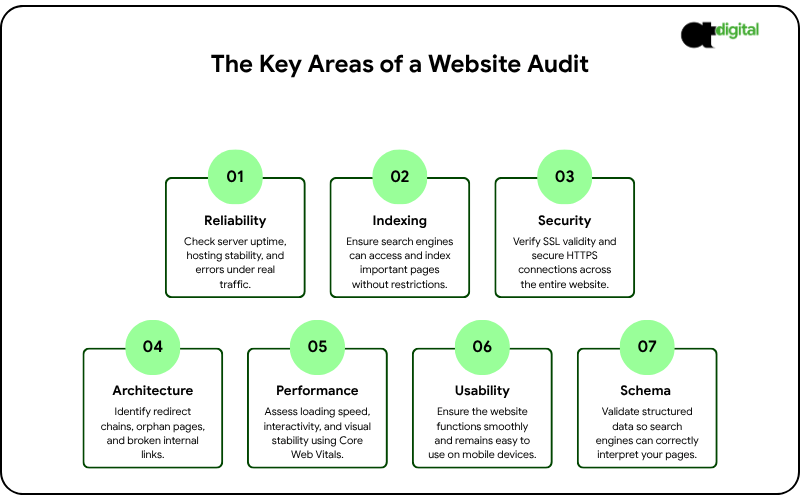
    • Server response and uptime. Is your hosting reliable, and how often do you throw 5xx errors under real traffic?
    • Crawlability and indexability. Can Googlebot actually reach your important pages? Are any accidentally blocked by robots.txt or a stray noindex tag?
    • Security. Is your SSL certificate valid and auto-renewing? Is the whole site served over HTTPS, not just the homepage?
    • Site architecture. Are there redirect chains, orphan pages, or broken internal links creating dead ends?
    • Core Web Vitals and speed. Does your site meet Google’s loading, interactivity and stability thresholds? (We go deep on this in our dedicated guide to page speed and the three-second rule.)
    • Mobile usability. Does the site actually work on a phone, not just resize to fit one?
    • Structured data. Is your schema markup valid, so Google can understand what each page actually is?

    This is the full scope behind a proper seo audit service, and it’s different from the automated “SEO audit report sample” tools generated in sixty seconds. Those tools are useful for a first pass. They don’t diagnose why your 503 errors spike every Tuesday at 2pm, or why your redirect chain is three hops deep.

    A Quick Self-Check: Run This Before You Call Anyone

    You don’t need an agency to catch the obvious problems. Use this as a basic SEO audit template you can run in under an hour:

    • Check Google Search Console’s Coverage and Core Web Vitals reports for a list of crawl errors and page experience issues Google has already flagged.
    • Run your homepage and top three pages through PageSpeed Insights to check your real-world loading speed.
    • Click through your main navigation and top 10 landing pages manually, looking for 404s and broken links.
    • Check your SSL certificate’s expiration date in your browser’s padlock icon, and confirm it’s set to auto-renew.
    • Search Google for site:yourdomain.com and scan the results for anything that looks wrong, duplicated, or outdated.

    If this surfaces more than a handful of issues, or if you don’t have the technical background to interpret what Search Console is telling you, that’s the point where technical SEO audits need someone who can actually fix what they find, not just list it. Our B2B SEO services include full technical audits as standard, and where the fix requires development work rather than configuration, our custom web development services team handles it directly instead of handing you a PDF and a separate invoice.

    Website Maintenance Services: Why a One-Time Fix Doesn’t Last

    Here’s an uncomfortable truth: fixing every error on this list today doesn’t mean you’re fixed in six months. Plugins update, themes conflict, certificates expire, and hosting environments degrade. This is exactly why website maintenance services exist as an ongoing category, not a one-time project.

    A proper website maintenance company should be handling, continuously:

    • Uptime monitoring that alerts someone the moment a 500 or 503 error starts firing, not when a customer complains
    • SSL certificate renewal, tracked and automated, so “your connection is not private” never happens unannounced
    • Plugin, theme and core software updates, applied on a schedule and tested, not left to accumulate until something breaks
    • Regular backups, so a critical error is a five-minute restore instead of a multi-day rebuild
    • Monthly crawl and broken-link checks, catching new 404s before they compound

    If you’re comparing web maintenance services, the question to ask isn’t “what does this cost per month.” It’s “what does one hour of my site being down cost me.” Industry downtime-cost research, including data compiled by business.com from provider benchmarks, puts small business downtime losses somewhere between roughly $127 and $427 per minute once you account for lost sales and the staff time spent diagnosing the problem. A single unmonitored outage can cost more than a year of proper maintenance.

    Tired of Finding Out About Outages From Customers?

    We monitor uptime, SSL and crawl health around the clock, so your team hears about a problem before a customer does, not after.

    See What Maintenance Should Actually Cover →

    The Real Cost: A Worked Example

    Meet Elena. She runs a mid-size B2B SaaS company, and her site pulls in 500 visitors a day from a mix of organic search and paid ads, converting at 2%, or 10 customers a day at an average contract value of $150. That’s $1,500 a day in revenue through that traffic, roughly $45,000 a month, running quietly in the background while her team focuses on product and sales.

    One Tuesday, a routine plugin update conflicts with her hosting environment. For 90 minutes during her peak afternoon traffic window, the site throws intermittent 503 errors, hitting roughly 15% of visitors before anyone notices and restarts the server. That’s about 75 people who hit a wall instead of her pricing page, at her 2% conversion rate, roughly 1.5 lost customers and $225 in revenue, gone in an hour and a half.

    Here’s the part that should really worry Elena: nothing in her dashboard flags this as an incident. No big red crash, no support tickets, nothing. Just a conversion rate that’s a little worse than usual that day, easy to write off as noise. This is illustrative math, not a guarantee, but it shows the mechanism exactly: these errors don’t show up as a dramatic crash in your reporting. They show up as a number that’s just slightly worse than it should be, month after month, which is exactly why most businesses never catch them without a dedicated audit.

    DIY Audit vs. Professional SEO Audit Service: How to Decide

    Your situation Your move
    Small site, no recent errors found in Search Console Run the self-check above quarterly
    Multiple crawl errors, slow pages, or an expired-feeling site Get a full technical SEO audit
    Errors keep recurring after you fix them You need ongoing website maintenance, not another one-time fix
    Running paid ads or heavy organic traffic to a site with known issues Fix this before spending another dollar on acquisition

    Sending paid traffic or ranking content to a technically broken site is the digital equivalent of a brilliant salesperson with a stutter and a bad phone line. The message might be perfect. The customer never hears it.

    The Verdict: Fix the Foundation Before You Build Higher

    Your website isn’t a brochure. It’s a software application made of code, and code breaks. The question was never whether something would eventually fail, a certificate expiring, a plugin conflicting, a server buckling under a traffic spike. The question is whether you catch it before a customer does, or after, from a quietly disappointing month you can’t quite explain.

    If your site is throwing any of the errors in this guide right now, the fix is usually hours, not weeks, and it’s almost always cheaper than the traffic you’re already paying to send there. If it isn’t, and you genuinely don’t know, that uncertainty is itself the answer: a healthy site doesn’t leave you guessing.

    Your content, your ads and your rankings are only as strong as the infrastructure underneath them. Our technical SEO audit checks every layer in this guide against your actual site, right now, and tells you exactly what’s costing you customers and in what order to fix it. Book it before your next ad dollar or content push goes to a page that might not even load.

    Get Your Technical SEO Audit

    Engineering-grade infrastructure analysis. Pure strategy. No sales scripts.
    Evaluate My Digital Equity →

  • Page Speed Optimization: The 3-Second Rule That’s Quietly Costing You Customers

    Page Speed Optimization: The 3-Second Rule That’s Quietly Costing You Customers

    You’ll never see them in your analytics as a lost sale. You’ll just see a slightly lower conversion rate than you expected, month after month, with no obvious cause.

    That’s the 3-second rule at work, and it’s the most expensive invisible problem in small business marketing. This guide explains what the rule actually means, how to measure where you stand, and exactly which fixes to make first. It builds on our pillar guide, The Silent Closer. If you’d rather have this handled for you, see our website design and development services.

    What Is the 3-Second Rule for Website Speed?

    The 3-second rule says most visitors abandon a page that takes longer than 3 seconds to load. Google’s 2016 mobile research found 53% of mobile visits were abandoned past that threshold, and half of users expect a page to load in under 2 seconds.

    The rest of this guide shows you how to test your own pages against that threshold, and exactly what to fix first.

    How Fast Is Your Site Actually Loading?

    We test your key pages on real mobile connections and show you exactly what’s costing you visitors.

    Get My Speed Audit →

    Where the 3-Second Rule Comes From

    The rule traces back to Google’s 2016 study, “The Need for Mobile Speed,” which analyzed more than 10,000 mobile web domains and found that 53% of mobile visits were abandoned when pages took longer than three seconds to load, with the average mobile site at the time taking 19 seconds on 3G connections. That data is now several years old, and connection speeds and expectations have shifted since, but the core principle hasn’t: people don’t wait, and mobile users wait even less than desktop ones.

    Treat three seconds as a warning line, not a magic threshold. A page that loads in 2.9 seconds isn’t safe, and one that loads in 3.1 isn’t doomed. Speed is a gradient, and every improvement helps, with the largest gains showing up on your key conversion pages.

    Google now measures real-world experience through Core Web Vitals. These are the targets to aim for:

    Metric What it measures “Good” target
    Largest Contentful Paint (LCP) How fast the main content appears 2.5 seconds or less
    Interaction to Next Paint (INP) How quickly the page responds to taps and clicks 200 milliseconds or less
    Cumulative Layout Shift (CLS) How much the page jumps around while loading 0.1 or less

    These are assessed on real visitor data, so a fast result on your own office Wi-Fi doesn’t guarantee a pass on a customer’s phone.

    Where the 3-Second Rule Comes From

    Page Speed Optimization

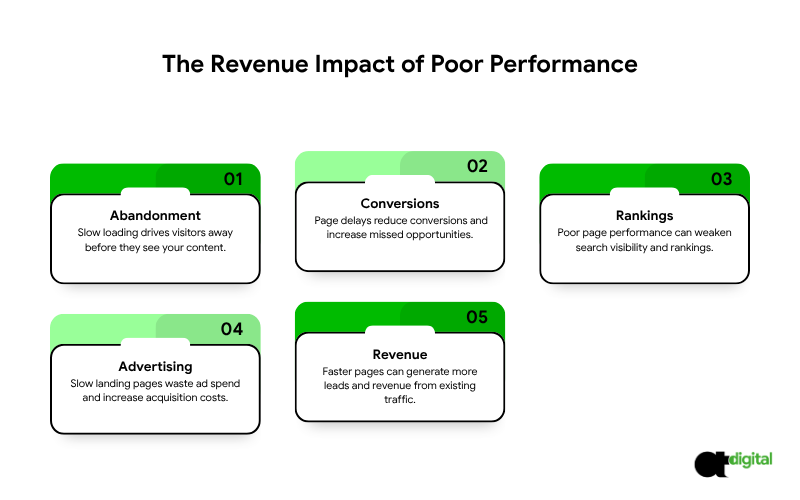
    Lost visitors, before they see anything. The longer a page takes, the more people leave before your content even renders. That’s not a bounce from disinterest; it’s a bounce from impatience, and it’s the most preventable kind you’ll ever face.

    Lost conversions, at a scale that compounds. Akamai’s 2017 analysis of 10 billion retail website visits found that a delay of just 100 milliseconds, one-tenth of a second, was associated with a 7% drop in conversion rate. Read that again: not a 3-second delay. A tenth of a second. If your key pages are running 2 or 3 seconds slower than they should be, the compounding effect on conversions is not small.

    Weaker search visibility. Page experience, including Core Web Vitals, is one of many ranking signals Google uses. Great content and relevance matter more, but between two similarly relevant pages, the faster one has a real edge.

    More expensive ads. If you send paid traffic to slow landing pages, you’re paying for clicks that leave before converting. Landing page experience also feeds into Google Ads Quality Score, which directly affects what you pay per click. If your ad spend and your site speed aren’t working together, see our PPC management services alongside the fixes below.

    A concrete example. Suppose your site gets 10,000 visitors a month and converts 2% into leads, or 200 leads. If speed improvements lift that to 2.4%, a realistic gain from fixing the issues below, that’s 240 leads from the exact same traffic. At a lead value of $100, that’s an extra $4,000 a month, without spending a dollar more on marketing. This is illustrative math, not a guarantee, but it shows the shape of the opportunity: speed fixes are one of the few improvements that pay you back in the traffic you already have.

    How to Measure Your Website Speed

    Don’t guess. Test.

    Use PageSpeed Insights. Enter a URL and choose the mobile tab. It shows two kinds of data: field data from real Chrome users, and lab data from a simulated test. Prioritize the field data when it’s available, since that’s what real visitors actually experience, not a simulation.

    Check Google Search Console. The Core Web Vitals report groups your pages into good, needs improvement and poor, so you can spot patterns across the whole site at once.

    Test more than your homepage. Check your top service pages, landing pages, contact page and checkout. Those are the pages where speed directly converts into revenue.

    Test on mobile and on a slower connection. Most of your visitors aren’t on office fiber. Tools like WebPageTest let you simulate real-world conditions.

    Record your baseline before changing anything, so you can actually prove the improvement afterward.

    What Usually Makes Pages Slow

    If your site has very slow loading web pages, the cause is usually one or more of these:

    • Oversized images uploaded straight from a camera or design tool
    • Too many scripts, especially third-party ones like chat widgets, trackers and social feeds
    • Cheap or overloaded hosting with no caching
    • Heavy themes and page builders that load code the page never actually uses
    • Render-blocking CSS and JavaScript that delays the first paint
    • Unoptimized fonts and too many font families
    • Auto-playing video in the hero section
    • Layout shift from banners, ads and images without set dimensions

    Web Performance Optimization Techniques: The Priority List

    Work in this order. The first items usually deliver the biggest gains for the least effort.

    • Optimize images. Compress them, use modern formats like WebP or AVIF, size them to the space they occupy, and lazy-load images below the fold. Don’t lazy-load the main image at the top of the page, since that delays your LCP score directly.
    • Improve hosting and caching. Use reliable hosting, enable page caching, and add a content delivery network so files load from a server physically near the visitor.
    • Cut and defer scripts. Audit every third-party tag. Remove what you don’t use, and delay what isn’t needed at first load.
    • Streamline CSS and JavaScript. Minify files, remove unused code, and avoid render-blocking resources.
    • Fix fonts. Limit font families and weights, and make text visible while fonts load rather than invisible.
    • Prevent layout shift. Set width and height on images, and reserve space for banners and embeds before they load.
    • Re-measure after each change. Confirm every fix actually helps, and that nothing else breaks in the process.

    Want These Fixes Made Without the DIY Risk?

    We optimize your images, hosting, scripts and code, then re-test until you pass Core Web Vitals, without breaking your forms or tracking.

    Book My Speed Fix Now →

    WordPress: How to Improve Site Speed

    Many small business sites run on WordPress, and it can be fast when configured well. A WordPress improve site speed checklist:

    • Choose quality hosting and keep PHP up to date
    • Install one reputable caching solution, not several that conflict with each other
    • Compress and resize images automatically on upload
    • Delete unused plugins and themes, and replace heavy plugins with lighter alternatives
    • Use a lightweight theme, and avoid loading a page builder’s full library on simple pages
    • Add a CDN
    • Clean the database periodically

    A fair note: custom-coded sites can be leaner, but a well-maintained WordPress site is fast enough for most businesses. Discipline matters more than the platform underneath it.

    Website Speed for Small Business: Start With the Free Wins

    You don’t need a big budget to see meaningful improvement. A sensible order:

    Week 1: Measure your key pages and record the baseline. Week 2: Compress images and enable caching. Week 3: Remove unused plugins and scripts, and fix layout shift. Week 4: Retest, compare, and decide whether the remaining gap justifies professional help.

    Often, the first two weeks deliver the largest visible gains, before you’ve spent a cent on outside help.

    Fast-Loading Website Design Starts With Design, Not Just Code

    Speed isn’t only a developer’s job. Design choices decide how much a page has to load in the first place:

    • Skip autoplay hero videos and heavy sliders unless they genuinely earn their weight
    • Use a small, consistent number of fonts and image sizes
    • Keep the first screen simple and focused on one message
    • Agree a performance budget before design starts, such as a maximum page weight and an LCP target

    A beautiful page that loads in six seconds is not beautiful to the 53% of mobile visitors who already left after three.

    When to Hire Website Speed Optimization Services

    You can handle the basics yourself. Consider professional website speed optimization services if:

    • You’ve done the basics and still fail Core Web Vitals in field data
    • Your site is heavily built with page builders or custom functionality
    • You run an online store, where speed affects revenue directly, not just experience
    • You need fixes made safely without breaking layout, forms or tracking

    A good page speed optimization service should:

    • Measure before and after using real-user field data, not just a lab score
    • Prioritize fixes by expected impact, not by whichever is easiest to bill
    • Explain what was changed and why
    • Protect functionality, including forms, tracking and checkout

    Be cautious of anyone who guarantees a perfect 100 score. A perfect score isn’t the goal. Passing Core Web Vitals and improving real conversions is.

    The Verdict: Fix Your Fastest-Leaking Page First

    Here’s the math that should drive your priorities: a 100-millisecond delay costs roughly 7% in conversions, and 53% of mobile visitors abandon anything past three seconds. If your key landing page is running even two seconds slower than it should, you’re not looking at a minor optimization opportunity. You’re looking at a leak that’s costing you real revenue every single day it goes unfixed.

    You don’t need to fix your entire site at once. You need to fix the one page that costs you the most: your best-converting landing page, your top service page, or your checkout. Measure it today, fix the biggest issue this week, and re-measure. The $4,000-a-month example above isn’t a hypothetical for every business, but it’s the right shape of thinking: speed fixes pay you back in the traffic you’re already paying to attract.

    Every day your site stays slow, you’re paying for clicks and rankings that a faster competitor converts and you don’t. Our speed audit tests your key pages on real mobile connections right now and tells you exactly what to fix first, in the order that gets you the fastest return. Book it today, and stop losing visitors before they even see what you offer.

    Stop Losing Visitors Before They See Your Site

    Engineering-grade friction analysis. Pure mathematics. Zero sales scripts.

    Get My Speed Audit Now →

  • Mobile First Reality: How Google Penalizes Desktop First Architecture

    Mobile First Reality: How Google Penalizes Desktop First Architecture

    THE VISIBILITY AUDIT

    (The Absent Digital Employee)

    As we proved in our overarching macro thesis, Digital Darwinism 2026: The Mathematics of Survival in a Revenue Driven Economy, the modern market executes the inefficient. Let us evaluate your current digital storefront exactly as if it were a highly paid corporate employee.

    Imagine recruiting an elite Senior Sales Director to handle your most lucrative accounts. You authorize a massive executive signing bonus. You grant them absolute, unrestricted access to your entire enterprise pipeline.

    Then, after a thirty day probationary period, you audit their performance and discover a catastrophic operational failure.

    They simply refuse to show up for the sixty percent of your most critical boardroom meetings happening with mobile users. They completely ignore the majority of your incoming inquiries. They walk out of the room right as the prospect is ready to sign the contract.

    You would not put this person on a performance improvement plan. You would not send them to additional corporate training. You would terminate them for gross negligence before the end of the week.

    Whether you lead a global enterprise or require dominant small business website design services, the vast majority of firms tolerate this exact, financially destructive behavior from their website design & development services every single day.

    Look directly at the global market reality. Current data proves that over sixty percent of all internet traffic is entirely mobile traffic. More importantly, seventy percent of elite B2B decision makers actively use their personal smartphones to research high ticket enterprise solutions.

    The real world corporate boardroom has officially moved.

    The modern B2B executive is no longer chained to a massive desktop monitor. They are just as likely to review your million dollar corporate proposal on a six inch pane of glass while sitting in an airport lounge as they are on a laptop in a formal conference room.

    They are making split second financial judgments while holding mobile devices in one hand.

    If your digital architecture hesitates under the pressure of a cellular connection. If it fractures the text and forces the enterprise buyer to pinch and zoom just to read your core value proposition. If the contact button is too small for a human thumb to accurately tap.
    You do not possess a reliable digital employee. Your Silent Closer is actively walking out on the majority of your highest intent buyers.

    THE ALGORITHMIC EXECUTION

    (Funding Your Own Invisibility)

    Let us look past the frustrated human user for a moment. The financial penalty for a broken mobile experience goes much deeper than a single lost sale.

    Google has officially moved to a ruthless, mandatory model dictated by google s mobile first indexing. This means the world’s most powerful search engine algorithm completely ignores your beautiful, complex desktop architecture.

    It does not care how much capital your website design & development services spent on intricate hover animations. It does not care how cinematic your wide background videos look on a corporate projector.

    The algorithm crawls your mobile site first. It judges your load speed down to the millisecond. It measures your core web vitals and strictly scrutinizes your mobile layout for human thumb accessibility.

    The algorithmic reality gets much worse.

    Recent search engine updates prove that Google no longer just lightly penalizes non mobile sites. They execute them.

    If your digital storefront does not load instantly and function perfectly on a standard cellular smartphone connection, Google will literally refuse your domain for indexing and ranking. They will not crawl the desktop version as a backup. They will simply reject your entire corporate presence.

    If your website fractures under the pressure of a mobile screen, you are not just pushed down to the second page of the search results.

    You are completely deleted from the search engine entirely.

    Because you failed to properly integrate SEO and website design, your digital storefront is stripped of all authority. Your marketing budget is rendered useless. You are rendered absolutely invisible to the capital.

    THE CONTENT PARITY TRAP

    (Designing for the Wrong Screen)

    Let us audit exactly why your current digital infrastructure is actively triggering this algorithmic death sentence.

    Most corporate websites are built entirely backward. Standard website design & development services focus entirely on a massive, stunning desktop experience. They build complex pages specifically designed to impress your executive team on a boardroom projector.

    Then, strictly as a rushed afterthought, they simply shrink all those visual elements down to fit onto smaller screens.

    To make that interface fit a small screen and look visually clean, the agency completely ignores the rules of SEO website design and commits a massive error. They hide your heavy, persuasive sales copy inside tight hamburger menus. They bury your core value proposition behind collapsible tabs.

    Amateur agencies call these failed mobile designs responsive design. At AtheosTech Digital, we call it a catastrophic structural failure.

    You must understand the mathematical reality of mobile indexing. Because Google only reads the mobile version of your site, any text you hide on the smartphone screen is officially hidden from the algorithm.

    You might possess a massive, keyword rich desktop site. You might have invested thousands of dollars into elite corporate copywriting. But if that text is suppressed on a mobile device, your SEO value is exactly zero.

    When you simply shrink a desktop site, you destroy the user experience and create massive corporate friction at the exact point of conversion.

    Critical checkout buttons become entirely too small for a human thumb to tap accurately. Complex navigation menus collapse into a completely unnavigable labyrinth. The modern enterprise buyer absolutely does not have the patience to pinch and zoom their way through your shrunken digital brochure.
    They will instantly hit the back button. They will leave your ecosystem entirely. They will hand their enterprise budget directly to your competitor.

    THE OMNIPRESENCE STANDARD

    (Engineering the Extraction Engine)

    To capture the modern B2B enterprise buyer, you must completely abandon the aesthetic delusion. You must view mobile optimization as a strict, non negotiable requirement for professional authority.

    At AtheosTech Digital, our website design & development services absolutely do not design pretty mobile brochures. We do not build digital art projects. We engineer the exact architecture outlined in our foundational master guide, The Silent Closer: Engineering the Digital Infrastructure That Outperforms Your Human Sales Team.

    We build responsive architectures that reflow and adapt to the screen with ruthless mathematical precision.

    Responsive website design services

    Here is the exact architectural blueprint required to dominate the mobile algorithm and force the digital close:

    • Strict Content Parity: We ensure absolute, one to one parity across both desktop and mobile. We absolutely do not hide your core value proposition behind hidden mobile menus. We engineer the layout so your most aggressive sales copy is fully visible immediately to both the human buyer and the search engine algorithm.
    • Frictionless Touch Interaction: We systematically eliminate the standard design mistakes that lead to mobile frustration. We mathematically map the exact physical reach of the human thumb on a modern smartphone screen. We ensure that every button is accessible. Every single lead form is thumb friendly. Every critical call to action is positioned securely within the immediate green reach zone.
    • Algorithmic Dominance: We strip away bloated code. We completely eliminate heavy, fragile plugins. By optimizing for instantaneous mobile speed and frictionless usability, we satisfy the strict, non negotiable requirements of the search engines. We ensure your digital infrastructure remains securely indexed and always ready to intercept high ticket prospects before they ever find your competition.

    THE DESIGN DISTRACTION

    Executives sit in the boardroom and argue over subjective color palettes instead of securing elite responsive website design services. They read amateur blogs on business websites design and debate aesthetics while their digital infrastructure silently bleeds capital. Stop asking artistic questions. You absolutely need a mathematical extraction engine.

    THE BOARDROOM DIRECTIVE

    (The Device Audit)

    Call your Chief Marketing Officer into the boardroom right now.

    Tell them to leave their massive laptop completely closed. Demand that they pull out their personal smartphone. Make them navigate directly to your corporate website using a standard, everyday cellular connection.

    Do not let them connect to the high speed corporate network.

    Tell them to try and submit a high ticket enterprise lead inquiry using only one hand.

    Watch them physically struggle with the interface. If they have to pinch the screen just to read your value proposition. If they accidentally click the wrong button because the touch elements are clustered too tightly together. If the page hesitates for even two seconds while loading the final contact form.
    Your digital storefront is not merely underperforming. It is actively bleeding cleared capital. Your absolute best, highest paid digital employee is currently sleeping on the job.

    When the pipeline collapses, executives panic and search for a generic website design company near me instead of auditing their structural failures. It is time to brutally audit the mobile infrastructure sitting on your domain right now, before Google completely executes your search engine ranking.

    INITIATE YOUR FORENSIC WEBSITE AUDIT

    (An engineering grade analysis of your current mobile UI and UX friction points, backend code bloat, and the exact structural changes required to permanently dominate the Google index.)

  • The 0.78% Trap in SEO Service: The Brutal Mathematics of the Page Two Graveyard

    The 0.78% Trap in SEO Service: The Brutal Mathematics of the Page Two Graveyard

    THE VISIBILITY CRISIS

    [THE TRAFFIC AUDIT]

    Metric
    Mathematical Reality
    Financial Impact
    The Power Law
    The Power Law of organic traffic dictates that Position #1 mathematically captures 31.7% of all user clicks.
    Absolute market dominance and the lowest possible Customer Acquisition Cost.
    The GraveyardExactly 0.78% of users click on a second page result within the organic results pages.Total digital invisibility and a near zero return on your website investment.
    The Wealth TransferHigh intent traffic bypasses unranked domains and landing pages.They steal your pipeline through featured snippets and top page dominance, creating a direct capital injection into your highest ranking competitor’s balance sheet.

    The Legacy Founder Hallucination

    As we established in our overarching thesis, Digital Darwinism 2026: The Mathematics of Survival in a Revenue Driven Economy, the modern market is completely unforgiving. Building a premium website without an organic ranking strategy is the corporate equivalent of constructing a flagship storefront in the middle of a desert and waiting for foot traffic.

    Many legacy founders operate under a dangerous and expensive corporate hallucination. They approve a massive budget for a digital marketing overhaul, launch a beautifully coded platform into the ecosystem, and assume the market will naturally gravitate toward their brand.

    They fundamentally fail to distinguish between two radically different states of business:

    • Being Present: Having a live URL that looks professional.
    • Being Profitable: Dominating the exact algorithmic intersection of consumer intent and capital.

    In the ruthless mathematics of 2026 and AI driven search, simply existing is a rounding error. You must be visible at the exact millisecond a highly qualified prospect decides to spend money. If your digital infrastructure is not mathematically engineered to command the search engines and their algorithms, you are operating in a total vacuum.

    The Equity Metric

    At AtheosTech Digital, our SEO consultant services do not treat organic rankings as a soft marketing metric.

    If you are missing from the first ten results, your website is silently leaking conversions. This briefing outlines the catastrophic financial consequences of the Page Two Graveyard and the architectural shifts required to stop the bleeding.

    THE PAGE TWO GRAVEYARD

    (The Illusion of Digital Presence)

    Your beautiful website is entirely worthless if it sits in a measurement void. You can invest massive amounts of capital into high end design and flawless copywriting, but without visibility, that corporate investment produces a zero percent return.

    Most executives judge the success of their business solely by the contracts they close, remaining completely blind to the capital they silently leak. It is the corporate equivalent of judging a leaky bucket only by the water it still holds.

    The Algorithm of Intent

    When a highly qualified buyer searches for your exact service, they are not casually browsing. For thousands of high intent google searches happening today, your brand does not exist. They are deploying immediate financial intent. Search is no longer just ten blue links. You must dominate the entire digital screen. They have a specific problem, an approved budget, and a mandate to execute a transaction today. Because the modern consumer is highly conditioned by digital convenience, they implicitly trust the algorithm. This is exactly why securing elite SEO consultant services is required to intercept the transaction.

    As established by the Power Law of search traffic, if your digital infrastructure is buried on the second page, you do not actually participate in the modern economy.Capturing only 0.78% of the market means you are a digital ghost. You are operating an invisible storefront on a dead end street while your competitors process the transactions on the main avenue.

    The Silent Hemorrhage

    The most dangerous aspect of this invisibility is the absolute silence. The true cost is realized when users find your competitor first. The prospects who fail to find you will never complain to your sales team. They will not fill out a contact form to tell you your website is unranked. They simply disappear into the pipeline of a competitor.

    The psychological fallout of missing the top ten results is absolute:

    • The Irrelevance Tax: If you are not in that elite group on Page 1, the consumer automatically assumes your business is an irrelevant player in the industry.
    • The Inferiority Bias: They perceive your brand and your services as fundamentally inferior to the companies that rank above you.
    • The Preemptive Loss: You lose the lucrative contract before your sales team ever gets the chance to make a pitch.

    THE BOARDROOM INTERROGATION

    Most executives fail to understand the true architecture of digital capital. They sit in the boardroom and ask, “what is search engine result page dominance actually worth in raw dollars?” They look at failing metrics and ask, “what are SEO consulting services going to do that our web developer cannot?”

    These are the wrong questions. The only question your leadership team must ask today is how to improve search engine results page rankings before the fiscal quarter ends and your competitors entirely absorb your market share.

    THE ZERO SUM REALITY

    (Funding Your Own Demise)

    Invisibility is never a neutral state of operations. It is an active and continuous financial hemorrhage. From local market capture to dominating international SEO services, search traffic operates in a strict zero sum reality. If your website fails to win the click, that transaction does not simply vanish; it guarantees your enemy will acquire the capital.

    When a highly qualified prospect searches for the exact solution you provide and fails to see your brand, their budget remains entirely intact. It is immediately and silently transferred to the competitor who engineered their way to the top of Page 1.

    The Overhead Imbalance

    Whether you require global enterprise architecture or precise small business SEO services, you are essentially absorbing the physical overhead, payroll, and daily operational friction to maintain a business while your digitally optimized rivals effortlessly harvest all the ready buyers from the ecosystem. They are operating with the lowest possible acquisition costs while your firm struggles with continuous margin compression.

    The Death Spiral Mechanism

    This is the exact “Death Spiral” mechanism we outlined in our foundational master guide, Paid Ads Buy Speed, SEO Buys Wealth: How to Build a Customer Acquisition System That Lowers Your CAC Every Year.

    The competitors who own the organic search results are not just getting leads. They are building permanent corporate wealth because they intercept your potential clients for absolutely free. Every click they secure is a lucrative contract you lost, creating a compounding deficit for your business:

    • The Cash Flow Injection: Your competitors receive the immediate revenue your brand was mathematically entitled to capture.
    • The Reinvestment Advantage: They actively use your lost capital to fund further digital dominance, dominate the knowledge graph, and secure absolute authority.
    • The Final Burial: They systematically widen the competitive gap until they possess the sheer financial leverage to eventually bury your market share entirely.

    THE ACQUISITION TRAP

    (The Tax on Invisibility)

    Without structural SEO consultant services in place, your executive team is forced into a desperate operational corner. To generate any predictable revenue, you must artificially buy your way to the top of the search results using paid ads or rely heavily on the unpredictable algorithms of social media platforms.

    Missing Page 1 forces your company to pay a permanent, compounding “Invisible Tax” on every single customer you acquire. You are permanently renting your market share from digital landlords instead of owning your own digital real estate.

    The Rental Economy

    While traditional organic visibility takes time, relying exclusively on paid ads and social channels for immediate velocity is a catastrophic financial model. Social platforms and ad networks are strictly rented spaces where algorithms fluctuate violently and organic reach is continually restricted by the host.


    Every time you turn off the ad spend or a platform radically updates its underlying code, your sales pipeline violently collapses. You have no structural foundation to fall back on. When revenue drops, executives panic and search for a generic SEO service near me instead of partnering with a structural engineering firm.

    The Structural Weakness

    By failing to engineer your organic infrastructure, or falling for the trap of cheap, affordable SEO services, this dependency triggers a severe and permanent weakness in your balance sheet:

    • The Margin Squeeze: Buying every single lead drastically inflates your overall Customer Acquisition Cost and systematically destroys your long term profit margins.
    • The Inflation Trap: You are constantly subjected to the annual inflation of auction density where your cost to acquire a client rises year over year regardless of your internal efficiency.
    • The Zero Equity Reality: You may spend millions to generate short term cash flow, but you build absolutely zero corporate equity in the digital ecosystem.

    CONCLUSION: THE VISIBILITY MANDATE

    (The Strategic Shift to Ownership)

    At AtheosTech Digital, we fundamentally reject the idea that a professional SEO Service is a soft marketing tactic. We engineer it as a strict, revenue-generating corporate asset. Your organic ranking is not a vanity metric; it is the ultimate, undeniable measure of your digital authority in the marketplace.

    It is time to stop hiding your premium infrastructure and stop asking what SEO consulting services are going to cost, and start asking what your invisibility is currently costing you. You must deploy aggressive organic SEO services to eliminate the invisible tax of paid acquisition and start aggressively extracting the capital that mathematically belongs to your business

    [INTERNAL DIAGNOSTIC: THE PAGE 1 TEST]

    Before your leadership team signs off on another quarterly marketing budget, your executives must sit down and answer these clinical diagnostic questions with absolute transparency. Evasion is not an option.

    • The Position Audit: When a high-intent buyer searches for your most profitable service today, does your company appear in the top three organic results, or are you completely invisible?
    • The Capital Leak: Exactly how much capital are you actively hemorrhaging to your competitors this quarter simply because their digital footprint outranks yours?
    • The Rent Penalty: Are you forced to pay continuous “rent” to ad platforms for every single lead because your website completely fails to generate organic, zero cost equity?

    If your leadership team cannot confidently claim Page 1 dominance, your digital presence is a liability. You are funding the enemy. Let us look at the mathematics of absolute visibility and reclaim your market share.

    REQUEST YOUR VISIBILITY AUDIT

    (Deploy our forensic SEO audit services for a technical review of your current search positioning and the precise engineering sequence required to claim Page 1)