Enterprise buyers seeking enterprise digital marketing services do not trust marketing copy. They trust the documented financial outcomes you have delivered to other executives. This blueprint outlines how to transform passive customer feedback into a highly weaponized digital asset, ensuring your reputation capital automatically converts high-intent traffic into predictable boardroom revenue..
A friend swears by Google Ads. A podcast says SEO is “the only marketing that compounds.” Both are right, for different businesses, and following advice written for somebody else is how first budgets get wasted.
This guide is for owners and founders of B2B, service and local businesses. You’ll get real 2026 numbers, three worked examples and a 60-second test that tells you which lane you’re in. For the bigger capital-allocation argument, read our pillar guide, Paid Ads Buy Speed, SEO Buys Wealth.
How Should You Split $5,000 Between SEO and Paid Search?
Split your first $5,000 by how fast you need leads. Need customers within 60 days: put about 70% into paid search and 30% into SEO foundations. Have 9+ months of runway: reverse it, 30% paid and 70% SEO. Either way, fix tracking and your landing page first.
Not sure which side you’re on? Keep reading. One 2026 statistic also changes how you should spend the SEO half.
Not Sure Which Side You’re On?
We review your keywords, competitors and margins, then tell you exactly how to split your budget.
SEO vs Paid Search: What Each Channel Actually Buys
Paid search is renting a storefront on the busiest street in town: customers arrive the day you sign the lease, and the lights go off the day you stop paying. SEO is buying the building: slower, more work up front, and yours.
Search engine optimization (SEO) earns unpaid organic traffic by making your pages the best answer to a search. Paid search, or PPC (pay-per-click), buys ad placements above and around those results. It is the most measurable form of internet advertising, while SEO is the slowest to start and the cheapest to keep.
| Paid search (PPC) | SEO | |
|---|---|---|
| Time to first lead | Days | Early indicators in months 3-4 |
| Cost behavior | Linear: stop paying, traffic stops | Front-loaded: cost per lead falls over time |
| Control | High: budget, targeting, message | Lower: depends on the algorithm |
| What you keep | Data and learnings | Rankings, content and authority |
| Best for | Fast pipeline, testing offers | Durable, lower-cost acquisition |
SEO vs Paid Search: What Each Channel Actually Buys
Search engine marketing (SEM) is the umbrella for everything you do to win search visibility. People who search “search engine marketing vs SEO” usually mean paid vs organic. The tradeoff is the same: speed against compounding.
Does Google Ads Help SEO?
Not directly. Google states that advertising with Google has no effect on your presence in organic search results. The benefit of running both is indirect: ads cover a different part of the page and give you keyword and conversion data that sharpen your organic targets.
The Zero-Click Twist: Why 2026 Changes the SEO Math
Here is the statistic most “SEO vs PPC” articles skip. According to SparkToro’s 2026 study using Similarweb data, 68.01% of US Google searches from January to April 2026 ended without a click, up from 60.45% in 2024. Two out of three searches never send anyone to a website, and AI Overviews (now on 20%+ of searches, per SparkToro) are a big reason.
For your $5,000, that means broad “what is” blog posts are the most exposed. But SparkToro says SEO still earns its keep for three kinds of searches: branded, local, and high-intent transactional queries. That is where buyers search, and where your SEO dollars should go.
Paid costs are moving the other way. WordStream’s 2026 benchmarks put the average Google Ads cost per click at $5.42, more than double the $2.32 it measured in 2016. Neither channel is a bargain anymore, and both reward businesses that aim at buyers instead of traffic.
The Three Variables That Decide PPC vs SEO
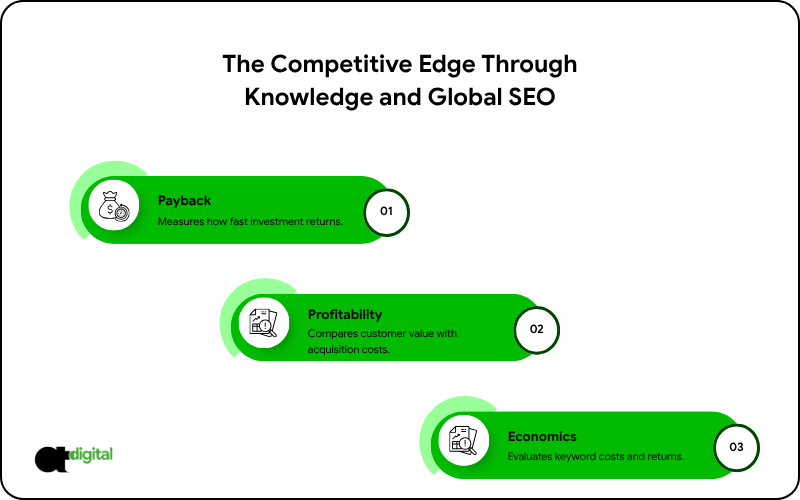
1. Time to Cash
How long can you operate before this channel must pay back? Under 90 days favors ads. Nine to twelve months of runway makes SEO viable.
2. Margin and Customer Lifetime Value
Ads work when a customer’s profit can pay for the click. If a customer is worth $300 and your customer acquisition cost (CAC) through ads is $250, you’re on a treadmill. High-margin businesses can absorb paid acquisition. Thin-margin ones usually cannot.
3. Keyword Economics
Check the cost per click (CPC) for your five most valuable keywords. WordStream’s data shows $9.87 per click for legal services, $8.33 for home services and $4.35 for auto repair. Same channel, wildly different math.
The Zero-Click Twist: Why 2026 Changes the SEO Math
Here is what $5,000 buys at WordStream’s 2026 median cost per lead in each category. A “lead” is a tracked call or form fill, and the math assumes every dollar goes to ad spend.
| Business type | Cost per lead | Leads from $5,000 | Customers at a 20% close rate* |
|---|---|---|---|
| Auto repair | $29.96 | about 167 | about 33 |
| All industries (median) | $66.69 | about 75 | about 15 |
| Home services | $90.92 | about 55 | about 11 |
| Business services | $93.69 | about 53 | about 11 |
| Legal services | $131.63 | about 38 | about 8 |
*The 20% close rate is illustrative. Use your own. Cost per lead figures are from WordStream’s 2026 Google Ads benchmarks, median across 13,474 US search campaigns.
The same $5,000 buys four times as many leads for an auto repair shop as for a law firm. That is why “just run ads” is not a strategy. Now the caveats:
- The first weeks are tuition. Traffic can start within days, but optimizing for profit typically takes four to six weeks of data.
- Your landing page is the multiplier. Google groups landing page experience with expected click-through rate and ad relevance as the three components of Quality Score. If your page is slow or vague, fix it first with our website design and development services.
- Waste is the silent budget killer. Broad matching sends you irrelevant searches. Our Ad Waste Audit guide explains how to stop it.
- Fees and shutoffs. Agency fees mean less than $5,000 reaches Google, and when the budget stops, the traffic stops.
Want specialists to run it? See our PPC management services.
What $5,000 Buys in SEO
$5,000 does not buy rankings. It buys foundation, and foundation keeps paying after the invoice is settled.
The Three Types of SEO Your Budget Covers
- Technical SEO ($1,000-$1,500): crawlability, page speed, indexation and structured data.
- On-page SEO ($500-$800 for research plus $2,000-$2,500 for content): a keyword and intent map, then four to six commercial-intent pages.
- Off-page and local SEO (the remainder): Google Business Profile, citations and early authority signals.
These are illustrative allocations, not quotes. (Paying for SEO, sometimes searched as “paid SEO”, is different from paying for ads: you’re funding assets, not clicks.)
Build Your SEO Content Strategy From the Bottom of the Funnel
Given the zero-click numbers, an effective SEO content strategy starts with pages for buyers ready to compare and purchase: pricing pages, “[competitor] alternatives”, service-plus-city pages. For SEO content creation, one page that answers a buying question better than anyone else beats ten thin posts.
Set SEO Goals You Can Hit in 90 Days
Revenue is too early. Track leading indicators: pages indexed, impressions in Search Console, rankings for your target terms, and your first organic conversions.
Build Your SEO Content Strategy From the Bottom of the Funnel
The formula is simple: SEO ROI = (organic revenue – SEO cost) / SEO cost. The catch is timing. Google notes it can take typically four months to a year to see the benefits of SEO changes, so SEO ROI starts negative.
An illustrative example: you spend $5,000 on foundation and five buyer-intent pages. Nothing happens for four months. From month five through twelve, the pages bring in just 4 leads a month, or 32 leads. At a 20% close rate that is about 6 customers, and at $1,500 per first order, about $9,600. SEO ROI: (9,600 – 5,000) / 5,000, or roughly 92% in year one, with the pages still working in year two at no extra cost.
See What SEO Could Earn in Your Market
We size the opportunity from your keywords, competitors and conversion data before you spend a dollar.
The Decision Framework: Three Businesses, Three Different Answers
Theory is cheap. Here is how the same $5,000 splits for three hypothetical businesses.
Dana, Emergency Plumber: Paid First
Dana runs a two-truck plumbing company, and her phone needs to ring this month. Home services cost about $90.92 per lead, so $5,000 in ads could produce roughly 55 calls and forms, or around 11 jobs at a 20% close rate. Someone searching “burst pipe near me” is ready to buy today, and ads reach them today.
Her split: $3,500 on search ads with a tight negative keyword list, $1,500 on SEO foundations: her Google Business Profile, a review habit and one service-area page. Local is one of the places SEO still pays, but it isn’t her lead engine yet.
Marcus, B2B Software Startup: SEO First
Marcus has 12 months of runway and a long sales cycle. Business services run about $93.69 per lead, and a lead is not a demo. He can’t afford to burn his budget in six weeks.
His split: $1,500 on ads for five bottom-funnel terms like “[competitor] alternative” and “[category] pricing”, run for four to six weeks to learn which ones convert. $3,500 on SEO: technical fixes, a keyword map and four or five comparison and pricing pages. That is SEO for startups done right: go narrow, pick a small set of buyer-intent keywords you can win, and go deep.
Priya, Two-Office Law Firm: Local SEO First
Priya’s clicks cost $9.87 on average and her leads cost $131.63, the highest in WordStream’s data. Her $5,000 buys about 38 leads, and ads alone would eat the budget fast.
Her split: $1,500 on ads for her most profitable practice area in the busier city, $3,500 on local SEO: a Google Business Profile per office, a review engine and a dedicated page per location. That is SEO for multiple locations in one line: every office needs its own page and profile with genuinely local content, and $5,000 stretches thin across ten, so start with your top one to three. Our guide to local search dominance shows how to expand.
The payoff can be large: one AtheosTech local client grew inbound phone leads 180% with no increase in ad spend after we fixed their local signals and built a review engine.
Use Paid Data to Choose Your SEO Targets
The smartest thing a small budget can do is use ads as research. Every paid keyword produces real conversion data, while keyword tools only estimate. Run a focused campaign for a few weeks, find the terms that produce leads, and build organic pages around those exact terms. That is the real role of PPC in SEO strategy: ads validate, SEO compounds, and you stop guessing which keywords deserve a permanent page.
Four Mistakes That Burn a $5,000 Budget
- Sending ad traffic to a slow or unconvincing page. You pay to lose visitors.
- Expecting SEO to pay back in 30 days. Anyone promising page one in a month is targeting terms nobody searches or risking penalties.
- Spreading the budget too thin. Five channels at $1,000 each give none of them enough data or momentum.
- Spending before tracking is set up. If you can’t connect a lead to its source, you can’t calculate ROI on either channel.
How to Choose an SEO and PPC Agency
If you hire an SEO and PPC agency, or a dedicated paid search agency, ask before you sign:
- Who owns the ad account and the data? It should be you.
- What exactly is delivered for $5,000, and what is explicitly not?
- How is success reported? Leads and revenue, not just traffic.
- Does one team run SEO and PPC management from shared keyword data, or are they separate silos?
Google itself advises walking away from anyone who guarantees a first-place ranking. To plan both channels as one system, see our SEO services and PPC management services.
The Verdict: Pick Your Lane in 60 Seconds
Answer three questions honestly.
- Do you need paying customers within 60 days?
- Can a customer’s profit cover your cost per customer? Divide your category’s cost per lead by your close rate. At the all-industry median, $66.69 / 0.20 is about $333 per customer. For legal, $131.63 / 0.20 is about $658.
- Can you wait 4 to 12 months for payback?
Now read your result:
- Yes to 1 and 2: go paid-first. Put about 70% ($3,500) into search ads on your best buyer keywords and 30% ($1,500) into SEO foundations. Fix tracking and your landing page before the first click.
- Yes to 1, no to 2: do not start with ads. They will lose money at your margins. Put your budget into your offer, your landing page and local or buyer-intent SEO, and test ads only after your page converts.
- No to 1, yes to 3: go SEO-first. Put about 70% ($3,500) into technical fixes and buyer-intent pages, and 30% ($1,500) into a paid test that shows you which keywords convert.
- Still torn? Test, then commit. Spend $1,500 on ads for four to six weeks on your five best buyer keywords. Let real conversion data decide where the other $3,500 goes.
One rule covers everything above: buy speed with ads only when a customer’s profit can pay for the click, and buy assets with SEO when you can afford to wait for them. And never split the budget evenly just because you can’t decide. That is the one option guaranteed to under-fund both.
Your $5,000 will be spent either way. The only choice is whether it goes to a plan built from your numbers or to a guess dressed up as strategy. Every week you spend guessing is a week a competitor is collecting the leads you’re paying to find. Our budget split audit takes your keywords, competitors and margins, and tells you where the first dollar should go. Book it before you spend another cent on either channel.
Where Should Your First $5,000 Go?
Engineering-grade analysis of your site, keyword economics and competitors. Pure strategy. No sales scripts.