
Run the numbers on a typical first order and you’ll find something uncomfortable: you probably didn’t make money on it.
Spend $50 in ads to land a customer who buys a $60 product once, and at a 50% margin, you’ve earned $30 against a $50 cost. You lost $20 the moment they checked out.
Now that same customer comes back twice more. Suddenly the $50 was one of the best investments you made all year. Nothing about your ad account changed. What changed is what happened after checkout, and that’s the entire game behind customer lifetime value.
This is the practical follow-up to our pillar guide, The Growth Engine. If you want help building this into your store, see our eCommerce marketing services.
How Do You Improve Customer Lifetime Value?
Improve customer lifetime value (LTV) by getting more customers to a second purchase, since that’s where compounding starts. Calculate LTV as average order value × orders per year × gross margin × expected years as a customer. Then fix your post-purchase experience, build lifecycle email flows, and reward top spenders.
The rest of this guide shows you exactly how, with the formula, the flows and the numbers that make the case.
What’s Your Store’s Real LTV?
We calculate your actual customer lifetime value from your order data and show you where the leaks are.
The Second Purchase Is the Whole Game
Here’s a pattern from Shopify store data that changes how you should think about retention: once a customer makes a second purchase, the odds of a third jump sharply, and each purchase after that increases loyalty further. The hardest transition in your entire funnel isn’t the first sale. It’s getting a first-time buyer to come back once. After that, momentum builds on its own.
That’s backed up by the baseline numbers. The average ecommerce repeat purchase rate sits at roughly 28%, according to Shopify-based benchmark research, meaning most stores lose nearly three out of every four customers after one order. If your store is anywhere near that average, the single highest-leverage fix you can make isn’t a better ad. It’s a better reason to come back.
How to Calculate LTV
A simple formula for a store:
LTV = average order value × orders per year × gross margin % × expected customer lifespan (in years)
An illustrative example, so replace it with your own numbers:
- Average order value: $60
- Orders per customer per year: 2.5
- Gross margin: 50%
- Expected lifespan: 3 years
$60 × 2.5 × 0.50 × 3 = $225 lifetime gross profit per customer
If it costs $50 to acquire that customer, your LTV to CAC ratio is 4.5 to 1, comfortably above the commonly cited 3-to-1 benchmark for a healthy business.
A more reliable method uses cohorts. Take everyone who bought for the first time in a given month, add up the gross profit they generated over the following 6 or 12 months, and divide by the number of customers. This uses real behavior instead of a guessed lifespan, and it’s the best starting model for a small store: a spreadsheet handles it, and it reveals your actual repeat-purchase pattern instead of an assumed one.
Why Retention Usually Beats Acquisition on Cost
This is one of the most repeated claims in ecommerce, and for once, the underlying research holds up. Frederick Reichheld’s foundational study for Bain & Company, published in Harvard Business Review, found that a 5% increase in customer retention can increase profits by 25% to 95%, depending on the industry. It’s a wide range because the original research pooled results across different sectors, from banking to insurance to auto services, so treat it as a directional signal, not a guarantee for your specific store.
Why does retention usually cost less to generate?
- You already paid for the introduction. The customer knows you and has already trusted you once.
- Email and SMS cost little to send compared with paid advertising, and you own the list.
- Repeat buyers tend to convert at higher rates than first-time visitors, since they’ve already resolved their doubts about you.
- Advertising costs move with the auction, while your own channels stay comparatively stable.
LTV to CAC: The Ratio That Guides Your Ad Budget
Once you know LTV, compare it to customer acquisition cost (CAC).
A common rule of thumb is a healthy LTV to CAC ratio of about 3 to 1 or higher. Treat it as a guide, not a law; margins, cash flow and growth goals all shift what’s right for you.
Two related checks matter just as much:
- Payback period: how long it takes to earn back your CAC in gross profit. A store with limited cash can’t wait 12 months for payback, even if the long-term ratio looks great.
- First-order margin: if the first purchase doesn’t cover CAC, you’re relying on repeat orders to make the math work. That’s fine, but only if repeat orders actually happen, which is why the section above matters so much.
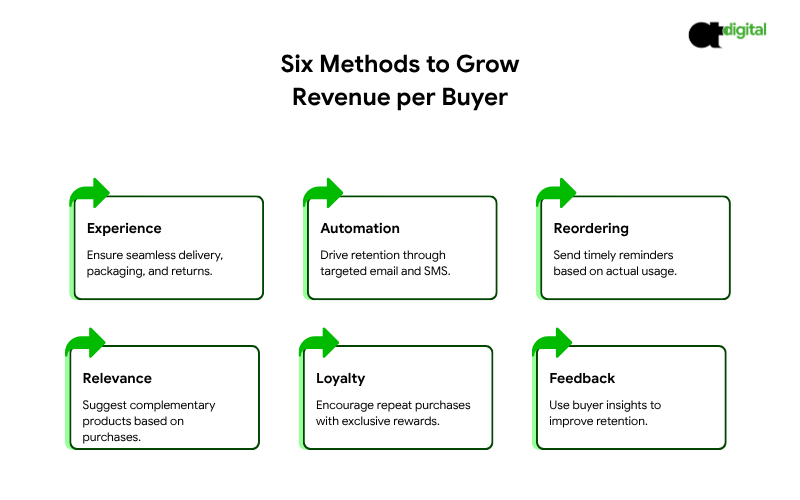
How to Improve Customer Lifetime Value: Six Levers
1. Deliver a Great Post-Purchase Experience
Fast shipping, accurate tracking, good packaging and easy returns all influence whether someone buys again. A poor experience undoes the best marketing you’ve ever run.
2. Build Lifecycle Email and SMS Flows
Automated messages tied to customer behavior are the workhorse of retention.
| Flow | Trigger | Goal |
|---|---|---|
| Welcome series | New subscriber | Introduce the brand, drive the first order |
| Post-purchase | After an order | Confirm, educate, request a review |
| Replenishment | Before the product runs out | Prompt the reorder |
| Cross-sell | After a specific purchase | Suggest a complementary product |
| Win-back | Inactive for a set period | Re-engage lapsed customers |
| Abandoned cart | Cart left unpaid | Recover interrupted sales |
3. Time Replenishment to Real Usage
If a product typically lasts 30 days, reminders sent around days 25 to 27 catch customers before they run out. Use your own repurchase data to set the timing rather than guessing.
4. Cross-Sell With Logic
Recommend what naturally goes with the last purchase, not a random discount. A relevant accessory outperforms a generic coupon almost every time.
5. Reward Your Best Customers
Look at the top slice of your customers by spend. Give them early access, small perks or a real loyalty program. Loyalty program members are typically far more likely to make repeat purchases than non-members, which makes this one of the more measurable levers on this list. Subscriptions work especially well for consumables.
6. Listen to Customers
Post-purchase surveys, reviews and support tickets show why people leave or stay. This is your voice of the customer data, and it often reveals fixes that no ad test would surface. As you grow, an analytics platform that combines these signals can help, but a spreadsheet and a short survey are a good start.
Which Lever Would Move Your LTV Most?
We build the flows, time the reminders and set up the loyalty tier that fits your category, not a generic template.
Customer Lifetime Value in Retail: Know Your Category
Not every product gets reordered. Skincare, coffee, supplements and pet food have natural repurchase cycles. Furniture and mattresses don’t, and repeat purchase rates vary enormously by category as a result: research shows they can range from under 10% in luxury goods to well over 60% in categories like grocery.
If your category has low repeat potential, focus your LTV effort on other levers: higher average order value through bundles and add-ons, complementary categories, referrals, reviews and extended warranties. Be honest about what your category allows rather than forcing a replenishment strategy onto a product nobody reorders.
Metrics to Track
- Repeat purchase rate: the share of customers who buy more than once
- Time between orders: helps set flow timing
- Cohort retention: how many customers from each month are still buying
- Revenue from returning customers as a share of total
- LTV to CAC ratio and payback period
- Average order value
Review these monthly. If repeat purchase rate is flat while ad spend rises, you’re buying growth instead of building it, and that pattern rarely ends well.
Consent and Privacy: Do This Properly
Retention marketing depends on customer data, so follow the rules.
- Email: include clear unsubscribe options and honor them quickly.
- SMS: in the US, marketing texts generally require clear prior consent. Get it at signup or checkout, and record it.
- Tracking: if you serve customers in regions with strong privacy laws, such as the EU, UK or California, make sure cookie consent and data policies are in place.
Relevant, well-timed messages also convert better than aggressive ones. Trust is part of retention, not separate from it.
A 30-Day Retention Plan
Week 1: Calculate your current LTV, CAC, payback period and repeat purchase rate. Find your average time between orders.
Week 2: Set up or audit the core flows: welcome, post-purchase and replenishment or cross-sell.
Week 3: Add a short post-purchase survey and review request. Segment your top customers.
Week 4: Launch a win-back flow for lapsed buyers. Compare the repeat rate to your baseline and set targets for the next quarter.
The Verdict: Fix the Second Purchase First
If your store sits anywhere near the 28% industry-average repeat purchase rate, you already know where the leak is: roughly three out of four customers who could come back, don’t. That single number should reorder your priorities more than any ad platform decision you’re weighing right now.
Here’s the honest math. Winning a new customer might cost you $50 and lose money on the first order. Winning that same customer back for a second purchase costs a fraction of that, usually just the price of a well-timed email, and it’s the purchase that makes the whole relationship profitable. You don’t need a bigger ad budget to fix this. You need a system that gets more first-time buyers to come back once.
Paid acquisition gets people through the door. Retention decides whether that spend was an investment or an expense, and for most stores, the gap between those two outcomes is sitting unaddressed in an empty post-purchase flow right now. Our LTV audit calculates your real numbers from your own order data and shows exactly which lever to pull first. Book it now, and stop paying to win the same customers you already have.
Find Your Store’s Leak
Engineering-grade analysis. Pure mathematics. Absolute market capture.