
A shopper adds your product to their cart, then pauses.
They scroll back up to the description, looking for one more detail, the material, the dimension, the one thing that tells them this won’t be a mistake. If it’s not there, they don’t ask. They don’t chat with support. They just leave, quietly, and you never know why that cart went cold.
This isn’t a hypothetical. It’s a documented pattern from one of the largest bodies of ecommerce usability research available, and it points to a specific, fixable problem sitting on most product pages right now. This guide shows you what that research actually found, and gives you a repeatable way to write descriptions that sell instead of just existing. It’s the practical companion to our pillar guide, The Growth Engine, which covers the full conversion system around your product pages.
What Makes a Product Description Actually Sell, Not Just Describe?
A product description sells when it answers the specific questions a buyer has before they’ll commit to purchase, not when it lists specifications. The research backs this up directly: the Baymard Institute’s usability testing found that when product descriptions leave key questions unanswered, shoppers don’t ask for help. They simply abandon the product, and sometimes the entire site.
The rest of this guide breaks down exactly what those questions are, and how to answer them in copy that converts.
Is Your Product Copy Costing You Sales?
We audit your product pages against real usability research and show you exactly what’s missing.
The Real Research Behind “Good” Product Descriptions
Here’s a number worth sitting with: Baymard’s large-scale ecommerce usability research found that 10% of the largest ecommerce sites fail to maintain consistently detailed product descriptions, while 90% of leading sites have already made thorough descriptions the industry standard. That means falling into that bottom 10% isn’t a minor gap. It’s an immediately noticeable failure against what shoppers now expect as baseline.
What happens when a description falls short isn’t subtle. In Baymard’s testing, one shopper comparing two office chairs discarded the one with a thin description the moment she saw a more detailed one beside it: “There’s a lot of information here, on the chair… I’m starting to discount [the other chair], because there’s very little information.” She didn’t contact support. She didn’t ask a question. She just moved on, and the thinner listing lost the sale without ever knowing why.
This matters more than most merchants assume, because online shoppers don’t have the option a physical store offers. There’s no employee to ask. The description is often the only source of information standing between a browser and a buyer, which means every gap in it is a door the customer can quietly walk out of.
What Is Copywriting in Marketing, and How Is It Different From Describing?
What is copywriting in marketing, exactly? It’s writing with a specific job: moving a reader toward a decision, not just informing them. A specification sheet describes. Copywriting persuades, using the exact language and priorities of the person reading it.
The difference in practice:
| Describing | Copywriting |
|---|---|
| “100% cotton, machine washable” | “Soft enough for everyday wear, tough enough to survive the dryer” |
| “15.6-inch display, 512GB SSD” | “A screen big enough to actually see your work, storage that won’t fill up by March” |
| “Stainless steel construction” | “Built to outlast the trend it started” |
Copywriting examples like these aren’t about being clever. They’re about translating a fact into what that fact means for the person reading it. Examples of good copywriting share one trait: every line answers an unasked question the reader actually has, rather than reciting what the manufacturer put on the box.
Features vs. Benefits: Say What It Does for Them
This is the single highest-leverage shift in product copy: nobody buys a spec. They buy what the spec lets them do.
A simple exercise for every bullet point on your page: write the feature, then ask “so what?” until you reach something the buyer actually cares about.
- Feature: “2.4GHz processor” → So what? → “Opens faster than you can finish your coffee”
- Feature: “Water-resistant to 50 meters” → So what? → “Survives the pool, the rain, the accidental drop in the sink”
- Feature: “Adjustable 5-point harness” → So what? → “Grows with your kid instead of needing replacing every season”
This is the core discipline behind copywriting for products: every technical fact earns its place on the page only once it’s been translated into a reason to buy. This is exactly where Harlow & Finch, a boutique home goods store, was stuck before rewriting anything: their catalog read like a warehouse inventory sheet, accurate, complete, and completely uninterested in persuading anyone.
What Should a Product Description Include?
Based on the same Baymard research, three categories of information come up again and again as the specific things shoppers look for and abandon products over when missing:
1. Materials and ingredients. In Baymard’s testing, 50% of beauty shoppers needed ingredient information before deciding, and would dismiss a product outright if it wasn’t available. The same pattern holds for apparel materials and any product where composition affects how it performs or feels.
2. Dimensions, clearly labeled. Unlabeled measurements actively hurt you: one tester couldn’t tell if “50 inches” referred to a chair’s height or its back, and had to guess. Detailed, clearly labeled dimensions (and both metric and imperial units where relevant) remove that friction entirely.
3. Compatibility information. For any product that needs to work with something else, a case, a part, a cable, shoppers who can’t confirm compatibility simply won’t risk the purchase. Partial information (a model series but not the exact model number) is treated the same as no information at all.
A practical product description template built from this research:
- Opening line: the core benefit, in plain language, not a spec.
- 2-3 sentences: the problem it solves or the experience it creates.
- Bulleted specifics: materials, dimensions, compatibility, whatever applies to your product type, clearly labeled.
- One trust element: a guarantee, a return policy note, or a detail that removes risk.
How to Write Product Descriptions That Sell: A Repeatable Framework
How to write product descriptions that actually convert comes down to structure, repeated consistently across your catalog.
The Pain-First Opening
Open with the problem your buyer already has, not a feature. “Tired of charging your earbuds every single night?” does more work than “30-hour battery life” ever will, because it meets the reader where their head already is.
Specific, Sensory Language Beats Generic Adjectives
“High-quality” and “premium” are now background noise; shoppers skim past them because every competitor uses the same words. Specifically, sensory language does the opposite: “the kind of soft that makes you want to wear it twice in one day” paints a picture generic adjectives can’t.
One Clear Next Step
Every strong description closes the gap between reading and buying. That might be addressing the one objection you know is coming (“Yes, it fits in a standard cup holder”) or simply reinforcing the single strongest reason to act now.
A quick checklist for product descriptions that convert: does it open with a problem, not a feature; does it include the specific details your product category needs (per the research above); is the language specific rather than generic; and does it close the gap between interest and action.
Here’s an illustration of what applying this framework can look like. Say Harlow & Finch rewrites their 20 highest-traffic product pages using exactly this structure: pain-first opening, materials and dimensions clearly labeled, one trust element at the close. If their product page conversion moves from 1.9% to 3.2%, that’s not a redesign, a new platform, or more traffic. It’s the same visitors, answering the same questions those visitors already had.
Want Your Product Pages Rewritten Properly?
We rebuild your descriptions around what shoppers actually need to see before they buy, backed by real usability research, not guesswork.
Product Page SEO: Writing Descriptions That Also Rank
A description that sells but never gets found is only doing half its job. Product page SEO and product description SEO work alongside persuasive copy, not against it, and the fundamentals follow the same principles covered in Google’s SEO Starter Guide: original, substantial, people-first content wins over thin or duplicated text.
SEO product descriptions and seo for product descriptions start with one non-negotiable rule: never paste the manufacturer’s default copy. Identical text across hundreds of retailers selling the same product is effectively duplicate content. Google’s own guidance on duplicate content confirms its systems pick one version to show in results and consolidate ranking signals onto it, which means a copied manufacturer description gives your specific page nothing unique to rank for. Writing original copy solves the sales problem and the SEO problem at the same time, which is exactly why Harlow & Finch’s rewrite paid off twice: once in conversion rate, and again a few months later when their product pages started ranking for searches their manufacturer-copy competitors couldn’t touch.
Practical product seo and seo e-commerce basics for every listing:
- Work your primary keyword naturally into the title and opening sentence, not stuffed repeatedly
- Use descriptive, keyword-aware alt text for product images
- Answer the specific questions covered above (materials, dimensions, compatibility) in actual text, not just a spec table images can’t read
- Keep the product detail page URL clean and readable
Product page design matters here too: a well-structured page with scannable headings and bullet points (not one dense paragraph) helps both shoppers skimming for the one detail they need and search engines parsing the page’s structure.
Where This Fits Your Bigger eCommerce Marketing Strategy
Product descriptions aren’t an isolated task. They sit inside a broader ecommerce marketing strategy, and it’s worth being clear about where this piece fits, since better copy alone won’t fix every leak in your funnel.
Strong product copy directly supports:
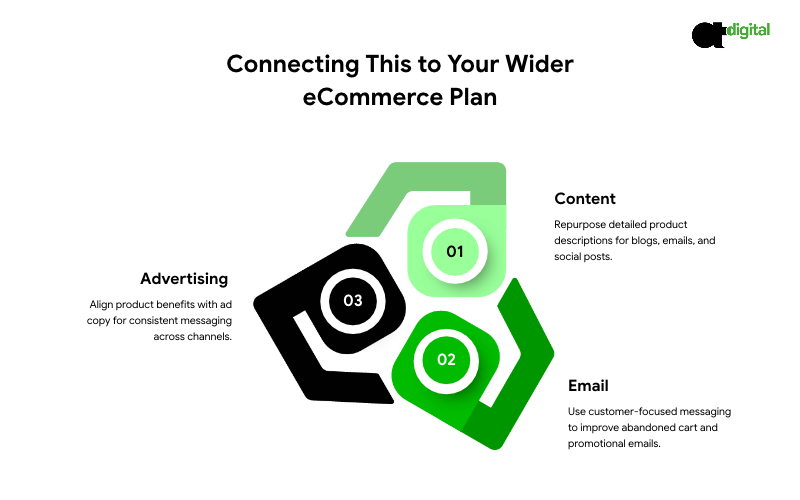
- Ecommerce content marketing, since unique, detailed descriptions are reusable raw material for blog content, email campaigns and social posts
- Email marketing for ecommerce, where the same pain-first language that converts on the page also strengthens abandoned cart and promotional emails
- Ecommerce advertising, since the same specific, benefit-driven language performing on your product page should also be driving your ad copy, rather than running two disconnected voices
If you’re building out a broader ecommerce marketing plan or researching digital marketing for ecommerce more generally, treat product description quality as a foundational layer, not an afterthought: it’s the page every other channel (search, ads, email, social) ultimately sends traffic to, so no amount of spend elsewhere compensates for a weak page at the end of the click.
Where Else Is This Leaking Revenue?
We check whether your product copy, ads and emails are all telling the same story, or working against each other.
Measuring the Impact
Track these to know whether your rewritten copy is actually working, not just reading better:
- Product page conversion rate, specifically, not just site-wide averages
- Add-to-cart rate versus completed purchases, which isolates whether the description itself (not checkout friction) is the issue
- Bounce rate on product pages, where a drop after a rewrite is a strong signal
- Return rate, since accurate, detailed descriptions reduce returns caused by mismatched expectations
A basic ecommerce analytics setup (your platform’s native reporting or Google Analytics) can surface all of this without specialized tools. For a broader view, a monthly ecommerce marketing report that tracks these alongside your other ecommerce metrics keeps copy performance visible instead of buried under traffic and revenue totals.
DIY vs. Hiring Help
Rewriting a handful of hero products yourself using the framework above is entirely doable. Consider bringing in dedicated support when:
- You have a catalog too large to rewrite manually in a reasonable timeframe
- You need descriptions that work across both conversion and SEO simultaneously
- Your current copy is largely manufacturer-supplied and needs wholesale replacement
For a team that handles product copy as part of a connected content and SEO system, see our eCommerce marketing services.
The Verdict: The Fix Is Smaller Than the Problem Feels
Here’s what makes this genuinely encouraging: fixing a product description is one of the cheapest, fastest changes you can make to a store, and the research shows the gap between an adequate page and a losing one is often just a few missing sentences, not a redesign.
Harlow & Finch didn’t rebuild their store, change platforms, or spend a dollar more on traffic. They rewrote 20 pages. That’s the entire lesson of this guide: the fix is almost always smaller and cheaper than the problem feels.
You don’t need to rewrite your entire catalog this week. Start with your highest-traffic products, the ones already earning the clicks, and make sure they answer the specific questions your buyers are actually asking before they abandon them. That’s a smaller job than it sounds, and it’s one of the few fixes that pays back almost immediately, since it costs nothing extra in traffic to capture a sale that was already one click away.
Somewhere in your catalog right now, a product is losing sales to a thin description, not a bad product. Our product page audit checks your top listings against the specific information categories shoppers actually abandon over, and shows you exactly what to fix first. Book it before your next round of ad spend sends more traffic to a page that isn’t ready to close.
Find Out What Your Product Pages Are Missing
Engineering-grade analysis. Pure mathematics. Absolute market capture.