Build Your Growth Stack

Confirm or adjust your services and enter your details.

Please select at least one service.
First name is required.
Last name is required.
Please enter a valid email address.

Tag: PPC strategy

  • Google vs Meta Ads: Pick the Wrong Advertising Platform and Your Budget Pays the Price

    Google vs Meta Ads: Pick the Wrong Advertising Platform and Your Budget Pays the Price

    Swap their platforms and both lose money, and neither will understand why. The plumber’s customer was searching. The candle buyer was scrolling. Google and Meta are built for two completely different moments, and most wasted ad spend starts with treating them as interchangeable.

    This guide is for owners and marketing leads deciding where their first (or next) ad dollars should go. You’ll get 2026 benchmark data from both platforms, a cost-per-customer test that changes the answer for some industries, and a 60-second decision at the end. For the deeper strategy behind wasted spend, read our pillar guide, The Ad Waste Audit.

    Google Ads or Meta Ads: Which Advertising Platform Fits Your Business?

    Choose Google Ads when people already search for what you sell, like emergency repairs, legal help or B2B software. Choose Meta Ads when your product is visual, impulse-friendly or new, so nobody is searching yet. Most businesses start with one of these advertising platforms, then add the other for retargeting.

    Not sure which camp you’re in? The next few sections show you how to tell, using real numbers.

    Not Sure Which Platform Deserves Your Budget?

    We review your market, competitors and margins, then tell you which platform to fund first and what to expect.

    Get My Ad Platform Audit →

    Intent vs Interruption: The Core Difference Between These Advertising Platforms

    Google Ads meets people who are already searching. Someone types “emergency HVAC repair near me” or “project management software for agencies” and you pay to appear at that moment. Meta Ads (Facebook and Instagram) meet people who are scrolling. Nobody opens Instagram planning to hire an accountant. You interrupt the feed with something interesting enough to earn attention.

    Here is how the two compare in 2026, using median figures from WordStream’s benchmark reports:

    Google Ads (Search) Meta Ads (leads campaigns)
    Buyer mindset Actively looking Passively browsing
    You target Keywords and search intent Audiences and creative
    Average cost per click $5.42 $1.80 (traffic campaigns: $0.60)
    Average conversion rate 8.18% 8.54%
    Average cost per lead $66.69 $27.39
    What makes it work Keywords, ad relevance, landing page Creative, offer, audience testing
    Main risk Paying for irrelevant searches Creative fatigue and low-intent leads

    Source: WordStream’s 2026 Google Ads benchmarks (13,474 US search campaigns) and 2026 Facebook Ads benchmarks (452 leads campaigns, so treat Meta figures as directional).

    On paper, Meta wins on cost: less than half the price per lead. So why doesn’t everyone just use Meta?

    Why a Cheaper Lead Isn’t Always a Cheaper Customer

    Because a lead from a search and a lead from a feed are not the same lead. Someone who searched “dentist near me” has a problem today. Someone who tapped a lead form while scrolling might be curious. That difference shows up in your close rate.

    Here is an illustration. Suppose Google leads close at 20% and Meta leads at 10%. The close rates are my assumptions, so replace them with yours. Using WordStream’s 2026 cost per lead by category:

    Category Google cost per lead Meta cost per lead Cost per customer: Google (20% close) Cost per customer: Meta (10% close) Winner
    Dentists $72.97 $61.56 about $365 about $616 Google
    Home services $90.92 $42.95 about $455 about $430 Toss-up
    Real estate $102.51 $13.74 about $513 about $137 Meta

    Same two platforms, three different answers. That is the point: compare cost per customer, not cost per click or cost per lead. Run this math with your own close rates before you spend a dollar
    Match the Advertising Platform to Your Business Model

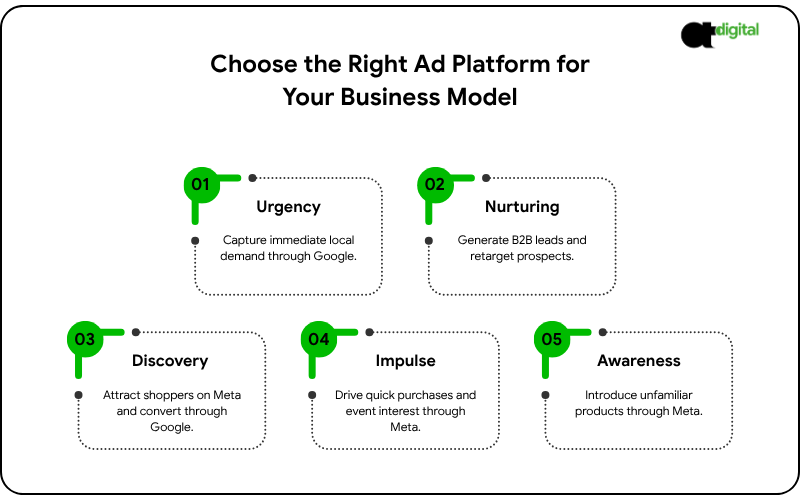
    Local and Emergency Services: Start With Google

    Sam runs an emergency HVAC company, and his customers search from a cold house. Home services cost about $90.92 per lead on Google, so $3,000 buys roughly 33 calls and form fills. Meta can support him later with reviews and reminders, but the first dollar belongs where the urgency is. Strong local visibility helps too: see our guide to local search dominance.

    B2B and High-Ticket Services: Google to Capture, Meta to Nurture

    Omar sells B2B software with a 60-day sales cycle. Buyers search for solutions on Google, so that’s where he captures demand. But most visitors won’t convert on the first visit, and that’s where Meta (or LinkedIn) earns its place: retargeting people who’ve already seen his site with a case study or an audit offer.

    Ecommerce and Visual Products: Meta to Discover, Google to Close

    Lena sells handmade candles. Nobody searches for “candle that smells like a rainy forest” until they’ve seen one. Meta puts the product in front of people who didn’t know they wanted it, and Google Shopping plus branded search then capture those who go looking afterward. If you also sell through large retail sites, marketplace advertising is a separate channel with its own economics. See our eCommerce marketing services for how to connect them.

    Low-Consideration Purchases and Events: Meta

    For restaurants, events and impulse buys, attention is cheap and decisions are quick. WordStream’s data shows restaurants pay $2.05 per click on Google but $0.45 on Meta traffic campaigns. When the customer doesn’t need to think long, paying four times as much for a search click rarely makes sense.

    New Categories Nobody Searches For: Meta

    If people don’t yet search for what you sell, Google has no demand to capture, no matter how much you spend. That is a Meta problem, and it often needs a strong offer to work.

    Three Tests Before You Spend a Dollar

    1. The demand test. Search your main service terms in Google’s Keyword Planner. Steady monthly searches mean Google can scale you. Almost none means Google can’t create demand. Then look at your competitors: the Meta Ad Library and Google’s Ads Transparency Center show which ads they’re running and for how long. An ad that has run for months is a decent (not perfect) signal that it pays for itself. Neither tool shows their spend or results.

    2. The economics test. Work backward from what a customer is worth. Illustration: you can spend $400 to win a customer and you close 20% of leads, so you can afford $80 per lead. At Google’s 8.18% average conversion rate, your maximum affordable click is about $6.54. The average $5.42 works. Legal advertisers paying $9.87 per click would lose money at those numbers.

    3. The capacity test. Google rewards keyword discipline and a strong landing page. Meta rewards a steady supply of fresh creative and enough volume: Meta’s own guidance points to roughly 50 optimization events in a 7-day window for an ad set to leave its learning phase. At $27.39 per lead, that is about $1,370 a week per ad set. On a small budget, that means one focused ad set, not five.

    What Good Ads Look Like on Each Platform

    A few Google Ads examples and Meta contrasts make the difference concrete.

    Google search ad: matches the query directly.

    Emergency HVAC Repair in [City] | 24/7 Same-Day Service | Licensed and Insured | Call Now for a Free Quote

    The searcher wants a fast solution, so the ad answers immediately.

    Meta ad: earns attention first, then makes an offer.

    A 20-second video: “3 signs your furnace will fail this winter.” Below it: “Book a free pre-season inspection.”

    The viewer wasn’t looking for an HVAC company. The ad gives them a reason to care.

    Running Ads Without Wasting the Budget: How to Sequence Your Spend

    The most common budget mistake is spreading a small budget across every platform. Try this:

    • Start with one platform that matches your business model.
    • Get to steady conversions before adding anything.
    • Add the second platform in a supporting role, usually retargeting people who visited from the first.
    • Judge both by cost per customer, and connect ads and sales data so you know which platform actually closes deals. Conversion tracking (including Meta’s Conversions API and server-side tracking) is covered in our pillar guide.

    Then plug the leaks:

    • On Google, the leak is irrelevant searches. Build a negative keyword list on day one and review your search terms weekly.
    • On Meta, the leaks are creative fatigue and constant edits that keep restarting the learning phase. Refresh creative on a schedule, and test one change at a time.
    • On both, the leak is a landing page that doesn’t match the ad. A great advertisement of your business sent to a generic homepage wastes the click. If yours is slow or vague, our website design and development services can fix it.

    Want Specialists to Run This for You?

    We choose the platform, build the campaigns, track cost per customer and cut the waste, so your budget goes where buyers are.

    Book My Ad Strategy Call →

    How to Choose Google PPC Management and Ad Management Services

    If you hire help, whether Google PPC management or a firm offering professional search engine marketing services, ask before you sign:

    • Do they build a strategy per platform, or copy one approach across all of them? Copy-paste strategy is a red flag.
    • Who owns the ad accounts and data? It should be you.
    • How do they report? Look for leads, customers and cost per customer, not just clicks and impressions.
    • What do Google ad management services fees cover, and does ad spend come out of the same budget?

    Be cautious of anyone who guarantees a specific return before looking at your economics. To handle Google and Meta as one system, see our PPC management services and social media marketing services.

    The Verdict: Pick Your Platform in 60 Seconds

    Answer three questions honestly:

    • Do people already search for what you sell? (Try it. Check the Keyword Planner.)
    • Is your product visual, impulse-friendly or new to the market?
    • Does your economics work? Divide your category’s cost per lead by your close rate. That is your cost per customer. Can a customer’s profit cover it?

    Now read your result:

    • Yes to 1: start with Google. Put most of your budget into search ads on your best buyer keywords. Add Meta retargeting once you have steady site traffic.
    • No to 1, yes to 2: start with Meta. Lead with a strong offer and fresh creative on one focused ad set. Add Google for branded and shopping searches once demand appears.
    • Yes to both (typical for ecommerce): Meta to discover, Google to close. Start with Meta for reach, then capture the people who search for you afterward.
    • Long sales cycle (typical for B2B): Google to capture, Meta or LinkedIn to nurture. Retarget site visitors with proof, not the same ad.
    • No to 3: don’t start with ads yet. Fix your offer, margins or landing page first. Ads make a broken funnel expensive faster.

    One line covers all of it: Google harvests demand that already exists. Meta creates demand that doesn’t yet. Pick the one that matches how your customers buy, and judge it on cost per customer, not cost per click.

    Every week you run the wrong platform, you are paying to reach the right people in the wrong mindset. Our ad platform audit compares your market, competitors and margins, and shows exactly which platform to fund first and what a customer should cost you. Book it before you spend the next dollar, and put your budget where buyers actually are.

    Which Platform Should Get Your Next Dollar?

    Engineering-grade account analysis. Pure mathematics. Zero sales scripts.
    Get My Ad Platform Audit Now →

  • SEO vs Paid Search: Where Your First $5,000 Works Hardest

    SEO vs Paid Search: Where Your First $5,000 Works Hardest

    A friend swears by Google Ads. A podcast says SEO is “the only marketing that compounds.” Both are right, for different businesses, and following advice written for somebody else is how first budgets get wasted.

    This guide is for owners and founders of B2B, service and local businesses. You’ll get real 2026 numbers, three worked examples and a 60-second test that tells you which lane you’re in. For the bigger capital-allocation argument, read our pillar guide, Paid Ads Buy Speed, SEO Buys Wealth.

    How Should You Split $5,000 Between SEO and Paid Search?

    Split your first $5,000 by how fast you need leads. Need customers within 60 days: put about 70% into paid search and 30% into SEO foundations. Have 9+ months of runway: reverse it, 30% paid and 70% SEO. Either way, fix tracking and your landing page first.

    Not sure which side you’re on? Keep reading. One 2026 statistic also changes how you should spend the SEO half.

    Not Sure Which Side You’re On?

    We review your keywords, competitors and margins, then tell you exactly how to split your budget.

    Get My Budget Split Audit →

    SEO vs Paid Search: What Each Channel Actually Buys

    Paid search is renting a storefront on the busiest street in town: customers arrive the day you sign the lease, and the lights go off the day you stop paying. SEO is buying the building: slower, more work up front, and yours.

    Search engine optimization (SEO) earns unpaid organic traffic by making your pages the best answer to a search. Paid search, or PPC (pay-per-click), buys ad placements above and around those results. It is the most measurable form of internet advertising, while SEO is the slowest to start and the cheapest to keep.

    Paid search (PPC) SEO
    Time to first lead Days Early indicators in months 3-4
    Cost behavior Linear: stop paying, traffic stops Front-loaded: cost per lead falls over time
    Control High: budget, targeting, message Lower: depends on the algorithm
    What you keep Data and learnings Rankings, content and authority
    Best for Fast pipeline, testing offers Durable, lower-cost acquisition

    SEO vs Paid Search: What Each Channel Actually Buys

    Search engine marketing (SEM) is the umbrella for everything you do to win search visibility. People who search “search engine marketing vs SEO” usually mean paid vs organic. The tradeoff is the same: speed against compounding.

    Does Google Ads Help SEO?

    Not directly. Google states that advertising with Google has no effect on your presence in organic search results. The benefit of running both is indirect: ads cover a different part of the page and give you keyword and conversion data that sharpen your organic targets.

    The Zero-Click Twist: Why 2026 Changes the SEO Math

    Here is the statistic most “SEO vs PPC” articles skip. According to SparkToro’s 2026 study using Similarweb data, 68.01% of US Google searches from January to April 2026 ended without a click, up from 60.45% in 2024. Two out of three searches never send anyone to a website, and AI Overviews (now on 20%+ of searches, per SparkToro) are a big reason.

    For your $5,000, that means broad “what is” blog posts are the most exposed. But SparkToro says SEO still earns its keep for three kinds of searches: branded, local, and high-intent transactional queries. That is where buyers search, and where your SEO dollars should go.

    Paid costs are moving the other way. WordStream’s 2026 benchmarks put the average Google Ads cost per click at $5.42, more than double the $2.32 it measured in 2016. Neither channel is a bargain anymore, and both reward businesses that aim at buyers instead of traffic.

    The Three Variables That Decide PPC vs SEO

    1. Time to Cash

    How long can you operate before this channel must pay back? Under 90 days favors ads. Nine to twelve months of runway makes SEO viable.

    2. Margin and Customer Lifetime Value

    Ads work when a customer’s profit can pay for the click. If a customer is worth $300 and your customer acquisition cost (CAC) through ads is $250, you’re on a treadmill. High-margin businesses can absorb paid acquisition. Thin-margin ones usually cannot.

    3. Keyword Economics

    Check the cost per click (CPC) for your five most valuable keywords. WordStream’s data shows $9.87 per click for legal services, $8.33 for home services and $4.35 for auto repair. Same channel, wildly different math.

    The Zero-Click Twist: Why 2026 Changes the SEO Math

    Here is what $5,000 buys at WordStream’s 2026 median cost per lead in each category. A “lead” is a tracked call or form fill, and the math assumes every dollar goes to ad spend.

    Business type Cost per lead Leads from $5,000 Customers at a 20% close rate*
    Auto repair $29.96 about 167 about 33
    All industries (median) $66.69 about 75 about 15
    Home services $90.92 about 55 about 11
    Business services $93.69 about 53 about 11
    Legal services $131.63 about 38 about 8

    *The 20% close rate is illustrative. Use your own. Cost per lead figures are from WordStream’s 2026 Google Ads benchmarks, median across 13,474 US search campaigns.

    The same $5,000 buys four times as many leads for an auto repair shop as for a law firm. That is why “just run ads” is not a strategy. Now the caveats:

    • The first weeks are tuition. Traffic can start within days, but optimizing for profit typically takes four to six weeks of data.
    • Your landing page is the multiplier. Google groups landing page experience with expected click-through rate and ad relevance as the three components of Quality Score. If your page is slow or vague, fix it first with our website design and development services.
    • Waste is the silent budget killer. Broad matching sends you irrelevant searches. Our Ad Waste Audit guide explains how to stop it.
    • Fees and shutoffs. Agency fees mean less than $5,000 reaches Google, and when the budget stops, the traffic stops.

    Want specialists to run it? See our PPC management services.

    What $5,000 Buys in SEO

    $5,000 does not buy rankings. It buys foundation, and foundation keeps paying after the invoice is settled.

    The Three Types of SEO Your Budget Covers

    • Technical SEO ($1,000-$1,500): crawlability, page speed, indexation and structured data.
    • On-page SEO ($500-$800 for research plus $2,000-$2,500 for content): a keyword and intent map, then four to six commercial-intent pages.
    • Off-page and local SEO (the remainder): Google Business Profile, citations and early authority signals.

    These are illustrative allocations, not quotes. (Paying for SEO, sometimes searched as “paid SEO”, is different from paying for ads: you’re funding assets, not clicks.)

    Build Your SEO Content Strategy From the Bottom of the Funnel

    Given the zero-click numbers, an effective SEO content strategy starts with pages for buyers ready to compare and purchase: pricing pages, “[competitor] alternatives”, service-plus-city pages. For SEO content creation, one page that answers a buying question better than anyone else beats ten thin posts.

    Set SEO Goals You Can Hit in 90 Days

    Revenue is too early. Track leading indicators: pages indexed, impressions in Search Console, rankings for your target terms, and your first organic conversions.

    Build Your SEO Content Strategy From the Bottom of the Funnel

    The formula is simple: SEO ROI = (organic revenue – SEO cost) / SEO cost. The catch is timing. Google notes it can take typically four months to a year to see the benefits of SEO changes, so SEO ROI starts negative.

    An illustrative example: you spend $5,000 on foundation and five buyer-intent pages. Nothing happens for four months. From month five through twelve, the pages bring in just 4 leads a month, or 32 leads. At a 20% close rate that is about 6 customers, and at $1,500 per first order, about $9,600. SEO ROI: (9,600 – 5,000) / 5,000, or roughly 92% in year one, with the pages still working in year two at no extra cost.

    See What SEO Could Earn in Your Market

    We size the opportunity from your keywords, competitors and conversion data before you spend a dollar.

    Size My SEO Opportunity →

    The Decision Framework: Three Businesses, Three Different Answers

    Theory is cheap. Here is how the same $5,000 splits for three hypothetical businesses.

    Dana, Emergency Plumber: Paid First

    Dana runs a two-truck plumbing company, and her phone needs to ring this month. Home services cost about $90.92 per lead, so $5,000 in ads could produce roughly 55 calls and forms, or around 11 jobs at a 20% close rate. Someone searching “burst pipe near me” is ready to buy today, and ads reach them today.

    Her split: $3,500 on search ads with a tight negative keyword list, $1,500 on SEO foundations: her Google Business Profile, a review habit and one service-area page. Local is one of the places SEO still pays, but it isn’t her lead engine yet.

    Marcus, B2B Software Startup: SEO First

    Marcus has 12 months of runway and a long sales cycle. Business services run about $93.69 per lead, and a lead is not a demo. He can’t afford to burn his budget in six weeks.

    His split: $1,500 on ads for five bottom-funnel terms like “[competitor] alternative” and “[category] pricing”, run for four to six weeks to learn which ones convert. $3,500 on SEO: technical fixes, a keyword map and four or five comparison and pricing pages. That is SEO for startups done right: go narrow, pick a small set of buyer-intent keywords you can win, and go deep.

    Priya, Two-Office Law Firm: Local SEO First

    Priya’s clicks cost $9.87 on average and her leads cost $131.63, the highest in WordStream’s data. Her $5,000 buys about 38 leads, and ads alone would eat the budget fast.

    Her split: $1,500 on ads for her most profitable practice area in the busier city, $3,500 on local SEO: a Google Business Profile per office, a review engine and a dedicated page per location. That is SEO for multiple locations in one line: every office needs its own page and profile with genuinely local content, and $5,000 stretches thin across ten, so start with your top one to three. Our guide to local search dominance shows how to expand.

    The payoff can be large: one AtheosTech local client grew inbound phone leads 180% with no increase in ad spend after we fixed their local signals and built a review engine.

    Use Paid Data to Choose Your SEO Targets

    The smartest thing a small budget can do is use ads as research. Every paid keyword produces real conversion data, while keyword tools only estimate. Run a focused campaign for a few weeks, find the terms that produce leads, and build organic pages around those exact terms. That is the real role of PPC in SEO strategy: ads validate, SEO compounds, and you stop guessing which keywords deserve a permanent page.

    Four Mistakes That Burn a $5,000 Budget

    1. Sending ad traffic to a slow or unconvincing page. You pay to lose visitors.
    2. Expecting SEO to pay back in 30 days. Anyone promising page one in a month is targeting terms nobody searches or risking penalties.
    3. Spreading the budget too thin. Five channels at $1,000 each give none of them enough data or momentum.
    4. Spending before tracking is set up. If you can’t connect a lead to its source, you can’t calculate ROI on either channel.

    How to Choose an SEO and PPC Agency

    If you hire an SEO and PPC agency, or a dedicated paid search agency, ask before you sign:

    • Who owns the ad account and the data? It should be you.
    • What exactly is delivered for $5,000, and what is explicitly not?
    • How is success reported? Leads and revenue, not just traffic.
    • Does one team run SEO and PPC management from shared keyword data, or are they separate silos?

    Google itself advises walking away from anyone who guarantees a first-place ranking. To plan both channels as one system, see our SEO services and PPC management services.

    The Verdict: Pick Your Lane in 60 Seconds

    Answer three questions honestly.

    1. Do you need paying customers within 60 days?
    2. Can a customer’s profit cover your cost per customer? Divide your category’s cost per lead by your close rate. At the all-industry median, $66.69 / 0.20 is about $333 per customer. For legal, $131.63 / 0.20 is about $658.
    3. Can you wait 4 to 12 months for payback?

    Now read your result:

    • Yes to 1 and 2: go paid-first. Put about 70% ($3,500) into search ads on your best buyer keywords and 30% ($1,500) into SEO foundations. Fix tracking and your landing page before the first click.
    • Yes to 1, no to 2: do not start with ads. They will lose money at your margins. Put your budget into your offer, your landing page and local or buyer-intent SEO, and test ads only after your page converts.
    • No to 1, yes to 3: go SEO-first. Put about 70% ($3,500) into technical fixes and buyer-intent pages, and 30% ($1,500) into a paid test that shows you which keywords convert.
    • Still torn? Test, then commit. Spend $1,500 on ads for four to six weeks on your five best buyer keywords. Let real conversion data decide where the other $3,500 goes.

    One rule covers everything above: buy speed with ads only when a customer’s profit can pay for the click, and buy assets with SEO when you can afford to wait for them. And never split the budget evenly just because you can’t decide. That is the one option guaranteed to under-fund both.

    Your $5,000 will be spent either way. The only choice is whether it goes to a plan built from your numbers or to a guess dressed up as strategy. Every week you spend guessing is a week a competitor is collecting the leads you’re paying to find. Our budget split audit takes your keywords, competitors and margins, and tells you where the first dollar should go. Book it before you spend another cent on either channel.

    Where Should Your First $5,000 Go?

    Engineering-grade analysis of your site, keyword economics and competitors. Pure strategy. No sales scripts.

    Get My Budget Split Audit Now →

  • The Ad Waste Audit: How to Stop Buying Clicks and Start Buying Market Share

    The Ad Waste Audit: How to Stop Buying Clicks and Start Buying Market Share

    The Casino vs. The Calculator: Anatomy of a Financial Hemorrhage

    Open the ledger on your current marketing department. Look past the colorful monthly reports. Look directly at the bottom line.

    Right now, most corporate executives and political directors are unknowingly operating a high-stakes casino directly from their boardrooms.

    The standard industry procedure looks exactly like this:

    • Load tens of thousands of corporate dollars into Google Ads, LinkedIn, or Meta.
    • Pull the algorithmic lever.
    • Sit back and pray for a return on investment.

    When the executive board demands measurable financial results, the traditional marketing agency deploys a smokescreen. They slide a polished PDF across the table. They celebrate vanity metrics like “impressions”, “brand awareness”, and a lower “cost per click”.

    Let us establish a brutal financial reality.

    • An impression does not make payroll.
    • A click-through rate does not win a contested congressional seat.
    • “Brand awareness” does not satisfy shareholders.

    If your Chief Financial Officer cannot mathematically prove that a $10,000 ad injection resulted in a $40,000 closed contract, your digital infrastructure is fundamentally broken.

    You are not executing a marketing strategy. You are executing corporate gambling. You are simply subsidizing Google and Meta’s quarterly earnings while your own market share stagnates.

    The AtheosTech Digital Mandate:

    We do not tolerate financial ambiguity. We approach paid media strictly as a mathematical arbitrage. Advertising is an engineering problem.

    You input capital into a precisely calibrated, closed-loop machine, and you extract a predictable, trackable profit. We do not guess. We do not hope. We engineer.

    This briefing dismantles the traditional, broken advertising agency model. We are going to expose the invisible financial leaks draining your budget right now. We will explore the exact structural engineering required to stop the bleed, kill the vanity metrics, and transform your ad spend into a deterministic corporate asset.

    PLATFORM ALLOCATION

    (The Psychology of Intent vs. Interruption)

    The very first point of catastrophic financial failure in any ad account is platform misalignment.

    Most agencies treat all ad networks as equal entities. They copy and paste the exact same strategy across every channel. This is a fundamental misunderstanding of human behavior. Platforms are not interchangeable. They serve completely different psychological functions.

    “Google vs. Meta: Which Platform Fits Your Business Model?”

    The Architecture of Search Intent (Google)

    Consider the exact mindset of the user. When a regional logistics director types “enterprise fleet tracking software” into a search bar, they are not casually browsing. They are actively executing a corporate procurement mission.

    • The Strategy: Google Ads allows you to intercept absolute, bottom-of-the-funnel intent.
    • The Mathematics: You will pay a premium cost per click on this platform. However, you are not buying a casual click. You are buying a prospect who already has their wallet open and their budget approved. You are paying for immediate market capture.

    The Architecture of Discovery (Meta & LinkedIn)

    Conversely, examine the psychology of a social feed. Nobody opens Facebook, Instagram, or LinkedIn with the explicit intention of hiring a political crisis management firm or a corporate tax auditor. They are there to consume content, read the news, and network.

    • The Strategy: Advertising on these platforms requires the precise engineering of interruption.
    • The Execution: You cannot rely on them searching for you. You must manufacture demand. You must deploy an irresistible, high-value proposition – like a proprietary industry report or a risk-assessment audit – to disrupt their scrolling and force a paradigm shift in a highly targeted executive demographic.

    The Absolute Rule of Capital Allocation:

    The most common way to incinerate corporate capital is platform confusion. If you attempt to run a direct-intent search strategy on an interruption-based social platform, you will burn your entire budget within days. Platform allocation requires absolute strategic discipline.

    THE INVISIBLE BLEED

    (Stopping Wasted Spend with Negative Architecture)

    Assuming you have selected the correct platform, a new financial threat emerges. The Google search algorithm is explicitly designed to maximize its own ad revenue. It achieves this by matching your ads to incredibly broad, loosely related concepts.
    If left unsupervised, the machine will quietly siphon your budget. We call this massive financial leak Search Term Bleed.

    The Broad Match Trap

    Let us examine a standard corporate campaign. You instruct the algorithm to bid on the high-value phrase “Enterprise IT Consulting”. You expect your ad to appear in front of Chief Technology Officers.

    Because of Google’s broad matching protocols, the algorithm will naturally show your ad to completely unqualified audiences.

    • A college student searching for: “Enterprise IT Consulting jobs”.
    • A startup founder searching for: “Free IT Consulting templates”.
    • A competitor researching: “Cheap IT Consulting software”.

    Every single time one of those unqualified users clicks your ad, $50 to $100 vanishes from your corporate account. You are paying premium rates for clicks that possess a mathematical zero percent chance of converting into a boardroom contract.

    Negative Keyword Architecture (The Defensive Moat)

    To stop this invisible bleed and immediately recession-proof your ad spend, you must abandon the amateur strategy of only picking winning keywords. You must engineer a defensive perimeter.

    At AtheosTech Digital, we deploy a ruthless defensive strategy known as Negative Keyword Architecture.

    The Rule of Exclusion:

    We proactively tell the algorithm exactly who we refuse to pay for. Before a single dollar is spent, we upload massive, proprietary lists of negative keywords. We permanently eliminate words like “free”, “jobs”, “cheap”, “templates”, and “salary” from your ecosystem.

    The Financial Result:

    This strict engineering forces every single dollar of your budget directly toward high-intent corporate buyers. You are no longer subsidizing student research. You instantly increase your Return on Investment not by spending more, but by drastically decreasing your wasted capital.

      DETERMINISTIC TRACKING

      (You Cannot Scale What You Cannot Verify)

      Welcome to the era of broken attribution. The most severe financial leak in any corporate or political advertising account is not a bad ad creative. It is the inability to track reality.

      If your conversion tracking still relies on outdated browser cookies or basic web pixels, your marketing department is flying blind. You are making six-figure budget decisions based on corrupted data.

      The iOS Data Blackout

      Following the rollout of strict data privacy protocols across Apple devices and global browsers, standard tracking pixels have suffered a catastrophic loss of visibility.

      Consider a standard enterprise transaction.

      • A CEO on an iPhone views your LinkedIn ad on a Tuesday.
      • They do not click immediately.
      • On Thursday, they search for your firm directly and sign a $100,000 corporate contract.

      Because of the iOS data blackout, your standard pixel will completely miss the connection. Your agency will look at their dashboard, declare that the LinkedIn ad failed, and prompt you to turn off a highly profitable campaign. You will literally optimize your account backward.

      Server-Side Data Engineering (The Jailbreak)

      To fix this massive blind spot, we completely abandon standard tracking. We bypass the browser entirely.

      At AtheosTech Digital, we engineer Server-Side Tracking.

      The Architectural Shift:

      Instead of relying on a fragile user browser to report a conversion, we build a secure conduit. We pass the conversion data directly from your corporate server to the advertising platform’s API.

      This technical jailbreak restores your data visibility. More importantly, it feeds the machine learning algorithm the exact, high-quality signals it needs to find more verified buyers. You are no longer starving the algorithm of the truth.

      Closed-Loop CRM Integration (The CFO Standard)

      The final tracking failure of the traditional agency is optimizing for the wrong metric. Most digital marketers optimize their campaigns for “form submissions” or “lead captures”.

      We do not optimize for form submissions. We optimize for cleared funds.

      We achieve this through Closed-Loop CRM Integration. We build an API bridge directly between your advertising account and your internal CRM system (like Salesforce or HubSpot).The Result: When your sales team closes a deal or a political donor clears a maximum contribution, that offline revenue data is instantly fired back into the ad platform. We train the algorithm to hunt exclusively for signed contracts instead of cheap clicks.

      THE LANDING PAGE TRAP

      (Why Great Ads Die on Bad Websites)

      The fastest way to commit financial arson is to pay $50 or $100 for a highly targeted B2B click, only to send that exact prospect to your generic corporate homepage.

      “The Landing Page Trap: Why Great Ads Fail on Bad Sites.”

      The Digital Brochure Vulnerability

      A corporate homepage is not a sales tool. It is a digital brochure. It is bloated with company history, generic mission statements, and dozens of outbound navigation links.

      When a high-level executive clicks an advertisement for a specific service like “Enterprise Cyber Security Audits”, they possess a singular, high-urgency intent. If they land on a generic homepage and have to click three times to hunt for the relevant information, they will instantly bounce.

      Your ad was perfect. Your website killed the deal.

      The Conversion Outpost (The Walled Garden)

      At AtheosTech Digital, we do not send paid traffic to brochures. We engineer Conversion Outposts. Every single ad campaign requires a dedicated, mathematically structured landing page that operates entirely separate from your main website.

      These outposts are built on three unshakeable engineering principles:

      Message Match (The Psychological Bridge): The headline of the outpost must be an exact, word-for-word continuation of the advertisement. If your LinkedIn ad promises a “2026 Corporate Tax Blueprint”, the landing page must immediately and aggressively deliver that exact blueprint. Any deviation in messaging destroys algorithmic and human trust.

      Frictionless Conversion (The Binary Choice): The page must contain zero external navigation links. There are no top menus. There are no social media icons to distract the prospect. The user is placed in a walled garden with a strict binary choice. They can either book the corporate consultation, or they can leave. We completely eliminate all alternative escape routes.

      The Mathematics of the Offer (The CPA Multiplier):

      This is where true financial scaling occurs. If you optimize your Digital Outpost and increase your landing page conversion rate from 2% to 4%, you have instantly cut your Cost Per Acquisition (CPA) in half. You achieve a massive spike in profitability without changing a single setting or spending an extra dollar in your ad account.

      THE 98% DEFICIT

      (Engineering the Retargeting Loop)

      Let us run the final numbers on a highly successful digital campaign. Even with elite structural engineering and a flawless Digital Outpost, an exceptional conversion rate peaks at roughly 5%.

      This leaves a glaring mathematical deficit. What happens to the other 95% to 98% of corporate users who clicked your ad but hesitated?

      The traditional marketing agency simply lets them disappear back into the internet. They consider a bounced visitor a lost cause. At AtheosTech Digital, we consider this a catastrophic waste of acquired capital.

      “Retargeting 101: How to Close the 98% Who Didn’t Buy.”

      The Asset Acquisition (You Own the Data)

      You have already paid a premium price for the initial click. Because of our deterministic tracking architecture, you now own that user’s pixel and server-side data. That data is a paid corporate asset. We do not abandon it.

      We engineer a highly aggressive, closed-loop retargeting sequence to capture the hesitant majority. We call this the Recapture Protocol.

      Digital Omnipresence

      When a target CEO leaves your site without booking a consultation, they do not escape your ecosystem. We deploy dynamic tracking protocols to follow that exact prospect across the internet.

      We force your brand to appear on their favorite financial news websites, their YouTube feed, and their LinkedIn timelines. We create the illusion of absolute market dominance. Everywhere they look, your corporate entity is present.

      Offer Escalation (Dismantling Objections)

      The biggest mistake in retargeting is showing the exact same ad to a user who already said no. If the initial message failed to convert, repeating it is a waste of budget.

      We do not repeat ourselves. We escalate the offer.

      The Psychological Nudge:

      We systematically dismantle their remaining objections. We serve them highly targeted video case studies of your past boardroom victories. We present them with ironclad risk-reversal guarantees. We surround them with undeniable social proof until the perceived risk is entirely eliminated. They are mathematically guided back to the Digital Outpost to finalize the transaction.

      UNIT ECONOMICS AND THE 5-DAY PROTOCOL

      (Killing Losers and Doubling Winners)

      When advertising is treated as an unpredictable creative expense, Chief Financial Officers will naturally attempt to cut the budget. They view it as a corporate liability. However, when advertising is engineered as a deterministic revenue machine, those same CFOs will demand to scale it.

      You can only achieve this level of aggressive financial scaling when your marketing department abandons all emotional attachment to their ad creatives. You must rely entirely on strict, mathematical testing protocols.

      The 5-Day Liquidation Strategy

      The digital landscape is ruthless. Ad creatives suffer from rapid market fatigue. A brilliant, highly converting advertisement today will mathematically lose its effectiveness within a matter of weeks.

      At AtheosTech Digital, we do not launch campaigns and hope they survive. We implement a strict 5-day testing window.

      The Agile Sprint: We rapidly deploy and test multiple headlines, corporate images, and risk-reversal offers against each other in real time.

      The Agile Sprint: We rapidly deploy and test multiple headlines, corporate images, and risk-reversal offers against each other in real time.

      Capital Reallocation: We take that salvaged capital from the dead ads and funnel it entirely into the proven, mathematical winners.

      Lifetime Value to CAC Ratio (LTV to CAC)

      Amateur agencies optimize for the cheapest initial click. They hunt for cheap, low-intent leads. We do not optimize for the initial transaction. We optimize exclusively for the Lifetime Value (LTV) of the corporate client.

      You must deeply understand your Customer Acquisition Cost (CAC). If you secure a corporate IT retainer worth $150,000 over three years, paying $15,000 to acquire that exact contract is a highly lucrative engineering feat.

      The Boardroom Metric:

      A healthy, scalable enterprise must aim for an LTV to CAC ratio of 3 to 1 or strictly higher. If you input $1 in acquisition cost, the system must mathematically map out how that client returns $3 or more in lifetime corporate revenue.

      The Ultimate Lever for Corporate Growth:

      When your server-side tracking is flawless, your invisible bleed is permanently stopped, and your 5-day testing protocol is locked in, advertising completely ceases to be a risk.

      It transforms into a predictable lever for corporate growth. You simply increase the daily spend until the mathematics explicitly tells you to stop.

      CONCLUSION: THE FINAL BOARDROOM EXERCISE

      Open a new tab and look at your current marketing dashboard. Or better yet, call your agency right now and ask them these three exact questions:

      1. Can you trace yesterday’s ad spend directly to a cleared invoice or a maximum political contribution?
      2. Do you know the exact search terms that consumed the first $500 of your budget this morning?
      3. Are you absolutely certain your competitors are not bidding on your exact brand name right now?

      If they hesitate, or if the answer to any of those questions is “no”, you are actively hemorrhaging corporate capital.

      The advertising platforms thrive on your ambiguity. They rely on you being too busy to check the underlying mathematics. You have a binary choice to make today. You can close this page, return to your colorful PDF reports, and continue funding the tech giants. Or, you can draw a hard line.Stop subsidizing the algorithm. Stop buying vanity clicks. Start buying market share.

      INTERACTIVE DIAGNOSTIC: THE AD WASTE AUDIT

      Your budget is bleeding. Let us find the exact puncture wound.

      At AtheosTech Digital, we do not want to manage your current mess. We want to ruthlessly audit it.

      Give us backend access to your operation. We will sit down with you and surgically dissect your search term reports. We will bypass your corrupted tracking architecture and locate the exact, hidden campaigns silently draining your boardroom capital today.

      The audit takes hours. The financial trajectory of your enterprise changes instantly.

      (Engineering-Grade Account Analysis. Pure Mathematics. Zero Sales Scripts.)