
Build Your Growth Stack

Confirm or adjust your services and enter your details.

Please select at least one service.
First name is required.
Last name is required.
Please enter a valid email address.

Tag: Paid Advertising

  • The Landing Page Trap: How a Bad Page Turns Your Best Ad Into a Wasted Click

    The Landing Page Trap: How a Bad Page Turns Your Best Ad Into a Wasted Click

    Then the visitor lands, and they bounce in four seconds flat. Not because your ad lied. Because the page it sent them to had nothing to do with what they just clicked.

    This is the landing page trap, and it’s one of the most expensive, least-diagnosed leaks in paid advertising. Agencies love to report on impressions and click-through rate because those numbers almost always look good. What they rarely show you is the page those clicks landed on, and whether it was built to close or just built to exist. This guide shows you exactly what separates a page that converts from one that quietly burns your ad budget. It’s the practical companion to our pillar guide, The Ad Waste Audit, which covers the full system behind wasted spend.

    What Is the Landing Page Trap, and Why Do Great Ads Fail on Bad Pages?

    The landing page trap is sending paid traffic to a generic page instead of a dedicated one built for that exact ad. A visitor who clicks a specific offer expects a page that continues that exact message. Send them to your homepage instead, and they have to hunt for what they came for, so most just leave.

    The rest of this guide breaks down exactly what a page needs to finish that job, and how to know if yours is failing.

    Is Your Landing Page Losing the Clicks You’re Paying For?

    We audit your current landing pages against message match, load time and conversion best practices, and show you exactly what’s costing you.

    Get My Landing Page Audit →

    The Homepage Mistake: Why “Just Send Them to Our Site” Fails

    Here’s the scenario that plays out thousands of times a day. Meridian Cybersecurity runs an ad for “Enterprise Cybersecurity Audits.” It’s a good ad, tightly targeted at IT directors with real budget authority, and it’s getting clicks. But every one of those clicks lands on Meridian’s homepage: a navigation bar, a mission statement, a careers link, and a generic “Our Services” dropdown somewhere in the mix. The visitor has a singular, high-urgency intent, and the homepage is answering a completely different question.

    Your homepage is built to orient a stranger to your whole business. A landing page is built to finish one specific conversation your ad already started. Conflating the two is the single most common reason conversion rate optimization best practices always start with the same instruction: never send paid traffic to your homepage. Meridian’s conversion rate on that campaign was sitting at 1.8%, well below what the keyword’s intent should have produced, and the team had no idea why until someone checked where the clicks were actually landing.

    Anatomy of a High-Converting Landing Page

    So what does a page that actually finishes the job look like? The anatomy of a landing page that converts comes down to a short list of non-negotiables, not clever design tricks.

    Message Match: The Rule Most Pages Break

    If your ad promises “Free 2026 Tax Planning Guide,” your headline needs to deliver exactly that, in roughly the same words, the instant the page loads. Any gap between what the ad promised and what the headline says creates a half-second of doubt, and doubt is where bounces come from. This single fix, matching your headline to your ad copy word for word, is consistently one of the highest-leverage changes you can make to landing pages that convert, and it’s a core finding behind the Nielsen Norman Group’s usability research on why visitors judge a page’s relevance within seconds of arrival.

    One Goal, One Page, No Exit Ramps

    A high converting landing page asks for exactly one action. Not “call us, download this, or follow us on social,” three competing calls to action that each dilute the others. Pick the single next step you want, and remove everything that offers an alternative path, including your main site navigation. Every link you leave on the page is an exit ramp away from the conversion you paid for.

    Bounce Rate vs. Exit Rate: What These Numbers Are Actually Telling You

    Before you can fix a landing page, you need to read its numbers correctly, and this is where most people mix up two different metrics.

    What is the bounce rate in SEO and analytics terms? It’s the percentage of visitors who land on a page and leave without taking any further action, viewing no other page, clicking nothing. For a landing page, a high bounce rate usually means a message match or relevance problem: people arrived expecting something the page didn’t deliver.

    Exit rate vs. bounce rate is the distinction worth knowing: exit rate measures how often a page is the last one in a session, regardless of how many pages the visitor viewed before that. A high exit rate on your “thank you” confirmation page is normal and expected. A high bounce rate on your landing page is a warning sign.

    What counts as a concerning number? There’s no single universal bounce rate benchmark or landing page bounce rate benchmark that applies everywhere, it varies by industry and traffic source, but a landing page bouncing well above 60-70% on paid traffic is usually telling you something is broken in message match, load speed, or mobile usability, not that your offer is bad. Meridian’s homepage, for what it’s worth, was bouncing paid visitors at 74%.

    How to improve bounce rate (and how to reduce bounce rate) on a paid landing page, in priority order:

    1. Fix message match between ad and headline first. This is almost always the biggest lever.
    2. Check your mobile experience specifically, since most paid traffic arrives on phones.
    3. Cut your page load time. Every extra second of waiting pushes more visitors to leave before they see anything.
    4. Remove navigation links and competing calls to action.

    Is Your Bounce Rate Telling You Something?

    We diagnose exactly why visitors are leaving, message match, speed or mobile friction, instead of guessing at a redesign.

    Diagnose My Bounce Rate →

    Conversion Rate Optimization Best Practices: The CPA Multiplier

    Our pillar guide makes a specific claim worth putting real numbers against: that lifting a landing page’s conversion rate from 2% to 4% cuts your cost per acquisition in half, without spending another dollar on ads. That math is simply true, and it’s why conversion rate optimization is often the highest-leverage lever available to a business already running ads, more reliable than trying to find cheaper clicks.

    For context on what you’re actually working against, Unbounce’s Conversion Benchmark Report, drawn from 57 million conversions across more than 41,000 landing pages, puts the median landing page conversion rate at 6.6% across all industries, though it varies sharply by sector: financial services pages convert at a median of 8.4%, while SaaS pages trail at 3.8%. If your page is sitting well below your industry’s median, that gap is where your CPA is quietly bleeding out.

    Here’s what that gap looked like for Meridian once the team built a dedicated page, matched the headline to the ad word for word, and stripped the navigation: conversion rate went from 1.8% to 5.1% on the same ad spend, same targeting, same bids. Same dollars in, nearly three times the qualified leads out.

    To increase website conversion rate and improve website conversion rate on a specific page, work through these in order of typical impact:

    • Tighten message match (covered above)
    • Shorten your form to the fewest fields that still qualify the lead
    • Add a single, clear, risk-reducing proof point (a guarantee, a specific result, a credible number)
    • Make your one call-to-action impossible to miss above the fold
    • Fix load speed, especially on mobile

    PPC Landing Pages vs. SEO Landing Pages: Do They Need to Be Different?

    Yes, and understanding why changes how you build each one.

    PPC landing page optimization and pages built for landing pages for Google ads specifically are built for one audience arriving in one mindset, often with a time-limited offer, and they’re allowed to be aggressively narrow and single-purpose, since every visitor arrives via the exact ad you control.

    Do landing pages help SEO? Generally, not much, and that’s by design. A true PPC landing page is usually set to no index, stripped of navigation, and built purely for conversion, none of which helps organic rankings. Google’s own guidance on thin content favors substantial, people-first pages for ranking purposes, which a tightly stripped PPC page deliberately isn’t built to be. If you want a page to rank organically, it needs internal links, broader on-page SEO structure, and content depth, elements that actively work against a tight, single-purpose PPC page. Trying to make one page serve both jobs well is how you end up with a page that does neither.

    Want a Page Built to Convert, Not Just Exist?

    We design, build and test dedicated landing pages matched to each campaign, so your ad spend doesn’t leak out through a generic page.

    Book My Landing Page Build →

    How to Test and Improve: A/B Testing, Tools and Analytics

    You shouldn’t be guessing which version of a page performs better. Landing page testing, specifically A/B testing for landing pages, is how you replace opinion with data.

    The basics of landing page split testing:

    • Test one variable at a time, a headline, a CTA button, a hero image, not a full redesign all at once, or you won’t know which change actually moved the needle.
    • Run the test long enough to reach a meaningful sample size before declaring a winner.
    • Start with the elements most likely to move conversion: headline and message match first, form length second, visual proof third.

    For landing page analytics and landing page analysis, track beyond the raw conversion rate: time on page, scroll depth, and where in the page people stop engaging all tell you where attention is being lost. Most major landing page optimization tools (your ad platform’s own landing page reports, your analytics suite, and dedicated page builders with built-in testing) surface these metrics without custom development.

    Dynamic landing pages, pages that automatically swap headlines or offer text to match the specific ad, keyword or audience that sent the visitor, take message match from a one-time fix to a systemized one. They’re worth the setup once you’re running more than a handful of campaigns at once, since manually building a unique page per ad doesn’t scale.

    Landing Page Copywriting: Say the One Thing They Came For

    Good landing page copywriting isn’t about clever lines. It’s about ruthless clarity. The visitor arrived with one question in mind, “can this solve my specific problem,” and every sentence on the page should move them closer to a confident yes.

    A simple structure that holds up across industries:

    1. Headline: restates exactly what the ad promised.
    2. Subheadline: adds the one detail that makes the offer credible (a number, a timeframe, a guarantee).
    3. Three to five benefit points: what changes for them, not a list of your features.
    4. One proof element: a testimonial, a stat, a case result.
    5. One call to action, repeated at the top and bottom of the page, worded identically both times.

    Cut anything that doesn’t serve one of those five jobs. A landing page is not the place for your company history.

    Common Landing Page Mistakes (That Are Easy to Fix)

    The recurring list of landing page mistakes we see most often, roughly in order of how much damage they do:
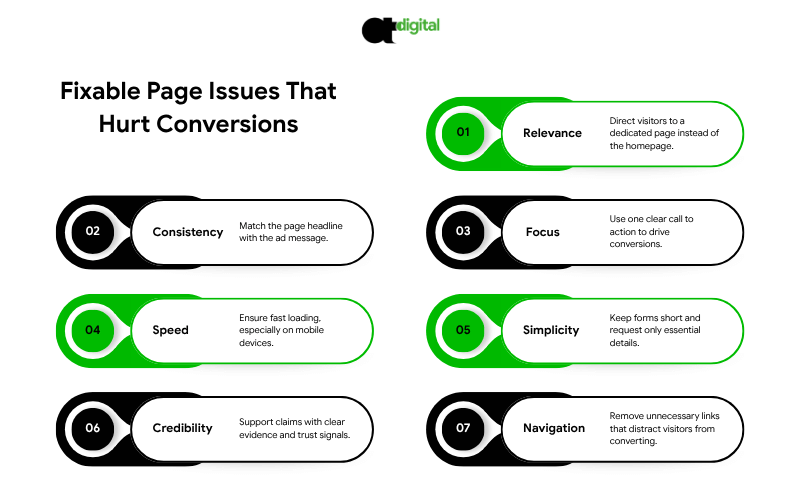
    • Sending traffic to the homepage instead of a dedicated page.
    • The headline doesn’t match the ad that drove the click.
    • Multiple competing calls to action diluting the one conversion you actually want.
    • Slow load time, especially on mobile, where most paid traffic lands first.
    • Forms with too many fields, asking for information you don’t actually need yet.
    • No proof element, nothing specific backing up the claim being made.
    • Full site navigation left in place, giving visitors an easy way to wander off before converting.

    Most pages have two or three of these at once, which compounds the damage rather than adding to it. Meridian had four.

    DIY vs. Hiring a Landing Page Optimization Agency

    You can fix the basics above yourself with a page builder and some discipline. Consider bringing in a landing page optimization agency, landing page optimization company, or an independent landing page optimization expert when:

    • You’re running multiple simultaneous campaigns and need dedicated pages for each, fast
    • You’ve fixed the obvious issues and conversion is still below your industry benchmark
    • You need proper A/B testing infrastructure, not guesswork
    • Your team doesn’t have the design or copywriting bandwidth to iterate quickly

    If you’re comparing landing page optimization services, ask any landing page optimizer you’re evaluating three things before signing: how they’ll measure success (conversion rate and cost per acquisition, not just “engagement”), whether they build dedicated pages per campaign or one reusable template, and how quickly they can turn around a new page when you launch a new ad. For a team that handles the ad account and the landing pages it feeds as one connected system, see our PPC management services.

    The Verdict: Your Ad Already Did the Hard Part

    Here’s the frustrating truth about the landing page trap: by the time a visitor clicks your ad, the expensive work is already done. You paid for the click, won the auction, and earned their attention for a few seconds. A broken landing page throws all of that away in the final step, the one that should have been the easiest to control.

    Meridian’s fix took a few weeks to build and test. It didn’t touch targeting, didn’t touch bids, didn’t add a dollar to the budget. It took the same traffic they were already paying for and nearly tripled what it produced. That’s the entire case for fixing this before anything else: run the math on your own numbers, and if lifting your conversion rate from 2% to 4% cuts your cost per acquisition in half, every dollar spent fixing the landing page makes every future ad dollar worth twice as much. Compare that to chasing cheaper clicks, which only ever buys you the same conversion rate at a slightly lower price.

    You don’t need a bigger ad budget to fix this. You need the page at the end of the click to finish the conversation your ad started. Our landing page audit checks your message match, load speed, mobile experience and form friction against what your industry actually converts at, and tells you exactly where your current pages are leaking budget. Book it before your next campaign sends another round of paid clicks to a page that isn’t ready for them.

    Stop Paying for Clicks Your Page Can’t Convert

    Engineering-grade account analysis. Pure mathematics. Zero sales scripts.
    Initiate My Forensic Ad Audit →

  • Google vs Meta Ads: Pick the Wrong Advertising Platform and Your Budget Pays the Price

    Google vs Meta Ads: Pick the Wrong Advertising Platform and Your Budget Pays the Price

    Swap their platforms and both lose money, and neither will understand why. The plumber’s customer was searching. The candle buyer was scrolling. Google and Meta are built for two completely different moments, and most wasted ad spend starts with treating them as interchangeable.

    This guide is for owners and marketing leads deciding where their first (or next) ad dollars should go. You’ll get 2026 benchmark data from both platforms, a cost-per-customer test that changes the answer for some industries, and a 60-second decision at the end. For the deeper strategy behind wasted spend, read our pillar guide, The Ad Waste Audit.

    Google Ads or Meta Ads: Which Advertising Platform Fits Your Business?

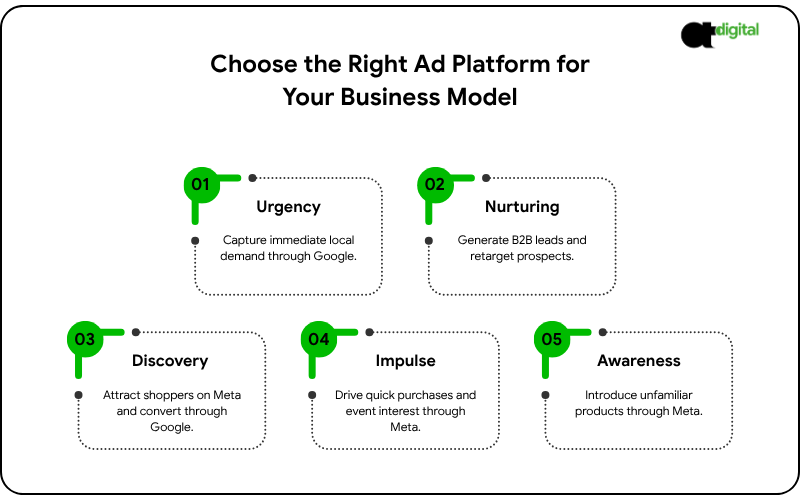
    Choose Google Ads when people already search for what you sell, like emergency repairs, legal help or B2B software. Choose Meta Ads when your product is visual, impulse-friendly or new, so nobody is searching yet. Most businesses start with one of these advertising platforms, then add the other for retargeting.

    Not sure which camp you’re in? The next few sections show you how to tell, using real numbers.

    Not Sure Which Platform Deserves Your Budget?

    We review your market, competitors and margins, then tell you which platform to fund first and what to expect.

    Get My Ad Platform Audit →

    Intent vs Interruption: The Core Difference Between These Advertising Platforms

    Google Ads meets people who are already searching. Someone types “emergency HVAC repair near me” or “project management software for agencies” and you pay to appear at that moment. Meta Ads (Facebook and Instagram) meet people who are scrolling. Nobody opens Instagram planning to hire an accountant. You interrupt the feed with something interesting enough to earn attention.

    Here is how the two compare in 2026, using median figures from WordStream’s benchmark reports:

    Google Ads (Search) Meta Ads (leads campaigns)
    Buyer mindset Actively looking Passively browsing
    You target Keywords and search intent Audiences and creative
    Average cost per click $5.42 $1.80 (traffic campaigns: $0.60)
    Average conversion rate 8.18% 8.54%
    Average cost per lead $66.69 $27.39
    What makes it work Keywords, ad relevance, landing page Creative, offer, audience testing
    Main risk Paying for irrelevant searches Creative fatigue and low-intent leads

    Source: WordStream’s 2026 Google Ads benchmarks (13,474 US search campaigns) and 2026 Facebook Ads benchmarks (452 leads campaigns, so treat Meta figures as directional).

    On paper, Meta wins on cost: less than half the price per lead. So why doesn’t everyone just use Meta?

    Why a Cheaper Lead Isn’t Always a Cheaper Customer

    Because a lead from a search and a lead from a feed are not the same lead. Someone who searched “dentist near me” has a problem today. Someone who tapped a lead form while scrolling might be curious. That difference shows up in your close rate.

    Here is an illustration. Suppose Google leads close at 20% and Meta leads at 10%. The close rates are my assumptions, so replace them with yours. Using WordStream’s 2026 cost per lead by category:

    Category Google cost per lead Meta cost per lead Cost per customer: Google (20% close) Cost per customer: Meta (10% close) Winner
    Dentists $72.97 $61.56 about $365 about $616 Google
    Home services $90.92 $42.95 about $455 about $430 Toss-up
    Real estate $102.51 $13.74 about $513 about $137 Meta

    Same two platforms, three different answers. That is the point: compare cost per customer, not cost per click or cost per lead. Run this math with your own close rates before you spend a dollar

    Match the Advertising Platform to Your Business Model

    Local and Emergency Services: Start With Google

    Sam runs an emergency HVAC company, and his customers search from a cold house. Home services cost about $90.92 per lead on Google, so $3,000 buys roughly 33 calls and form fills. Meta can support him later with reviews and reminders, but the first dollar belongs where the urgency is. Strong local visibility helps too: see our guide to local search dominance.

    B2B and High-Ticket Services: Google to Capture, Meta to Nurture

    Omar sells B2B software with a 60-day sales cycle. Buyers search for solutions on Google, so that’s where he captures demand. But most visitors won’t convert on the first visit, and that’s where Meta (or LinkedIn) earns its place: retargeting people who’ve already seen his site with a case study or an audit offer.

    Ecommerce and Visual Products: Meta to Discover, Google to Close

    Lena sells handmade candles. Nobody searches for “candle that smells like a rainy forest” until they’ve seen one. Meta puts the product in front of people who didn’t know they wanted it, and Google Shopping plus branded search then capture those who go looking afterward. If you also sell through large retail sites, marketplace advertising is a separate channel with its own economics. See our eCommerce marketing services for how to connect them.

    Low-Consideration Purchases and Events: Meta

    For restaurants, events and impulse buys, attention is cheap and decisions are quick. WordStream’s data shows restaurants pay $2.05 per click on Google but $0.45 on Meta traffic campaigns. When the customer doesn’t need to think long, paying four times as much for a search click rarely makes sense.

    New Categories Nobody Searches For: Meta

    If people don’t yet search for what you sell, Google has no demand to capture, no matter how much you spend. That is a Meta problem, and it often needs a strong offer to work.

    Three Tests Before You Spend a Dollar

    1. The demand test. Search your main service terms in Google’s Keyword Planner. Steady monthly searches mean Google can scale you. Almost none means Google can’t create demand. Then look at your competitors: the Meta Ad Library and Google’s Ads Transparency Center show which ads they’re running and for how long. An ad that has run for months is a decent (not perfect) signal that it pays for itself. Neither tool shows their spend or results.

    2. The economics test. Work backward from what a customer is worth. Illustration: you can spend $400 to win a customer and you close 20% of leads, so you can afford $80 per lead. At Google’s 8.18% average conversion rate, your maximum affordable click is about $6.54. The average $5.42 works. Legal advertisers paying $9.87 per click would lose money at those numbers.

    3. The capacity test. Google rewards keyword discipline and a strong landing page. Meta rewards a steady supply of fresh creative and enough volume: Meta’s own guidance points to roughly 50 optimization events in a 7-day window for an ad set to leave its learning phase. At $27.39 per lead, that is about $1,370 a week per ad set. On a small budget, that means one focused ad set, not five.

    What Good Ads Look Like on Each Platform

    A few Google Ads examples and Meta contrasts make the difference concrete.

    Google search ad: matches the query directly.

    Emergency HVAC Repair in [City] | 24/7 Same-Day Service | Licensed and Insured | Call Now for a Free Quote

    The searcher wants a fast solution, so the ad answers immediately.

    Meta ad: earns attention first, then makes an offer.

    A 20-second video: “3 signs your furnace will fail this winter.” Below it: “Book a free pre-season inspection.”

    The viewer wasn’t looking for an HVAC company. The ad gives them a reason to care.

    Running Ads Without Wasting the Budget: How to Sequence Your Spend

    The most common budget mistake is spreading a small budget across every platform. Try this:

    • Start with one platform that matches your business model.
    • Get to steady conversions before adding anything.
    • Add the second platform in a supporting role, usually retargeting people who visited from the first.
    • Judge both by cost per customer, and connect ads and sales data so you know which platform actually closes deals. Conversion tracking (including Meta’s Conversions API and server-side tracking) is covered in our pillar guide.

    Then plug the leaks:

    • On Google, the leak is irrelevant searches. Build a negative keyword list on day one and review your search terms weekly.
    • On Meta, the leaks are creative fatigue and constant edits that keep restarting the learning phase. Refresh creative on a schedule, and test one change at a time.
    • On both, the leak is a landing page that doesn’t match the ad. A great advertisement of your business sent to a generic homepage wastes the click. If yours is slow or vague, our website design and development services can fix it.

    Want Specialists to Run This for You?

    We choose the platform, build the campaigns, track cost per customer and cut the waste, so your budget goes where buyers are.

    Book My Ad Strategy Call →

    How to Choose Google PPC Management and Ad Management Services

    If you hire help, whether Google PPC management or a firm offering professional search engine marketing services, ask before you sign:

    • Do they build a strategy per platform, or copy one approach across all of them? Copy-paste strategy is a red flag.
    • Who owns the ad accounts and data? It should be you.
    • How do they report? Look for leads, customers and cost per customer, not just clicks and impressions.
    • What do Google ad management services fees cover, and does ad spend come out of the same budget?

    Be cautious of anyone who guarantees a specific return before looking at your economics. To handle Google and Meta as one system, see our PPC management services and social media marketing services.

    The Verdict: Pick Your Platform in 60 Seconds

    Answer three questions honestly:

    • Do people already search for what you sell? (Try it. Check the Keyword Planner.)
    • Is your product visual, impulse-friendly or new to the market?
    • Does your economics work? Divide your category’s cost per lead by your close rate. That is your cost per customer. Can a customer’s profit cover it?

    Now read your result:

    • Yes to 1: start with Google. Put most of your budget into search ads on your best buyer keywords. Add Meta retargeting once you have steady site traffic.
    • No to 1, yes to 2: start with Meta. Lead with a strong offer and fresh creative on one focused ad set. Add Google for branded and shopping searches once demand appears.
    • Yes to both (typical for ecommerce): Meta to discover, Google to close. Start with Meta for reach, then capture the people who search for you afterward.
    • Long sales cycle (typical for B2B): Google to capture, Meta or LinkedIn to nurture. Retarget site visitors with proof, not the same ad.
    • No to 3: don’t start with ads yet. Fix your offer, margins or landing page first. Ads make a broken funnel expensive faster.

    One line covers all of it: Google harvests demand that already exists. Meta creates demand that doesn’t yet. Pick the one that matches how your customers buy, and judge it on cost per customer, not cost per click.

    Every week you run the wrong platform, you are paying to reach the right people in the wrong mindset. Our ad platform audit compares your market, competitors and margins, and shows exactly which platform to fund first and what a customer should cost you. Book it before you spend the next dollar, and put your budget where buyers actually are.

    Which Platform Should Get Your Next Dollar?

    Engineering-grade account analysis. Pure mathematics. Zero sales scripts.
    Get My Ad Platform Audit Now →

  • The 98 Percent Deficit: Engineering a Dragnet to Recover Lost Corporate Capital

    The 98 Percent Deficit: Engineering a Dragnet to Recover Lost Corporate Capital

    THE 98 PERCENT DEFICIT

    (The Accepted Hemorrhage)

    Stop reading this briefing for exactly ten seconds. I want you to open a new tab, log into your corporate advertising account, review your PPC management services, and look at your total spend for the last thirty days. Do not look at the impressions. Do not look at the clicks. Look at the raw capital you just wired to google ads or Meta.

    Now, look at how many closed boardroom contracts actually came from that exact spend.

    Mathematics is going to make you uncomfortable. Let us run the final numbers on what your agency calls a highly successful digital marketing campaign. Your executive team authorizes a massive budget to target high value foreign markets and premium enterprise clients. You successfully bid for the click. You drive the prospect to a flawlessly engineered Digital Outpost.

    Even with elite structural engineering and absolute message match, an exceptional conversion rate peaks at roughly five percent.

    Traditional PPC marketing services simply let them disappear back into the internet. They look you in the eye and tell you a bounced visitor is a natural casualty of doing business. At AtheosTech Digital, we look at your balance sheet, and we consider this a catastrophic waste of acquired capital.

    The Single Touch Fallacy

    You are relying on a corporate prospect to convert on their very first visit to your website. Think about your own boardroom habits. Would you sign a six figure vendor contract on your first click?

    You are relying on a corporate prospect to convert on their very first visit to your website. Think about your own boardroom habits. Would you sign a six figure vendor contract on your first click?Of course not. As we proved in our macro survival thesis, Digital Darwinism 2026: The Mathematics of Survival in a Revenue Driven Economy, when deploying elite SEO and PPC services in the 2026 enterprise economy, high ticket transactions do not happen on impulse. They require intense due diligence.

    • The Competitor Audit: They showed interest, but they are actively comparing your proprietary solution against three other global competitors.
    • The Capital Friction: They are waiting for internal boardroom approval to release the necessary budget.
    • The Operational Distraction: They are interrupted by an immediate corporate crisis and simply close the active tab.

    Subsidizing the Enemy

    Here is the brutal financial reality. When these potential customers leave your site, their financial intent does not disappear. It remains fully active in the market.

    If your marketing department does not possess the digital infrastructure to aggressively stalk and follow them, you just committed financial arson. You simply paid the premium acquisition cost to educate a highly qualified buyer who will eventually close the contract with your rival.

    PHASE 1: CROSS DEVICE IDENTITY RESOLUTION

    (You Own the Data)

    We must completely redefine how your Chief Financial Officer views a digital visitor.

    Stop calling them traffic. When you pay fifty or one hundred dollars for a highly targeted B2B search click, that individual instantly becomes an active, depreciating investment on your corporate balance sheet.


    Because of the advanced PPC ads services tracking architecture we established in our foundational master guide, The Ad Waste Audit: How to Stop Buying Clicks and Start Buying Market Share, you now own that user’s server side data.. You are no longer renting fragile browser cookies from the tech giants.

    The Multi Device Blindspot

    Look at the daily routine of the exact enterprise decision maker you are trying to close. The modern executive does not operate on a single screen, which means the traditional agency tracking model is fundamentally broken.

    Retargeting Advertising Strategy
    • The Mobile Interception: They click your initial advertisement on their iPhone while commuting or waiting in an airport lounge.
    • The Device Disconnect: They quickly browse your mobile site, get distracted by an incoming call, and close the tab.
    • The Desktop Transition: Hours later, they arrive at the office, open a secure corporate desktop, and resume their daily operations.

    A standard pixel tracks basic behavior but completely loses this user the moment they switch devices. The traditional agency looks at their analytics and considers that expensive mobile click a total loss.

    The Recapture Protocol

    We refuse to accept that loss. We engineer a highly aggressive, closed loop sequence called the Recapture Protocol.

    This elite retargeting platform utilizes advanced Cross Device Identity Resolution.We build deterministic custom audiences and mathematically connect their fragmented digital footprint into a single, undeniable corporate profile. We seamlessly track that exact Chief Executive Officer from their mobile device in the morning directly to their desktop computer in the boardroom that afternoon.

    You never lose the asset. You simply wait for them to log back into the ecosystem.

    PHASE 2: THE SATURATION THRESHOLD

    (Algorithmic Restraint vs. Brand Fatigue)

    Think about your own digital experience for a moment. You click on specific products or a consulting service on a Tuesday, and for the next thirty days, the exact same annoying display ads stalk you across every single website you visit.

    It does not make you want to buy the product. It breeds active resentment.


    This is the hallmark of amateur PPC management services. They attempt to brute force their way to a conversion by bombarding the user with the exact same advertisement fifty times a day. This causes immediate brand fatigue and actively annoys the high value prospect. When you do this to a corporate executive, you do not just lose the sale. You permanently damage your boardroom authority.

    The Multi Platform Dragnet

    To execute this correctly, your Recapture Protocol must seamlessly cross digital borders to intercept their attention, but it must utilize calculated frequency to maintain a premium posture.

    We do not scream for them to come back. We simply become omnipresent:

    Retargeting Advertising Strategy
    • The Professional Perimeter: When a foreign logistics director abandons your pricing page, we do not spam them with immediate offers. Instead, your highly polished corporate case studies casually appear in their LinkedIn feed the following morning while they are drinking their coffee.
    • The Visual Perimeter: When they read a niche industry publication or a financial news site on the Google Display Network, your brand authority advertisements silently dominate the margins of the article. You are simply present.
    • The Social Perimeter: When they scroll through Meta platforms after hours, your video testimonials gently intercept their feed, providing undeniable social proof without begging for a click.

    You are forcefully and repeatedly injecting your corporate narrative into their daily digital consumption, but you are executing it with absolute algorithmic restraint. Everywhere they look, your corporate entity is present, powerful, and highly professional.

    PHASE 3: DYNAMIC ASSET DEPLOYMENT

    (The Anti Discount Protocol)

    Imagine your top sales executive sitting in a boardroom. A corporate prospect declines their initial pitch. Does your executive just stare at them and repeat the exact same sentence, verbatim, five times in a row? Of course not. They pivot. They address the objection. Yet, your active retargeting campaigns are currently repeating the exact same failed banner advertisement to users who already walked away. If the initial message failed to convert the prospect, repeating it is a complete waste of your budget. This is known as Creative Decay.

    The Discount Reflex

    Now look at how standard PPC management services respond to a bounced visitor. The moment a prospect leaves your site, the amateur marketer panics and immediately deploys cheap ad retargeting with a ten percent discount.

    We call this the Discount Reflex. Whether you are selling high ticket enterprise consulting or require massive scale eCommerce PPC services, offering a cheap discount instantly destroys your premium corporate positioning. It screams desperation and trains your market to wait for a price drop.

    Dismantling the Objections

    To execute a high velocity recovery, your architecture must automatically deploy dynamic assets that systematically dismantle their remaining objections based exactly on where they abandoned the session:

    • The Authority Nudge: If they left the homepage immediately, they lack baseline trust. We do not ask them to buy. We serve them highly targeted video case studies of your past boardroom victories to build authority and prove your competence.
    • The Risk Reversal: If they abandoned the pricing page, they have high intent but deep financial hesitation. We do not offer a cheap discount. We present them with ironclad risk reversal guarantees to completely eliminate their fear of making a bad corporate investment.
    • The Social Proof Matrix: If they are stalling for internal consensus, we surround them with undeniable social proof and localized endorsements until the perceived risk of hiring your firm is entirely eliminated.

    Data proves they are 70 more likely to convert when mathematically guided back to your Digital Outpost to finalize the transaction. And they do it at full price.

    THE BOARDROOM DIRECTIVE: PIPELINE ASSESSMENT

    (The Capital Recovery Audit)

    Call your marketing director into the boardroom right now. Ask them to map out exactly what happens to a prospect five minutes after they visit your website and leave. If they hand you a generic report built by affordable PPC services regarding broad brand awareness, you have a massive structural problem.

    Executives sit in the boardroom and constantly ask what is PPC management services actually going to do differently to fix this broken pipeline. The answer is complete capital recovery. Your digital advertising is either mathematically operating as a closed loop Capital Recovery Engine, or it is a leaky bucket actively draining your marketing budget. There is absolutely no middle ground in enterprise paid acquisition.

    I need your executive board to fundamentally change its definition of a bounced visitor. Stop viewing them as a lost cause and start viewing them as future paying customers. They are a highly qualified, paid asset sitting dormant on your balance sheet. It is time to deploy effective retargeting, audit your retention architecture, and stop letting your competitors harvest the exact traffic you just paid a premium to acquire.

    Assess Your Dragnet


    Before you authorize another single dollar increase in your cold traffic budget, your executive team must sit down and answer these clinical diagnostic questions with absolute transparency:

    • The Asset Test: Are you actively tracking and mathematically resolving the identities of the ninety eight percent of users who leave your site without buying, and are you following them seamlessly across all their personal and corporate devices?
    • The Restraint Test: Do you possess strict algorithmic frequency capping to prevent brand fatigue, or is your current agency actively annoying your most lucrative prospects with amateur spam?
    • The Value Test: Are you systematically fortifying your corporate value with fresh case studies and risk reversal guarantees, or are you resorting to cheap discounts just to win a desperate click?

    If your leadership team cannot confidently answer these three questions, your overall marketing strategy and paid acquisition is not an asset. It is a massive corporate liability. You are actively burning cash.

    INITIATE YOUR AD WASTE AUDIT

    (A technical breakdown of your retargeting architecture and the exact capital you are silently leaking to the ninety eight percent.)