Build Your Growth Stack

Confirm or adjust your services and enter your details.

Please select at least one service.
First name is required.
Last name is required.
Please enter a valid email address.

Tag: landing page optimization

  • The Landing Page Trap: How a Bad Page Turns Your Best Ad Into a Wasted Click

    The Landing Page Trap: How a Bad Page Turns Your Best Ad Into a Wasted Click

    Then the visitor lands, and they bounce in four seconds flat. Not because your ad lied. Because the page it sent them to had nothing to do with what they just clicked.

    This is the landing page trap, and it’s one of the most expensive, least-diagnosed leaks in paid advertising. Agencies love to report on impressions and click-through rate because those numbers almost always look good. What they rarely show you is the page those clicks landed on, and whether it was built to close or just built to exist. This guide shows you exactly what separates a page that converts from one that quietly burns your ad budget. It’s the practical companion to our pillar guide, The Ad Waste Audit, which covers the full system behind wasted spend.

    What Is the Landing Page Trap, and Why Do Great Ads Fail on Bad Pages?

    The landing page trap is sending paid traffic to a generic page instead of a dedicated one built for that exact ad. A visitor who clicks a specific offer expects a page that continues that exact message. Send them to your homepage instead, and they have to hunt for what they came for, so most just leave.

    The rest of this guide breaks down exactly what a page needs to finish that job, and how to know if yours is failing.

    Is Your Landing Page Losing the Clicks You’re Paying For?

    We audit your current landing pages against message match, load time and conversion best practices, and show you exactly what’s costing you.

    Get My Landing Page Audit →

    The Homepage Mistake: Why “Just Send Them to Our Site” Fails

    Here’s the scenario that plays out thousands of times a day. Meridian Cybersecurity runs an ad for “Enterprise Cybersecurity Audits.” It’s a good ad, tightly targeted at IT directors with real budget authority, and it’s getting clicks. But every one of those clicks lands on Meridian’s homepage: a navigation bar, a mission statement, a careers link, and a generic “Our Services” dropdown somewhere in the mix. The visitor has a singular, high-urgency intent, and the homepage is answering a completely different question.

    Your homepage is built to orient a stranger to your whole business. A landing page is built to finish one specific conversation your ad already started. Conflating the two is the single most common reason conversion rate optimization best practices always start with the same instruction: never send paid traffic to your homepage. Meridian’s conversion rate on that campaign was sitting at 1.8%, well below what the keyword’s intent should have produced, and the team had no idea why until someone checked where the clicks were actually landing.

    Anatomy of a High-Converting Landing Page

    So what does a page that actually finishes the job look like? The anatomy of a landing page that converts comes down to a short list of non-negotiables, not clever design tricks.

    Message Match: The Rule Most Pages Break

    If your ad promises “Free 2026 Tax Planning Guide,” your headline needs to deliver exactly that, in roughly the same words, the instant the page loads. Any gap between what the ad promised and what the headline says creates a half-second of doubt, and doubt is where bounces come from. This single fix, matching your headline to your ad copy word for word, is consistently one of the highest-leverage changes you can make to landing pages that convert, and it’s a core finding behind the Nielsen Norman Group’s usability research on why visitors judge a page’s relevance within seconds of arrival.

    One Goal, One Page, No Exit Ramps

    A high converting landing page asks for exactly one action. Not “call us, download this, or follow us on social,” three competing calls to action that each dilute the others. Pick the single next step you want, and remove everything that offers an alternative path, including your main site navigation. Every link you leave on the page is an exit ramp away from the conversion you paid for.

    Bounce Rate vs. Exit Rate: What These Numbers Are Actually Telling You

    Before you can fix a landing page, you need to read its numbers correctly, and this is where most people mix up two different metrics.

    What is the bounce rate in SEO and analytics terms? It’s the percentage of visitors who land on a page and leave without taking any further action, viewing no other page, clicking nothing. For a landing page, a high bounce rate usually means a message match or relevance problem: people arrived expecting something the page didn’t deliver.

    Exit rate vs. bounce rate is the distinction worth knowing: exit rate measures how often a page is the last one in a session, regardless of how many pages the visitor viewed before that. A high exit rate on your “thank you” confirmation page is normal and expected. A high bounce rate on your landing page is a warning sign.

    What counts as a concerning number? There’s no single universal bounce rate benchmark or landing page bounce rate benchmark that applies everywhere, it varies by industry and traffic source, but a landing page bouncing well above 60-70% on paid traffic is usually telling you something is broken in message match, load speed, or mobile usability, not that your offer is bad. Meridian’s homepage, for what it’s worth, was bouncing paid visitors at 74%.

    How to improve bounce rate (and how to reduce bounce rate) on a paid landing page, in priority order:

    1. Fix message match between ad and headline first. This is almost always the biggest lever.
    2. Check your mobile experience specifically, since most paid traffic arrives on phones.
    3. Cut your page load time. Every extra second of waiting pushes more visitors to leave before they see anything.
    4. Remove navigation links and competing calls to action.

    Is Your Bounce Rate Telling You Something?

    We diagnose exactly why visitors are leaving, message match, speed or mobile friction, instead of guessing at a redesign.

    Diagnose My Bounce Rate →

    Conversion Rate Optimization Best Practices: The CPA Multiplier

    Our pillar guide makes a specific claim worth putting real numbers against: that lifting a landing page’s conversion rate from 2% to 4% cuts your cost per acquisition in half, without spending another dollar on ads. That math is simply true, and it’s why conversion rate optimization is often the highest-leverage lever available to a business already running ads, more reliable than trying to find cheaper clicks.

    For context on what you’re actually working against, Unbounce’s Conversion Benchmark Report, drawn from 57 million conversions across more than 41,000 landing pages, puts the median landing page conversion rate at 6.6% across all industries, though it varies sharply by sector: financial services pages convert at a median of 8.4%, while SaaS pages trail at 3.8%. If your page is sitting well below your industry’s median, that gap is where your CPA is quietly bleeding out.

    Here’s what that gap looked like for Meridian once the team built a dedicated page, matched the headline to the ad word for word, and stripped the navigation: conversion rate went from 1.8% to 5.1% on the same ad spend, same targeting, same bids. Same dollars in, nearly three times the qualified leads out.

    To increase website conversion rate and improve website conversion rate on a specific page, work through these in order of typical impact:

    • Tighten message match (covered above)
    • Shorten your form to the fewest fields that still qualify the lead
    • Add a single, clear, risk-reducing proof point (a guarantee, a specific result, a credible number)
    • Make your one call-to-action impossible to miss above the fold
    • Fix load speed, especially on mobile

    PPC Landing Pages vs. SEO Landing Pages: Do They Need to Be Different?

    Yes, and understanding why changes how you build each one.

    PPC landing page optimization and pages built for landing pages for Google ads specifically are built for one audience arriving in one mindset, often with a time-limited offer, and they’re allowed to be aggressively narrow and single-purpose, since every visitor arrives via the exact ad you control.

    Do landing pages help SEO? Generally, not much, and that’s by design. A true PPC landing page is usually set to no index, stripped of navigation, and built purely for conversion, none of which helps organic rankings. Google’s own guidance on thin content favors substantial, people-first pages for ranking purposes, which a tightly stripped PPC page deliberately isn’t built to be. If you want a page to rank organically, it needs internal links, broader on-page SEO structure, and content depth, elements that actively work against a tight, single-purpose PPC page. Trying to make one page serve both jobs well is how you end up with a page that does neither.

    Want a Page Built to Convert, Not Just Exist?

    We design, build and test dedicated landing pages matched to each campaign, so your ad spend doesn’t leak out through a generic page.

    Book My Landing Page Build →

    How to Test and Improve: A/B Testing, Tools and Analytics

    You shouldn’t be guessing which version of a page performs better. Landing page testing, specifically A/B testing for landing pages, is how you replace opinion with data.

    The basics of landing page split testing:

    • Test one variable at a time, a headline, a CTA button, a hero image, not a full redesign all at once, or you won’t know which change actually moved the needle.
    • Run the test long enough to reach a meaningful sample size before declaring a winner.
    • Start with the elements most likely to move conversion: headline and message match first, form length second, visual proof third.

    For landing page analytics and landing page analysis, track beyond the raw conversion rate: time on page, scroll depth, and where in the page people stop engaging all tell you where attention is being lost. Most major landing page optimization tools (your ad platform’s own landing page reports, your analytics suite, and dedicated page builders with built-in testing) surface these metrics without custom development.

    Dynamic landing pages, pages that automatically swap headlines or offer text to match the specific ad, keyword or audience that sent the visitor, take message match from a one-time fix to a systemized one. They’re worth the setup once you’re running more than a handful of campaigns at once, since manually building a unique page per ad doesn’t scale.

    Landing Page Copywriting: Say the One Thing They Came For

    Good landing page copywriting isn’t about clever lines. It’s about ruthless clarity. The visitor arrived with one question in mind, “can this solve my specific problem,” and every sentence on the page should move them closer to a confident yes.

    A simple structure that holds up across industries:

    1. Headline: restates exactly what the ad promised.
    2. Subheadline: adds the one detail that makes the offer credible (a number, a timeframe, a guarantee).
    3. Three to five benefit points: what changes for them, not a list of your features.
    4. One proof element: a testimonial, a stat, a case result.
    5. One call to action, repeated at the top and bottom of the page, worded identically both times.

    Cut anything that doesn’t serve one of those five jobs. A landing page is not the place for your company history.

    Common Landing Page Mistakes (That Are Easy to Fix)

    The recurring list of landing page mistakes we see most often, roughly in order of how much damage they do:
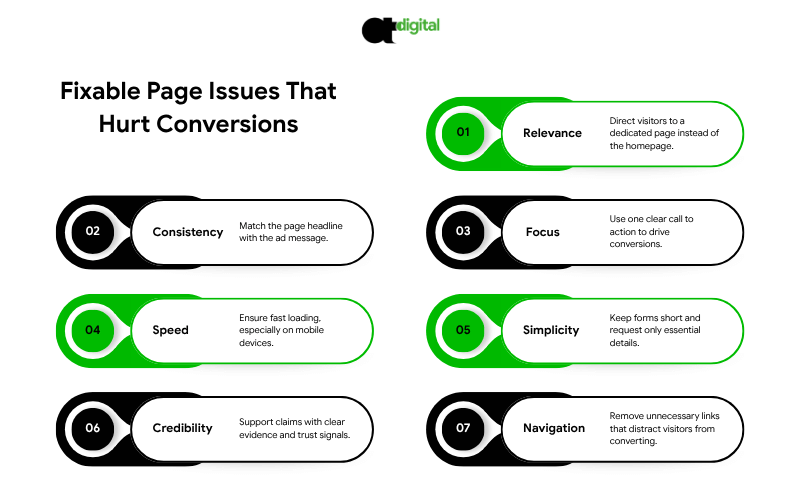
    • Sending traffic to the homepage instead of a dedicated page.
    • The headline doesn’t match the ad that drove the click.
    • Multiple competing calls to action diluting the one conversion you actually want.
    • Slow load time, especially on mobile, where most paid traffic lands first.
    • Forms with too many fields, asking for information you don’t actually need yet.
    • No proof element, nothing specific backing up the claim being made.
    • Full site navigation left in place, giving visitors an easy way to wander off before converting.

    Most pages have two or three of these at once, which compounds the damage rather than adding to it. Meridian had four.

    DIY vs. Hiring a Landing Page Optimization Agency

    You can fix the basics above yourself with a page builder and some discipline. Consider bringing in a landing page optimization agency, landing page optimization company, or an independent landing page optimization expert when:

    • You’re running multiple simultaneous campaigns and need dedicated pages for each, fast
    • You’ve fixed the obvious issues and conversion is still below your industry benchmark
    • You need proper A/B testing infrastructure, not guesswork
    • Your team doesn’t have the design or copywriting bandwidth to iterate quickly

    If you’re comparing landing page optimization services, ask any landing page optimizer you’re evaluating three things before signing: how they’ll measure success (conversion rate and cost per acquisition, not just “engagement”), whether they build dedicated pages per campaign or one reusable template, and how quickly they can turn around a new page when you launch a new ad. For a team that handles the ad account and the landing pages it feeds as one connected system, see our PPC management services.

    The Verdict: Your Ad Already Did the Hard Part

    Here’s the frustrating truth about the landing page trap: by the time a visitor clicks your ad, the expensive work is already done. You paid for the click, won the auction, and earned their attention for a few seconds. A broken landing page throws all of that away in the final step, the one that should have been the easiest to control.

    Meridian’s fix took a few weeks to build and test. It didn’t touch targeting, didn’t touch bids, didn’t add a dollar to the budget. It took the same traffic they were already paying for and nearly tripled what it produced. That’s the entire case for fixing this before anything else: run the math on your own numbers, and if lifting your conversion rate from 2% to 4% cuts your cost per acquisition in half, every dollar spent fixing the landing page makes every future ad dollar worth twice as much. Compare that to chasing cheaper clicks, which only ever buys you the same conversion rate at a slightly lower price.

    You don’t need a bigger ad budget to fix this. You need the page at the end of the click to finish the conversation your ad started. Our landing page audit checks your message match, load speed, mobile experience and form friction against what your industry actually converts at, and tells you exactly where your current pages are leaking budget. Book it before your next campaign sends another round of paid clicks to a page that isn’t ready for them.

    Stop Paying for Clicks Your Page Can’t Convert

    Engineering-grade account analysis. Pure mathematics. Zero sales scripts.
    Initiate My Forensic Ad Audit →

  • The Silent Closer: Engineering the Digital Infrastructure That Outperforms Your Human Sales Team

    The Silent Closer: Engineering the Digital Infrastructure That Outperforms Your Human Sales Team

    THE PERFORMANCE REVIEW: IS YOUR WEBSITE SLACKING?

    THE OPERATIONAL AUDIT

    • Annual Working Capacity: 8,760 hours with zero sick days.
    • Simultaneous Prospect Capacity: Infinite.
    • The Financial Penalty: 88.0% of prospects will never return to a site after a single negative experience.

    If your website were a human employee, you would have terminated them months ago. Imagine hiring a Senior Sales Director with a massive signing bonus and a premium salary. You give them total access to your hottest leads and the best tools in the industry. Then, they spend 23 hours a day sleeping. When they finally speak to a prospect, they mumble, use confusing jargon, and completely forget to ask for the transaction.

    You would terminate that employee for gross negligence before the end of their first week. Yet, most enterprise firms tolerate this exact behavior from their digital infrastructure every single day. They treat their digital storefront as a passive brochure rather than a high-performance operator. They waste capital on subjective aesthetic trends instead of demanding objective operational ROI.

    At AtheosTech Digital, we do not design websites for artistic validation or “creative” awards. We engineer The Silent Closer. We view UI/UX as a strict, mathematically optimized behavioral script that either forces a conversion or permits a bounce. Your digital architecture should be your most consistent, most persuasive, and most profitable employee. It is time to stop hoping for engagement and start commanding the close.
    This briefing outlines the exact forensic metrics required to evaluate your website as a strategic hire. You are about to discover the architectural shifts needed to turn a passive liability into a high-velocity asset that out-works and out-closes your top-tier human sales reps.

    THE 3-SECOND PERFORMANCE REVIEW

    (The Cost of a Slow Response)

    THE PUNCTUALITY AUDIT

    • User Expectation: 2.0 seconds or less.
    • The Abandonment Threshold: 3.0 seconds.
    • The Financial Penalty: A 1.0 second delay results in a 7.0% reduction in conversions.

    If your website takes more than 3 seconds to load, your digital employee has effectively walked out of the boardroom before the prospect even finished their first sentence.

    In the high-velocity corporate sector, speed is the ultimate metric of professional respect. Statistics prove that 47.0% of users expect a load time of 2.0 seconds or less. Every millisecond of delay is a financial leak that directly impacts your bottom line. A slow site does not just annoy users; it signals operational incompetence and a total lack of technical discipline.

    “The 3-Second Rule: How Speed Impacts Your Bottom Line.”

    The Efficiency Protocol

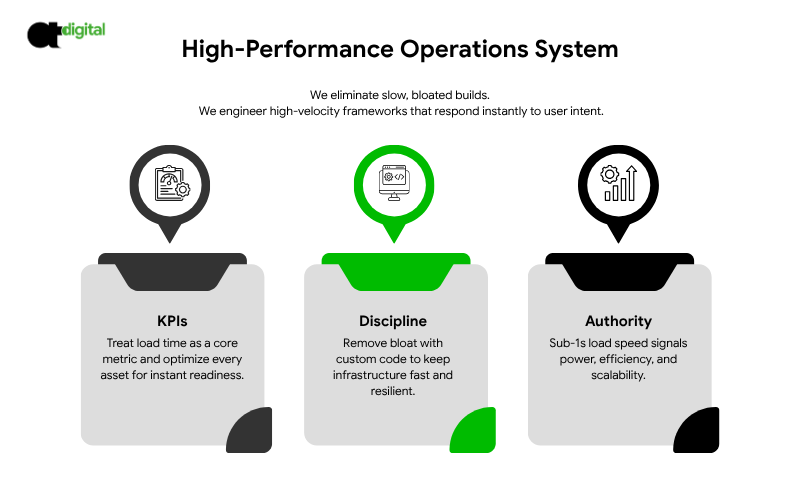
    At AtheosTech Digital, we do not tolerate digital tardiness. We do not build bloated, heavy sites using fragile, off-the-shelf templates that are weighed down by unnecessary code. Instead, we engineer high-velocity frameworks that respond instantly to user intent.

    The Performance Mandate:

    • Non-Negotiable KPIs: We treat load time as a primary operational metric. If the site is not fast, the employee is failing their most basic duty. We optimize every asset to ensure the “Silent Closer” is ready the moment the prospect arrives.
    • Technical Discipline: We strip away the digital clutter. By using custom-coded solutions rather than heavy plugins, we ensure your infrastructure remains agile and responsive under high-volume traffic.
    • First Impression Authority: A site that loads in under 1,000 milliseconds communicates power. It tells the executive prospect that your firm is efficient, modern, and ready to handle their business at scale.

    The Reality of Speed: Speed is not a luxury; it is a conversion requirement. When you eliminate the wait, you eliminate the first and most common reason for a prospect to choose your competitor.

    THE MOBILE-FIRST MANDATE

    (Visibility in the Modern Boardroom)

    THE VISIBILITY AUDIT

    • Global Mobile Traffic Share: 60.2%
    • B2B Executive Behavior: 70.0% of decision makers use mobile devices to research enterprise solutions.
    • The Search Reality: 100% of new websites are now evaluated by Google using mobile-first indexing.

    If your website is not perfectly optimized for mobile devices, you have hired an employee who refuses to show up for 60.0% of your potential meetings.

    Google has moved to a ruthless mobile-first indexing model. This means that if your digital storefront looks elite on a desktop but fractures on a smartphone, you are effectively invisible to the world’s most powerful search algorithm. Market leaders recognize that the modern boardroom is mobile. An executive is just as likely to review your million dollar proposal on a phone during a commute as they are on a high-end laptop in a conference room.

    “Mobile-First Reality: Why Google Ignores Desktop-Only Sites.”

    The Omnipresence Standard

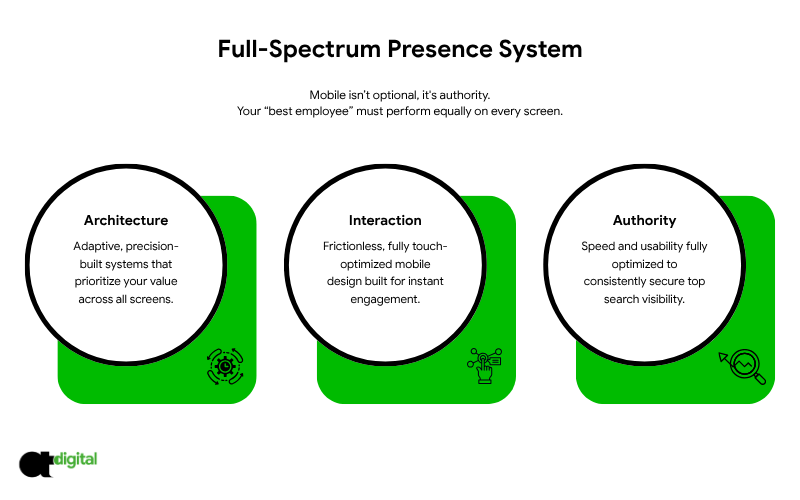
    At AtheosTech Digital, we do not view mobile optimization as an afterthought. We view it as a non-negotiable requirement for professional authority. Your “best employee” must be as effective and persuasive in a prospect’s hand as they are on a massive boardroom projector.

    The Mobile Execution:

    • Adaptive Architecture: We do not build “shrunken” desktop sites. We engineer responsive architectures that reflow and adapt with mathematical precision. We ensure that your value proposition is the first thing an executive sees, regardless of their screen size.
    • Frictionless Touch Interaction: We eliminate the design mistakes that lead to mobile frustration. We ensure that every button is accessible, every lead form is thumb-friendly, and every call to action is positioned for immediate engagement.
    • Algorithmic Dominance: By optimizing for mobile speed and usability, we satisfy the strict requirements of search engines. This ensures your “Silent Closer” remains at the top of the search results, ready to intercept prospects before they ever find your competition.

    The Visibility Mandate: If you are not visible on mobile, you do not exist in the modern sales cycle. We ensure your digital infrastructure maintains absolute authority on every device, every time.

    THE CONVERSION ENGINE

    (CRO: Training Your Site to Close)

    THE CLOSING AUDIT

    • Standard B2B Conversion Rate: 2.2% to 3.1%.
    • CRO Optimization Lift: Potential for 100% to 400% increase in lead volume.
    • The Efficiency Win: Doubling your leads without spending an extra $1.00 on traffic.

    A “Worst Employee” website merely exists. It sits in a digital corner and waits for the prospect to take the initiative. A “Best Employee” website is predatory. It actively extracts data, qualifies the visitor, and moves the lead toward a terminal decision.

    Conversion Rate Optimization (CRO) is the engineering process of training your digital employee to stop mumbling and start closing. Most sites fail because they prioritize fleeting creative trends over hard sales psychology. They build for awards while we build for the ledger.

    “CRO Basics: Simple Tweaks to Double Your Leads.”

    The Extraction Logic

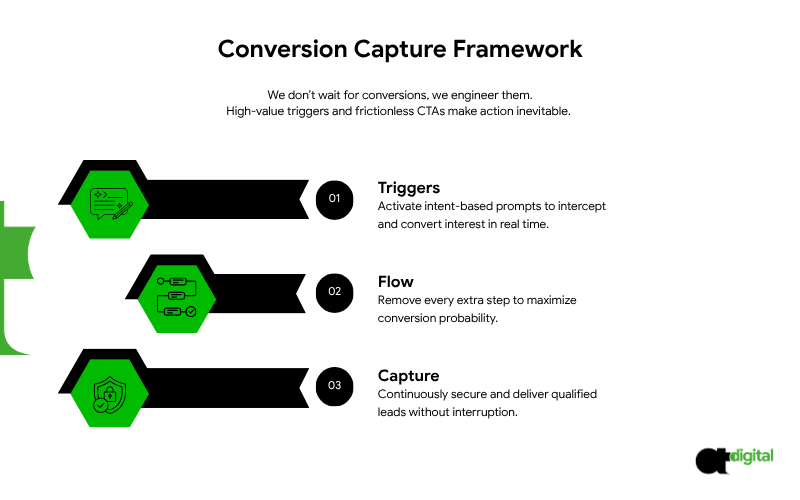
    At AtheosTech Digital, we do not “hope” for a contact form submission. We engineer the environment to make it inevitable. We install high-value intellectual tripwires and frictionless calls to action throughout your entire digital architecture.

    The Closing Tactics:

    • Intent-Based Triggers: We replace passive “Contact” buttons with active, intent-based triggers. If a prospect lingers on a specific service page for 45 seconds, the “Silent Closer” intercepts them with a high-value asset tailored to that exact interest.
    • Frictionless Pathing: Every extra field in a form is a 10.0% drop in conversion probability. We strip away the friction. We ensure that the path from “interested” to “invested” is a straight line with zero obstacles.
    • Persistent Lead Capture: Your website functions as a lead-capture machine that delivers hot, qualified prospects to your CRM while your human team is off the clock. It never forgets a follow-up; it never misses a detail.

    The Closing Reality: You do not always need more traffic. Most often, you need a website that actually knows what to do with the traffic you already have. We turn your passive visitors into cleared invoices through pure behavioral engineering.

    CONCLUSION: THE BOARDROOM ULTIMATUM

    THE OPPORTUNITY COST OF MEDIOCRITY

    • The Revenue Gap: A site converting at 1.0% requires 400.0% more ad spend than a site converting at 5.0% to hit the same target.
    • The Attrition Rate: You are currently losing 8 out of 10 mobile prospects due to architectural friction.
    • The Terminal Status: If your website is not your top lead generator by the end of 2026, your digital strategy is obsolete.

    If your current website is merely a digital placeholder, it is a liability. It is a “Worst Employee” that is costing you market share every single minute it remains active. You are paying for its hosting, its maintenance, and the traffic it wastes.


    It is time to implement absolute structural discipline. Stop viewing your website as a design project. Start viewing it as a strategic, high-stakes hire that must produce a measurable, mathematical return on investment.

    THE DIGITAL PERFORMANCE REVIEW

    Is your website a strategic asset or a sunk expense?

    At AtheosTech Digital, we do not offer subjective critiques. We perform Forensic Audits on the digital infrastructure of high-tier corporate entities. We treat your code like a ledger and your UI/UX like a sales script.

    Give us your URL. We will run a strict, black and white diagnostic to determine if your “Silent Closer” is actually working or just taking up space.

    The 72-Hour Deliverable:

    • The Friction Audit: We identify the exact points where your UI/UX is failing to convert and forcing prospects to bounce.
    • The Velocity Report: We expose the slow load times and heavy backend bloat that are currently bleeding your revenue.
    • The Capture Blueprint: We map out the “Best Employee” version of your site, including high-velocity extraction points and automated closing triggers.

    (Engineering-Grade Analysis. Pure Mathematics. Zero Sales Scripts.)

  • The Ad Waste Audit: How to Stop Buying Clicks and Start Buying Market Share

    The Ad Waste Audit: How to Stop Buying Clicks and Start Buying Market Share

    The Casino vs. The Calculator: Anatomy of a Financial Hemorrhage

    Open the ledger on your current marketing department. Look past the colorful monthly reports. Look directly at the bottom line.

    Right now, most corporate executives and political directors are unknowingly operating a high-stakes casino directly from their boardrooms.

    The standard industry procedure looks exactly like this:

    • Load tens of thousands of corporate dollars into Google Ads, LinkedIn, or Meta.
    • Pull the algorithmic lever.
    • Sit back and pray for a return on investment.

    When the executive board demands measurable financial results, the traditional marketing agency deploys a smokescreen. They slide a polished PDF across the table. They celebrate vanity metrics like “impressions”, “brand awareness”, and a lower “cost per click”.

    Let us establish a brutal financial reality.

    • An impression does not make payroll.
    • A click-through rate does not win a contested congressional seat.
    • “Brand awareness” does not satisfy shareholders.

    If your Chief Financial Officer cannot mathematically prove that a $10,000 ad injection resulted in a $40,000 closed contract, your digital infrastructure is fundamentally broken.

    You are not executing a marketing strategy. You are executing corporate gambling. You are simply subsidizing Google and Meta’s quarterly earnings while your own market share stagnates.

    The AtheosTech Digital Mandate:

    We do not tolerate financial ambiguity. We approach paid media strictly as a mathematical arbitrage. Advertising is an engineering problem.

    You input capital into a precisely calibrated, closed-loop machine, and you extract a predictable, trackable profit. We do not guess. We do not hope. We engineer.

    This briefing dismantles the traditional, broken advertising agency model. We are going to expose the invisible financial leaks draining your budget right now. We will explore the exact structural engineering required to stop the bleed, kill the vanity metrics, and transform your ad spend into a deterministic corporate asset.

    PLATFORM ALLOCATION

    (The Psychology of Intent vs. Interruption)

    The very first point of catastrophic financial failure in any ad account is platform misalignment.

    Most agencies treat all ad networks as equal entities. They copy and paste the exact same strategy across every channel. This is a fundamental misunderstanding of human behavior. Platforms are not interchangeable. They serve completely different psychological functions.

    “Google vs. Meta: Which Platform Fits Your Business Model?”

    The Architecture of Search Intent (Google)

    Consider the exact mindset of the user. When a regional logistics director types “enterprise fleet tracking software” into a search bar, they are not casually browsing. They are actively executing a corporate procurement mission.

    • The Strategy: Google Ads allows you to intercept absolute, bottom-of-the-funnel intent.
    • The Mathematics: You will pay a premium cost per click on this platform. However, you are not buying a casual click. You are buying a prospect who already has their wallet open and their budget approved. You are paying for immediate market capture.

    The Architecture of Discovery (Meta & LinkedIn)

    Conversely, examine the psychology of a social feed. Nobody opens Facebook, Instagram, or LinkedIn with the explicit intention of hiring a political crisis management firm or a corporate tax auditor. They are there to consume content, read the news, and network.

    • The Strategy: Advertising on these platforms requires the precise engineering of interruption.
    • The Execution: You cannot rely on them searching for you. You must manufacture demand. You must deploy an irresistible, high-value proposition – like a proprietary industry report or a risk-assessment audit – to disrupt their scrolling and force a paradigm shift in a highly targeted executive demographic.

    The Absolute Rule of Capital Allocation:

    The most common way to incinerate corporate capital is platform confusion. If you attempt to run a direct-intent search strategy on an interruption-based social platform, you will burn your entire budget within days. Platform allocation requires absolute strategic discipline.

    THE INVISIBLE BLEED

    (Stopping Wasted Spend with Negative Architecture)

    Assuming you have selected the correct platform, a new financial threat emerges. The Google search algorithm is explicitly designed to maximize its own ad revenue. It achieves this by matching your ads to incredibly broad, loosely related concepts.
    If left unsupervised, the machine will quietly siphon your budget. We call this massive financial leak Search Term Bleed.

    The Broad Match Trap

    Let us examine a standard corporate campaign. You instruct the algorithm to bid on the high-value phrase “Enterprise IT Consulting”. You expect your ad to appear in front of Chief Technology Officers.

    Because of Google’s broad matching protocols, the algorithm will naturally show your ad to completely unqualified audiences.

    • A college student searching for: “Enterprise IT Consulting jobs”.
    • A startup founder searching for: “Free IT Consulting templates”.
    • A competitor researching: “Cheap IT Consulting software”.

    Every single time one of those unqualified users clicks your ad, $50 to $100 vanishes from your corporate account. You are paying premium rates for clicks that possess a mathematical zero percent chance of converting into a boardroom contract.

    Negative Keyword Architecture (The Defensive Moat)

    To stop this invisible bleed and immediately recession-proof your ad spend, you must abandon the amateur strategy of only picking winning keywords. You must engineer a defensive perimeter.

    At AtheosTech Digital, we deploy a ruthless defensive strategy known as Negative Keyword Architecture.

    The Rule of Exclusion:

    We proactively tell the algorithm exactly who we refuse to pay for. Before a single dollar is spent, we upload massive, proprietary lists of negative keywords. We permanently eliminate words like “free”, “jobs”, “cheap”, “templates”, and “salary” from your ecosystem.

    The Financial Result:

    This strict engineering forces every single dollar of your budget directly toward high-intent corporate buyers. You are no longer subsidizing student research. You instantly increase your Return on Investment not by spending more, but by drastically decreasing your wasted capital.

      DETERMINISTIC TRACKING

      (You Cannot Scale What You Cannot Verify)

      Welcome to the era of broken attribution. The most severe financial leak in any corporate or political advertising account is not a bad ad creative. It is the inability to track reality.

      If your conversion tracking still relies on outdated browser cookies or basic web pixels, your marketing department is flying blind. You are making six-figure budget decisions based on corrupted data.

      The iOS Data Blackout

      Following the rollout of strict data privacy protocols across Apple devices and global browsers, standard tracking pixels have suffered a catastrophic loss of visibility.

      Consider a standard enterprise transaction.

      • A CEO on an iPhone views your LinkedIn ad on a Tuesday.
      • They do not click immediately.
      • On Thursday, they search for your firm directly and sign a $100,000 corporate contract.

      Because of the iOS data blackout, your standard pixel will completely miss the connection. Your agency will look at their dashboard, declare that the LinkedIn ad failed, and prompt you to turn off a highly profitable campaign. You will literally optimize your account backward.

      Server-Side Data Engineering (The Jailbreak)

      To fix this massive blind spot, we completely abandon standard tracking. We bypass the browser entirely.

      At AtheosTech Digital, we engineer Server-Side Tracking.

      The Architectural Shift:

      Instead of relying on a fragile user browser to report a conversion, we build a secure conduit. We pass the conversion data directly from your corporate server to the advertising platform’s API.

      This technical jailbreak restores your data visibility. More importantly, it feeds the machine learning algorithm the exact, high-quality signals it needs to find more verified buyers. You are no longer starving the algorithm of the truth.

      Closed-Loop CRM Integration (The CFO Standard)

      The final tracking failure of the traditional agency is optimizing for the wrong metric. Most digital marketers optimize their campaigns for “form submissions” or “lead captures”.

      We do not optimize for form submissions. We optimize for cleared funds.

      We achieve this through Closed-Loop CRM Integration. We build an API bridge directly between your advertising account and your internal CRM system (like Salesforce or HubSpot).The Result: When your sales team closes a deal or a political donor clears a maximum contribution, that offline revenue data is instantly fired back into the ad platform. We train the algorithm to hunt exclusively for signed contracts instead of cheap clicks.

      THE LANDING PAGE TRAP

      (Why Great Ads Die on Bad Websites)

      The fastest way to commit financial arson is to pay $50 or $100 for a highly targeted B2B click, only to send that exact prospect to your generic corporate homepage.

      “The Landing Page Trap: Why Great Ads Fail on Bad Sites.”

      The Digital Brochure Vulnerability

      A corporate homepage is not a sales tool. It is a digital brochure. It is bloated with company history, generic mission statements, and dozens of outbound navigation links.

      When a high-level executive clicks an advertisement for a specific service like “Enterprise Cyber Security Audits”, they possess a singular, high-urgency intent. If they land on a generic homepage and have to click three times to hunt for the relevant information, they will instantly bounce.

      Your ad was perfect. Your website killed the deal.

      The Conversion Outpost (The Walled Garden)

      At AtheosTech Digital, we do not send paid traffic to brochures. We engineer Conversion Outposts. Every single ad campaign requires a dedicated, mathematically structured landing page that operates entirely separate from your main website.

      These outposts are built on three unshakeable engineering principles:

      Message Match (The Psychological Bridge): The headline of the outpost must be an exact, word-for-word continuation of the advertisement. If your LinkedIn ad promises a “2026 Corporate Tax Blueprint”, the landing page must immediately and aggressively deliver that exact blueprint. Any deviation in messaging destroys algorithmic and human trust.

      Frictionless Conversion (The Binary Choice): The page must contain zero external navigation links. There are no top menus. There are no social media icons to distract the prospect. The user is placed in a walled garden with a strict binary choice. They can either book the corporate consultation, or they can leave. We completely eliminate all alternative escape routes.

      The Mathematics of the Offer (The CPA Multiplier):

      This is where true financial scaling occurs. If you optimize your Digital Outpost and increase your landing page conversion rate from 2% to 4%, you have instantly cut your Cost Per Acquisition (CPA) in half. You achieve a massive spike in profitability without changing a single setting or spending an extra dollar in your ad account.

      THE 98% DEFICIT

      (Engineering the Retargeting Loop)

      Let us run the final numbers on a highly successful digital campaign. Even with elite structural engineering and a flawless Digital Outpost, an exceptional conversion rate peaks at roughly 5%.

      This leaves a glaring mathematical deficit. What happens to the other 95% to 98% of corporate users who clicked your ad but hesitated?

      The traditional marketing agency simply lets them disappear back into the internet. They consider a bounced visitor a lost cause. At AtheosTech Digital, we consider this a catastrophic waste of acquired capital.

      “Retargeting 101: How to Close the 98% Who Didn’t Buy.”

      The Asset Acquisition (You Own the Data)

      You have already paid a premium price for the initial click. Because of our deterministic tracking architecture, you now own that user’s pixel and server-side data. That data is a paid corporate asset. We do not abandon it.

      We engineer a highly aggressive, closed-loop retargeting sequence to capture the hesitant majority. We call this the Recapture Protocol.

      Digital Omnipresence

      When a target CEO leaves your site without booking a consultation, they do not escape your ecosystem. We deploy dynamic tracking protocols to follow that exact prospect across the internet.

      We force your brand to appear on their favorite financial news websites, their YouTube feed, and their LinkedIn timelines. We create the illusion of absolute market dominance. Everywhere they look, your corporate entity is present.

      Offer Escalation (Dismantling Objections)

      The biggest mistake in retargeting is showing the exact same ad to a user who already said no. If the initial message failed to convert, repeating it is a waste of budget.

      We do not repeat ourselves. We escalate the offer.

      The Psychological Nudge:

      We systematically dismantle their remaining objections. We serve them highly targeted video case studies of your past boardroom victories. We present them with ironclad risk-reversal guarantees. We surround them with undeniable social proof until the perceived risk is entirely eliminated. They are mathematically guided back to the Digital Outpost to finalize the transaction.

      UNIT ECONOMICS AND THE 5-DAY PROTOCOL

      (Killing Losers and Doubling Winners)

      When advertising is treated as an unpredictable creative expense, Chief Financial Officers will naturally attempt to cut the budget. They view it as a corporate liability. However, when advertising is engineered as a deterministic revenue machine, those same CFOs will demand to scale it.

      You can only achieve this level of aggressive financial scaling when your marketing department abandons all emotional attachment to their ad creatives. You must rely entirely on strict, mathematical testing protocols.

      The 5-Day Liquidation Strategy

      The digital landscape is ruthless. Ad creatives suffer from rapid market fatigue. A brilliant, highly converting advertisement today will mathematically lose its effectiveness within a matter of weeks.

      At AtheosTech Digital, we do not launch campaigns and hope they survive. We implement a strict 5-day testing window.

      The Agile Sprint: We rapidly deploy and test multiple headlines, corporate images, and risk-reversal offers against each other in real time.

      The Agile Sprint: We rapidly deploy and test multiple headlines, corporate images, and risk-reversal offers against each other in real time.

      Capital Reallocation: We take that salvaged capital from the dead ads and funnel it entirely into the proven, mathematical winners.

      Lifetime Value to CAC Ratio (LTV to CAC)

      Amateur agencies optimize for the cheapest initial click. They hunt for cheap, low-intent leads. We do not optimize for the initial transaction. We optimize exclusively for the Lifetime Value (LTV) of the corporate client.

      You must deeply understand your Customer Acquisition Cost (CAC). If you secure a corporate IT retainer worth $150,000 over three years, paying $15,000 to acquire that exact contract is a highly lucrative engineering feat.

      The Boardroom Metric:

      A healthy, scalable enterprise must aim for an LTV to CAC ratio of 3 to 1 or strictly higher. If you input $1 in acquisition cost, the system must mathematically map out how that client returns $3 or more in lifetime corporate revenue.

      The Ultimate Lever for Corporate Growth:

      When your server-side tracking is flawless, your invisible bleed is permanently stopped, and your 5-day testing protocol is locked in, advertising completely ceases to be a risk.

      It transforms into a predictable lever for corporate growth. You simply increase the daily spend until the mathematics explicitly tells you to stop.

      CONCLUSION: THE FINAL BOARDROOM EXERCISE

      Open a new tab and look at your current marketing dashboard. Or better yet, call your agency right now and ask them these three exact questions:

      1. Can you trace yesterday’s ad spend directly to a cleared invoice or a maximum political contribution?
      2. Do you know the exact search terms that consumed the first $500 of your budget this morning?
      3. Are you absolutely certain your competitors are not bidding on your exact brand name right now?

      If they hesitate, or if the answer to any of those questions is “no”, you are actively hemorrhaging corporate capital.

      The advertising platforms thrive on your ambiguity. They rely on you being too busy to check the underlying mathematics. You have a binary choice to make today. You can close this page, return to your colorful PDF reports, and continue funding the tech giants. Or, you can draw a hard line.Stop subsidizing the algorithm. Stop buying vanity clicks. Start buying market share.

      INTERACTIVE DIAGNOSTIC: THE AD WASTE AUDIT

      Your budget is bleeding. Let us find the exact puncture wound.

      At AtheosTech Digital, we do not want to manage your current mess. We want to ruthlessly audit it.

      Give us backend access to your operation. We will sit down with you and surgically dissect your search term reports. We will bypass your corrupted tracking architecture and locate the exact, hidden campaigns silently draining your boardroom capital today.

      The audit takes hours. The financial trajectory of your enterprise changes instantly.

      (Engineering-Grade Account Analysis. Pure Mathematics. Zero Sales Scripts.)