
Someone clicks your ad, your eRight now, someone within five miles of you has a problem only your business can solve, and they’re about to type “near me” into their phone.mail link, or your top Google result, and for three agonizing seconds, nothing happens.
In the next sixty seconds, Google will hand them three businesses to choose from, and if you’re not one of them, you don’t exist to that searcher. Not “rank lower.” Invisible.
That’s the brutal, binary nature of hyperlocal search, and it’s why “optimize for local SEO” is useless advice without a map of exactly where your visibility starts and stops. This guide breaks down what actually determines whether you appear in that 5-mile radius, how to expand it on purpose, and when it’s worth bringing in help. It builds on our pillar guide, The Architecture of Local Dominance, which lays out why the Map Pack is a zero-sum game.
What Is Hyperlocal Targeting, and How Do You Reach Customers Within 5 Miles?
Hyperlocal targeting means optimizing your business to appear in searches from people physically near you. Google confirms it runs on three signals: how well your listing matches the search (relevance), how close you are to the searcher (distance), and how well-known your business is (prominence). Win those three, and you own the radius.
The rest of this guide shows you how to build each of those three factors, deliberately, instead of hoping your “near me” visibility happens on its own.
Where Does Your Business Actually Rank Within 5 Miles?
We run a block-by-block local ranking scan and show you exactly where your visibility starts and stops.
Why “Near Me” Is the Only Radius That Matters
“SEO services near me” isn’t just a keyword, it’s a behavior pattern, and it describes most of your buyers. Google’s own guidance confirms that local results are based primarily on relevance, distance and prominence, three signals working together, not one magic switch you flip. There’s no way to pay for a better local ranking either, which means the businesses winning the Map Pack earned it through the fundamentals below, not a bigger ad budget.
Picture two auto repair shops two blocks apart. Ravi’s shop has a complete profile, 140 recent reviews and consistent citations everywhere. The shop next door has a bare-bones listing and 9 reviews from three years ago. They’re the same distance from almost every searcher in the neighborhood, so distance is a wash, but relevance and prominence aren’t. Ravi shows up in the Map Pack. His neighbor shows up on page two, if at all, for searches his own storefront sign is standing right next to.
Here’s why that radius matters more than almost any other SEO decision you’ll make: a searcher looking for “emergency plumber near me” isn’t comparing your blog content to a competitor’s three states away. They’re comparing you to the three or four businesses physically closest to them who also show up as relevant. Win that tight circle, and you’ve essentially won the sale before it starts.
Google Business Profile (GBP): Your Hyperlocal Foundation
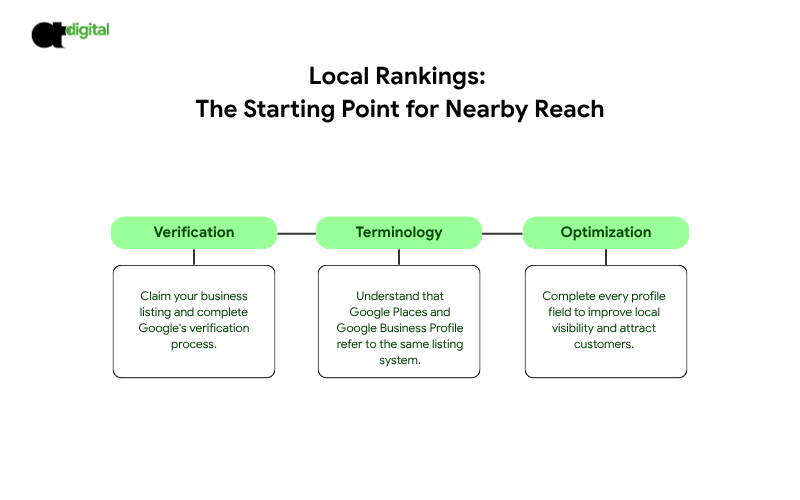
Everything in this guide sits on top of one listing: your Google Business Profile, still commonly searched as GMB (Google My Business, its former name). If this isn’t claimed, verified and complete, nothing else here will work.
How to Add Your Business to Google
If you haven’t claimed your listing yet, the process is straightforward: search for your business name on Google, click “Claim this business” or go directly to google.com/business, and complete verification, usually by postcard, phone or email, depending on your business type. Once verified, Google confirms you’re authorized to represent the business, which is the baseline trust signal everything else builds on.
Google Places vs. Your Business Profile: Same System, Different Name
If you’re searching “Google Places SEO,” you’re looking for the same system. Google Places was the old consumer-facing name for what eventually became Google Business Profile. The listing, the Map Pack placement and the ranking factors are all the same system under one current name.
Completing the Profile That Actually Converts
A claimed listing isn’t a finished listing. Fill in every field: accurate categories (primary and secondary), complete hours including holiday exceptions, your service area if you don’t have a storefront, photos, and a description using the language your customers actually search with. Incomplete profiles are explicitly less likely to show up in local results, straight from Google’s own guidance.
NAP Citations and Business Citations: The Trust Layer
Once your profile is solid, the next layer is consistency across the rest of the web.
What Are NAP Citations, and Why Do They Matter?
A citation is any online mention of your business Name, Address and Phone number, usually on a directory, industry listing or review site, whether or not it links back to you. NAP citations work as a trust signal: when your information matches exactly across dozens of sources, Google treats your business as a verified, stable entity. Bright Local’s research on local citations consistently finds inconsistent NAP data among the most common local SEO problems it finds in audits. When “Suite 100” on one site becomes “Ste. 100” on another, that inconsistency erodes the prominence signal your rankings depend on.
Local Citation Building: Where to Start
You don’t need hundreds of citations to make progress. Prioritize in this order:
- The major data aggregators that feed dozens of smaller directories (these vary by country, but getting your NAP correct here cascades outward).
- Industry-specific directories relevant to your field, a bar association directory for a law firm, a trade association listing for a contractor.
- General business directories with real domain authority.
- Local directories tied to your specific city or region.
Audit your existing business citations first. A single wrong phone number sitting on an old directory can quietly undermine months of other local SEO work.
Is Your NAP Data Consistent Everywhere That Matters?
We find and fix the citation inconsistencies that are confusing Google about who and where you actually are.
Geotargeting: How the 5-Mile Radius Actually Works
Geotargeting is the practice of tailoring your visibility and content to a specific geographic area, and it’s the mechanism behind that “distance” ranking factor Google describes. Understanding it changes how you think about local SEO entirely.
Here’s the part most business owners miss: your local visibility isn’t a fixed circle you can simply widen with more effort on your main page. It fades gradually with distance from your listed address, and relevance and prominence can extend or shrink that radius for specific searches. A business with exceptional reviews and a tightly optimized profile might surface for searchers eight miles out. A thin, generic profile might only surface two miles from its own front door, which is exactly what’s happening to Ravi’s under-optimized neighbor above.
This is precisely why our pillar guide describes an “algorithmic geofence”: the radius isn’t something you request from Google. It’s something you earn, search by search, through the strength of the three factors above. Search Engine Land’s analysis of a 2021 Google local update found the distance signal carries real, shifting weight in the algorithm, not a fixed rule you can game once and forget.
Multi-Location SEO: Targeting More Than One 5-Mile Circle
If you operate in more than one city or neighborhood, multi-location SEO means treating each location as its own hyperlocal campaign, not one page with a list of cities bolted on.
The mistakes to avoid:
- One generic “service areas” page listing 20 cities. This reads as thin content to both searchers and Google, and it rarely ranks for any single one of those cities.
- Duplicate location pages with only the city name swapped. Generic, copy-pasted content is one of the fastest ways to undermine your own rankings across every location at once.
- A single Business Profile for multiple addresses. Each physical location needs its own separate, verified profile.
What works instead: a dedicated page per location, with genuinely local content, that location’s own reviews highlighted, local service details, and (where relevant) local business seo services considerations specific to that market’s competition. Each location is its own 5-mile radius with its own competitors, and it needs to be treated that way.
Managing Visibility Across More Than One Location?
We build and optimize dedicated profiles and pages for every market you operate in, not one generic page trying to cover them all.
Running a Local SEO Audit: What to Check First
Before spending on local online marketing, know what’s actually broken. A local SEO audit typically checks:
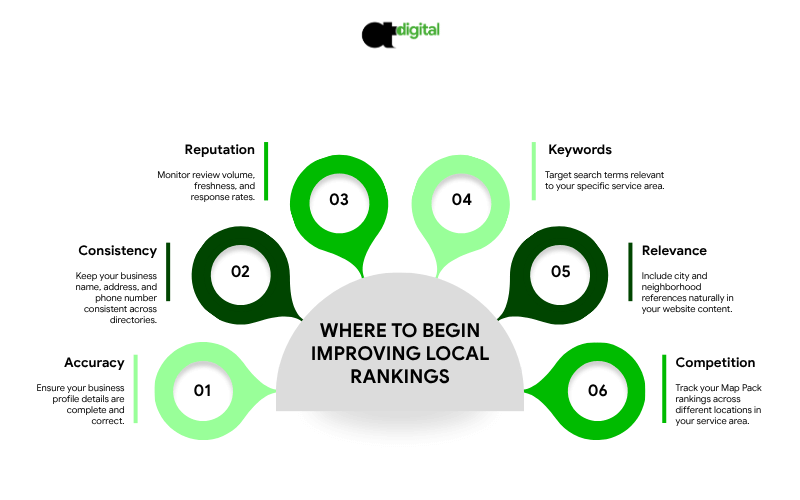
- Profile completeness and accuracy across every field in your Business Profile
- NAP consistency across your top citations
- Review volume, recency and your response rate
- Local SEO keyword research, confirming you’re targeting the terms your specific area actually searches, not generic national terms
- On-page local signals, like city and neighborhood names appearing naturally in your content, not stuffed in
- Your competitive position in the Map Pack for your core terms, measured from multiple points across your service area, not just your office address
That last point matters more than most businesses realize. Your ranking isn’t one number. It’s different at every point across your radius, which is exactly why a single “am I ranking?” check from your own office tells you almost nothing about how you look from three miles away.
Local SEO Pricing: What to Expect From Companies and Packages
If you’re comparing local SEO companies, researching local SEO pricing, or evaluating local SEO packages, a few things are worth knowing before you sign anything.
Pricing varies enormously by scope. A single-location audit and cleanup is a different investment than ongoing multi-location management across ten markets. Be wary of any local SEO expert or agency quoting a flat price without first reviewing your current citations, reviews and competitive landscape.
What a solid package should include, at minimum:
- Full Business Profile optimization and ongoing management
- Citation audit and cleanup
- A structured review generation system
- Monthly reporting tied to rankings, calls and direction requests, not just “visibility” scores
Red flags when evaluating local SEO agencies:
- Guarantees of a specific Map Pack position (nobody can promise this, including Google itself, per its own guidance)
- No mention of citation consistency or NAP auditing
- Pricing with no explanation of what’s actually being done each month
If you’d rather have this built and managed for you, see our local marketing agency services.
The Verdict: Your Radius Is Earned, One Signal at a Time
Here’s the uncomfortable truth behind every keyword in this guide: there is no single fix for hyperlocal visibility. Not a better website, not more ad spend, not one perfect blog post. Your 5-mile radius is the compounding result of a complete profile, consistent citations, a steady flow of recent reviews, and content that actually speaks to your specific area, all reinforcing each other at once.
Go back to Ravi and his neighbor. The difference between them wasn’t luck, location or even a bigger budget. It was 140 reviews versus 9, and a complete profile versus a bare one. That’s the whole game, and it’s entirely available to the business two doors down from you right now, if they bother to build it before you do.
Somewhere within five miles of your business right now, a customer is searching for exactly what you offer, and the three businesses Google shows them were decided by the fundamentals in this guide, not luck. Our hyperlocal audit plots exactly where your visibility starts and stops across your service area, and shows you which of these levers to pull first. Book it now, and stop losing customers to competitors who simply built the foundation you haven’t yet.
Find Out Exactly Where Your Visibility Ends
Strategic geo-grid analysis. Pure mathematics. No sales scripts.