
Build Your Growth Stack

Confirm or adjust your services and enter your details.

Please select at least one service.
First name is required.
Last name is required.
Please enter a valid email address.

Tag: Google Map Pack

  • The Neighborhood Monopoly: Engineering Local Dominance in 2026

    The Neighborhood Monopoly: Engineering Local Dominance in 2026

    THE PROXI|MITY PARADOX

    [THE LOCAL AUDIT]

    MetricImpact FactorMathematical Reality
    Search Intent46.0%Nearly half of all daily global queries are hyper-localized extraction attempts.
    Conversion Velocity76.0%High-intent local searchers visit a physical location within a 24 hour window.
    The Invisible Filter50.0%Half of your market reaches a decision in the Map Pack without ever visiting a website.

    The Great Signage Delusion

    There is a massive strategic delusion currently infecting business owners and the leadership of small businesses alike. Many local businesses believe that their physical storefront, their expensive signage, or their prominent street address is enough to capture the market.

    They operate under the assumption that if potential customers are walking past their building, they will inevitably walk through your door to initiate the commercials. In reality, foot traffic is a failing metric if you are digitally invisible.

    This is an antiquated, high-risk hallucination.

    In the modern landscape, that customer is not looking at your sign. They are looking at their smartphones. Even as they stand ten feet from your entrance, they are conducting a silent, brutal digital audit. They are comparing your physical proximity against the digital authority of your competitors.When a prospect initiates a high-intent search for digital marketing services near me, they are not looking for a directory; they are looking for immediate authority. If you do not dominate these local search results, that customer will walk past your door and into the office of a competitor simply because that competitor appeared first on their screen.

    The Digital Glass Barrier

    Proximity without visibility is a corporate liability. You are paying premium rent for foot traffic that has already been digitally intercepted before they reached your sidewalk.

    While you rely on the luck of someone looking up from their device, your competitors are using geospatial engineering to bring people away from your storefront. A system that successfully brings customers to you must be optimized for the specific people searching for solutions within your immediate radius.

    At AtheosTech Digital, we view local dominance as a game of mathematical extraction. We do not believe in “participating” in the local economy; we believe in monopolizing it. If you are not the first, second, and third option presented to a prospect, you are effectively invisible. At AtheosTech Digital, we view local dominance as a game of mathematical extraction. This briefing outlines the architectural requirements to dominate a local market​ and stop the catastrophic leakage of capital to your more visible competitors.

    THE DIGITAL DOORSTEP

    (The New Physical Reality of a Digital Marketing Service)

    In the modern economy, the “door” to your business is no longer made of wood or glass. It is a digital listing. The references for modern local marketing are clear. If your marketing approach does not treat the digital listing as the primary filter for all commerce, you are operationally invisible.

    The data for 2026 local marketing is absolute: the buyer’s journey begins long before a prospect reaches your sidewalk. Whether you are architecting digital marketing for professional services or running a rural retail store, your digital doorstep is the primary filter for all local commerce.

    Outdated marketing strategies that ignore the digital doorstep ensure the customer never arrives at your physical location. They have already “entered” the business of a competitor who understood that digital proximity is the only proximity that matters.

    The Rent-to-Revenue Disconnect

    As we established in our foundational master guide Digital Darwinism 2026: The Mathematics of Survival in a Revenue-Driven Economy, visibility is the only metric that precedes revenue. In a local context, invisibility is not just a marketing failure; it is a terminal operational condition.

    While many executives discuss the broad benefits of local SEO as a general marketing perk, we view it as the fundamental infrastructure required to prevent your physical rent from becoming a total loss.

    You are essentially paying premium rent for a physical location while failing to deploy the digital marketing services required to harvest the actual digital traffic from your own street.

    If a prospect standing on your corner cannot find your verified Map Pack listing within three seconds, you do not exist to them. You are subsidizing the neighborhood while more agile, digitally-focused firms extract the capital from the very air around your building.

    At AtheosTech Digital, we do not build “listings”. We engineer digital fortifications. We ensure that your digital doorstep is the most prominent, most authoritative, and most efficient entry point in your entire postal code.

    THE PROXIMITY PARADOX

    (Being Close But Invisible)

    In the high velocity economy of 2026, distance is measured in milliseconds, not miles. Physical proximity is a worthless metric if it is not backed by digital dominance.

    If a prospect is within a five mile radius of your business and searches for your exact service, there are only three spots that matter: the Google Local Map Pack. If you are not in one of those three positions, you are a ghost. You are operating in a measurement void while your own neighbors are being systematically redirected to your competitors by the very devices in their pockets.

    Executives often overlook the technical reality of how to dominate local search, mistakenly believing that physical proximity is a sufficient moat. In the high velocity economy of 2026, distance is measured in milliseconds, and if you are not in the top three results, you do not exist.

    The Risk-Averse Consumer

    The modern consumer has been conditioned to avoid risk at all costs. They no longer “try out” local businesses based on visual appeal or a nice storefront; they verify them with clinical precision. Even if a customer knows exactly where your office is located, they will search for your brand to check your current operational status, your peak hours, and your Trust Architecture.

    This is the localized version of the “Algorithmic Hijack” we dissected in The Referral Illusion: Why Word of Mouth Cannot Scale a Business in 2026.

    When a prospect searches for you and finds a superior, more communicative listing belonging to a competitor three blocks away, the hijack is complete. You have done the hard work of existing in the real world, but your competitor has harvested the digital intent.

    The Friction Penalty

    If your local listing is incomplete, lacks high velocity review growth, or features outdated imagery, the customer experiences immediate psychological friction. They do not walk in. They keep walking.
    By failing to maintain a high performance digital doorstep, you have just paid the “Invisible Tax” we detailed in Your Store is Open, But is Anyone Watching? The Cost of Digital Invisibility. Invisibility in your own neighborhood is not a missed opportunity; it is an active financial penalty that you pay every single hour your doors are open.

    HYPER-LOCAL EXTRACTION

    (Engineering the Map Pack via Hyperlocal Marketing Services)

    To solve for how to dominate local SEO, you must move beyond basic listings and address the specific local SEO ranking factors​ that govern the Map Pack algorithm. This is not an accident of geography; it is a result of specific technical engineering designed to capture every high intent search in your radius.

    In a high-velocity digital economy, you do not “hope” to be found; you engineer the extraction. To capture the capital walking past your door, your digital infrastructure must satisfy three strict, non-negotiable criteria.
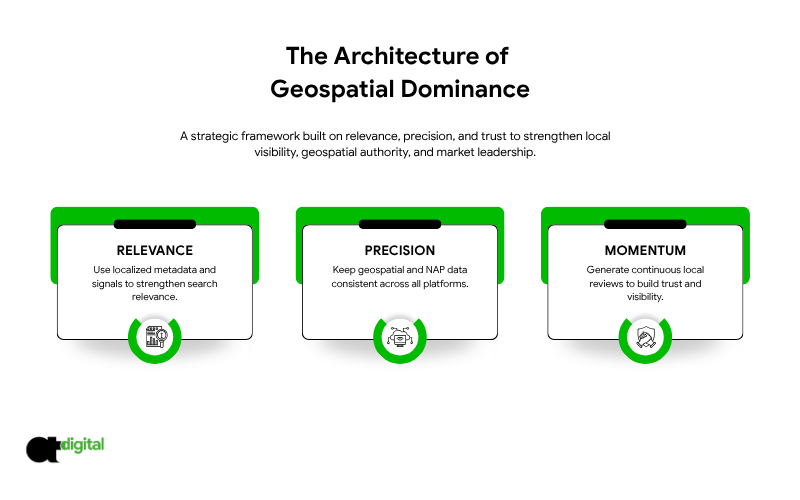
    The Three Pillars of Geospatial Dominance

    Relevance Architecture

    Your metadata must speak the dialect of the local search engine. Whether you are sponsoring a community event or hosting a specific local event, these signals must be digitally encoded to prove your active participation in the local community.

    It is not enough to say you are a “Lawyer”. You must be the “Commercial Litigation Expert in Downtown Chicago.” Your metadata and on-page signals must speak the dialect of the local search engine.

    Proximity Signal Optimization

    You must feed the algorithms the exact geospatial data points required to prove you are the most reliable solution in your specific coordinate set. This involves a rigorous synchronization of your Name, Address, and Phone Number (NAP) data across the entire digital ecosystem.

    Any inconsistency is interpreted as operational instability by the algorithm, leading to an immediate ranking penalty. This technical precision becomes even more critical when managing local SEO for multiple locations, where the geospatial data must be perfectly synchronized across several territories to prevent brand dilution.

    Trust Velocity

    A static google business profile is a dead asset. You need a systematic mechanism to generate fresh, localized proof through consistent customer reviews. Frequent, high-intent feedback signals to the Map Pack that you are the current market leader.

    The Real Estate Liability

    Without these three pillars, your physical location is an active liability. This is especially critical when deploying digital marketing services for startups, where every localized lead is a vital component of early traction and market validation.

    At AtheosTech Digital, we do not build “profiles”. We engineer neighborhood monopolies. We ensure that when the moving capital in your radius reaches for a smartphone, your business is the only logical and visible destination.

    CONCLUSION: THE TERRITORIAL MANDATE

    At AtheosTech Digital, we do not believe in sharing the local market; we believe in dominating it. If you maintain a physical presence, you have a mathematical obligation to capture every single high-intent search within your radius.

    Your physical signage is a tool for the 1990s, but your Local Map Pack ranking is your primary storefront for 2026. It is time to stop viewing digital marketing services for small business as an optional expense and start seeing them as the infrastructure of territorial survival.

    It is time to stop letting customers walk past your door and start pulling them in through their screens. AtheosTech Digital operates as the best local SEO agency for firms that demand absolute territorial control and predictable revenue extraction.
    As we have demonstrated throughout this series, from the catastrophic Cost of Digital Invisibility to the fragile nature of The Referral Illusion, local success is an engineering problem. You are either the local monopoly or you are a geospatial ghost.

    This territorial mandate is a critical component of the survival architecture detailed in our master guide:

    [INTERNAL DIAGNOSTIC: THE LOCAL VISIBILITY TEST]

    Before we map out the commercials for your territorial dominance, your executive team must answer these strict diagnostic questions with absolute transparency.

    • If you search for your primary service while standing two blocks from your office, do you appear in the top 3 results, or is your competitor intercepting that lead?
    • Is your local listing providing enough high-velocity data to close the sale without the prospect ever needing to visit your secondary website?
    • How much capital did you lose today simply because a local buyer could not verify your operational credibility in under ten seconds?

    If you are not the first choice on the screen, you are the last choice in the real world. You are either engineering a neighborhood monopoly or you are funding one for your competition. Let us look at the mathematics of absolute local control.

    REQUEST YOUR LOCAL AUDIT

    (A technical review of your local search positioning and the sequence required to claim your territory.)
  • The Architecture of Local Dominance: Intercepting the ‘Near Me’ Search to Capture Regional Market Share

    The Architecture of Local Dominance: Intercepting the ‘Near Me’ Search to Capture Regional Market Share

    The Death of the “Customer Journey” (And the Rise of Interception)

    Let us abandon the outdated marketing concept of the “customer journey”. In the 2026 local economy, there is no leisurely journey. There is only a high-stakes interception.

    Consider a Manhattan corporate board dealing with a sudden data breach at 8:00 AM. Consider a logistics facility in Chicago whose commercial refrigeration just failed, risking a $200,000 inventory loss. Consider a political campaign in a contested Pennsylvania district requiring an immediate crisis management firm.

    These decision-makers do not download your whitepapers. They do not subscribe to your email newsletters. They completely bypass your meticulously crafted sales funnels. Instead, they pull out a smartphone and execute a ruthless, four-word query: “Emergency commercial IT near me”.

    This is the Zero Moment of Truth. The buyer has absolute intent, maximum urgency, and corporate capital ready to deploy immediately.

    The mathematics governing this exact moment are absolute and unforgiving:

    • The 24-Hour Conversion Window: According to 2026 behavioral search data, 78% of local mobile searches result in an offline purchase, a facility visit, or a direct phone call within 24 hours. * The “Zero-Click” Reality: The search landscape has fundamentally shifted. Current metrics reveal that roughly 60% of all Google searches now end without a single click to an external website. The high-value prospect reads your reviews, verifies your proximity, and taps “Call” directly from the search engine results page.

    The Brutal Mathematics of the Map Pack

    This brings us to the zero-sum reality of regional search visibility.

    If your corporate headquarters, retail storefront, or regional office is not positioned strictly inside the Google Map Pack (the top three local results), you are mathematically irrelevant to the searcher. You are a digital ghost in your own zip code.

    Consider the statistical cliff of local rankings. The Top 3 Map Pack results capture up to 50% of all local search clicks. Position number four is not a respectable second place. Position number four is a digital graveyard, experiencing a visibility drop of over 85%.

    When you fail to secure those top three positions, your competitor captures a massive six-figure contract or a critical bloc of foot traffic. They do not win because they possess a superior product, a sharper legal mind, or a better political platform. They win for one simple reason. They engineered a superior digital dragnet. They built a localized architecture specifically designed to intercept the buyer exactly when their wallet was open.

    This article breaks down the hard mechanics of Hyperlocal Dominance. We will move beyond basic directory listings and explore how to engineer your local infrastructure to convert digital visibility into physical movement and measurable revenue.

    THE MULTI-PLATFORM OPERATING SYSTEM

    (Your Digital Storefront is Not Just Google)

    Let us look at the anatomy of a massive operational failure. Most US executives treat their Google Business Profile (GBP) like a static digital billboard. They upload a corporate logo, type in their operating hours, and consider the job done.

    In 2026, this passive approach is borderline corporate negligence. Your local profiles are no longer directories. They are highly aggressive Lead Interception Engines.

    “Google Business Profile: The Most Underrated Sales Tool”

    The “Zero-Click” Interface Monopoly

    Why do your website analytics look stagnant while your competitors continue to expand? Welcome to the “Zero-Click” revolution. Google no longer wants users to visit your website. It has engineered the search results to ensure the transaction happens entirely on its own platform.

    Industry data reveals a brutal truth. Over 50% of local commercial searches now result in a zero-click conversion. The high-value prospect searches for your enterprise. They read your localized reviews. They check your integrated service menu. Then, they tap the “Call” button directly from the search results.

    Your expensive, custom-built website never even loads. If your GBP is not fully weaponized to close the deal on its own, you are bleeding high-intent revenue directly to your rivals.

    The iOS Blind Spot

    (Apple CarPlay & AI Integration)

    Now, let us uncover the blind spot that is actively draining your market share. Google is the largest landlord, but it is not the only one.

    In the United States, Apple iOS controls roughly 60% of the mobile market. This represents the highest-income demographic in the country. Millions of executives use iPhones. Millions of high-end vehicles run Apple CarPlay.

    When a CEO in a luxury vehicle presses a button and asks Siri for a “corporate tax attorney near me”, Siri does not check Google. Siri checks Apple Maps. Furthermore, Bing currently powers the local search queries for massive AI platforms like ChatGPT.

    If your digital team only optimizes for Google, you are systematically abandoning the most lucrative demographic in the nation.

    The Algorithmic Cross-Examination

    (Data Parity)

    The search engines do not just take your word for it. Google, Apple Maps, and AI bots run continuous, microscopic cross-examinations of your business data. They scan massive, hidden data aggregators like Data Axle, Foursquare, and Neustar. They are looking for one single metric. Algorithmic Trust.

    To achieve this trust, your Name, Address, and Phone Number (NAP) must be mathematically identical across every single platform on the internet.

    If your corporate address says “Suite 100” on Google but “Ste. 100” on a secondary legal directory, the machine flags a data conflict. In a zero-sum economy, a data conflict destroys trust. When the algorithm loses trust, your ranking immediately plummets. You vanish from the Map Pack, and your competitor intercepts your client.

    PART II: THE REPUTATION MULTIPLIER

    (Weaponizing Social Proof into Predictable Leverage)

    Let us look at the anatomy of a lost deal. You deploy thousands of dollars into a highly targeted digital campaign. The prospect sees your brand, understands your value proposition, and prepares to initiate contact. Then, they run a final background check on Google.

    They see your firm sitting at a 3.8-star rating. Right below you is a competitor boasting a 4.8-star rating with hundreds of detailed testimonials. The deal dies instantly. Your marketing budget just successfully funded your competitor’s acquisition.

    In the zero-sum arena of local search, your “Star Rating” is never just a vanity metric. It acts as a strict mathematical ceiling on your conversion rate, your pricing power, and your corporate authority.

    “Reputation Management: Turning 5-Star Reviews into Sales”

    The Psychology of the “Social Proxy” (Risk Mitigation)

    The modern American decision-maker uses online reviews as a direct proxy for professional competence and corporate risk mitigation. Whether they are hiring a logistics fleet or a specialized tax consultant, nobody wants to be the executive who hired a poorly rated vendor.

    • The Predictability Premium: A regional enterprise with a 4.8-star rating and 200 detailed reviews will mathematically out-convert a perfect 5.0-star business with only 5 vague reviews.
    • The market values high-volume predictability and historical data over the fragile illusion of perfection.

    Engineering the “Review Velocity” Loop

    Reputation management is not a passive customer service task. It requires a defensive, systematic operational loop engineered directly into your service delivery model.

    • The Recency Bias: Google’s local algorithm heavily prioritizes recency over legacy. Having 500 reviews from three years ago carries significantly less algorithmic weight than acquiring 10 fresh reviews this current month.
    • If your review velocity goes dormant, the machine assumes your business is either declining in market share or entirely defunct. You must build automated systems to capture positive sentiment at the exact moment of contract completion.

    Semantic Keyword Injection (The NLP Advantage)

    This is where reputation transcends public relations and becomes hard search infrastructure. Google utilizes advanced Natural Language Processing (NLP) to read and categorize the text within your reviews.

    • Algorithmic Feeding: When a high-ticket client leaves a review explicitly mentioning “flawless corporate tax consultation in Austin” or “rapid emergency server recovery”, the AI processes those exact phrases.
    • Your clients literally write your SEO content for you. They help you rank for high-value, long-tail search terms by feeding the algorithm the exact contextual data it craves.

    The Response Architecture

    A dominant local operation does not just collect reviews. They weaponize the replies. When an owner rapidly responds to a review, it signals active, responsive management to both the algorithm and future prospects. A strategic, professionally engineered reply can subtly inject secondary service keywords into the ecosystem, further reinforcing the semantic relevance of the entire digital profile.

    HYPERLOCAL ARCHITECTURE

    (Breaching the Algorithmic Geofence)

    Let us establish a brutal technical reality. Optimizing your basic Google profile is a defensive maneuver. It protects your immediate block. However, if you want to capture market share in the wealthy suburbs, the adjacent commercial districts, or the neighboring swing counties, you face a massive mathematical problem.

    Google places an invisible digital cage around your physical address. We call this the Algorithmic Geofence.

    If your corporate headquarters is in downtown Houston, the algorithm naturally restricts your high-intent visibility to a tight 2-mile radius. If a massive enterprise client sits 8 miles away and searches for your exact service, you are invisible. To breach this geofence and digitally occupy territories where you do not physically exist, you must build heavy, proprietary website infrastructure.

    This is where basic marketing dies and true Search Engineering begins.

    URL Node Architecture (Weaponizing “City Pages”)

    Most agencies attempt to solve the radius problem by slapping a list of fifty cities onto a single “Service Areas” webpage. The Google algorithm identifies this as spam and instantly ignores it.

    To dominate a neighboring territory, you must build what we call Digital Forward Operating Bases. These are highly structured URL silos engineered for a specific zip code or district.

    • The Architecture: Instead of a generic page, you create a distinct, high-performance node. For example: yourdomain.com/tx/houston/commercial-litigation/.
    • The Payload: This page cannot just be copied text with the city name swapped out. It must be injected with hyper-localized data. It requires geo-tagged project images from that specific neighborhood, localized case studies, and an embedded, interactive map pinpointing your exact operational history in that specific zip code. You are proving to the algorithm that you own this territory.

    Spatial Data Engineering (Advanced JSON-LD Schema)

    Search engine crawlers do not read your marketing copy. They read your backend code. If you want to force the algorithm to rank you in a specific perimeter, you must speak its native language using Advanced Schema Markup.

    This is not a plugin. This is raw JavaScript Object Notation (JSON-LD) hardcoded into your site architecture.

    • Coordinate Injection: We explicitly define your entity using the LocalBusiness schema protocol. We inject your exact latitude and longitude coordinates into the code.
    • Polygon Mapping: We utilize the areaServed and hasMap properties to define the exact geographical polygons your business covers. When the algorithm crawls this code, there is zero ambiguity. You are handing the machine a mathematically perfect map of your corporate territory.

    The Digital Moat (Localized Algorithmic Endorsements)

    You can build a flawless website architecture, but the Google algorithm demands aggressive third-party validation before it hands you a local monopoly. In the SEO industry, we call this Digital Neighborhood Authority.

    You must acquire localized backlinks. However, we do not want generic internet links. We want hyper-local digital endorsements.

    • The Strategy: When a regional trade association, a local business journal, or a district Chamber of Commerce links back to your domain, the algorithm tracks the geographical IP location of that referring domain.
    • The Result: It sees that the local digital ecosystem is pointing directly at you. This creates an impenetrable moat around your rankings. You transcend being just another vendor. You become a verified, structurally integrated pillar of the local economy.

    DETERMINISTIC ATTRIBUTION

    (Tracking Physical Movement and Boardroom ROI)

    Let us address the most critical flaw in the modern marketing industry. Marketing agencies sell “impressions”, “reach”, and “pageviews”. A Chief Financial Officer cannot deposit an impression into a corporate bank account.

    At AtheosTech Digital, we do not track vanity metrics. We track physical corporate movement, highly qualified phone calls, and closed revenue. If you cannot mathematically prove that a digital search resulted in a physical visit to your office or a signed contract in your boardroom, your digital strategy is just expensive guesswork.
    We solve this through the science of Navigational Intent and Closed-Loop Attribution.

    The GPS Trigger (Direction Requests)

    When a high-value prospect interacts with your Google Business Profile or Apple Maps listing, we monitor a very specific digital action. We track the exact volume of users who click the “Get Directions” protocol.

    This is not a casual interaction. When a user clicks this button, they are actively engaging their mobile GPS or vehicle navigation system to map a physical route to your exact coordinates. This is the ultimate, undeniable indicator of localized foot traffic intent. We track this metric to show you exactly how many competitors’ clients we diverted directly to your front door.

    Session-Level Telephony (Dynamic Call Tracking)

    In the B2B enterprise sector, high-ticket retail, and political campaigning, deals are rarely closed via an automated web form. They are closed through direct, high-stakes phone conversations.

    We deploy a specialized infrastructure called Dynamic Number Insertion (DNI) across your entire digital footprint. When a regional prospect calls your headquarters, we do not just record the call. We trace that exact phone interaction directly back to the specific “Near Me” search query they typed, the exact digital node they were viewing, and their precise geographical location. We show your sales team exactly what the prospect was searching for before the phone even rings.

    Offline Conversion Syncing (The CFO Dashboard)

    This is the apex of revenue engineering. A top-tier Map Pack ranking is useless if it does not translate into a signed contract. We eliminate the disconnect between your digital marketing data and your actual sales floor.

    We architect a secure API bridge between the search engine data centers and your internal CRM system, such as Salesforce or HubSpot. When your regional director signs a $100,000 contract or secures a massive local procurement deal, your CRM instantly feeds that offline conversion data back to the algorithm.

    This creates a flawless, closed-loop reporting environment. It allows your executive board to definitively prove that a specific local search click on a Tuesday directly generated hard revenue in your boardroom on a Friday.

    CONCLUSION: THE ZERO-SUM REALITY OF LOCAL DOMINANCE

    (Dominate the Grid or Be Displaced)

    In the architecture of regional commerce and political influence, there is no participation trophy. The local search ecosystem operates on a brutal, zero-sum framework.

    You are either entrenched within the Top 3 Map Pack and capturing the absolute majority of the market share, or you are entirely irrelevant. There is no middle ground. If you are not intercepting the demand, you are actively funding your competitor’s expansion by yielding your own territory to them.

    Every single day your executive team delays the deployment of localized search engineering, you create a digital vacuum. Your rivals are systematically building their digital moats and filling that exact void. You are not simply losing a vanity ranking on a mobile screen. You are actively bleeding high-margin enterprise contracts, critical constituent votes, and highly lucrative physical foot traffic that is originating from the exact same zip code as your regional headquarters.

    The algorithmic geofence is already drawn. The only question is whether you are locking your competitors out, or if they have already locked you in.

    Own your district. Or someone else will.

    INTERNAL DIAGNOSTIC: THE GEO-GRID AUDIT

    Are you a digital ghost in your own target district?

    At AtheosTech Digital, we do not guess. We measure mathematical reality. We perform Engineering-Grade Hyperlocal Audits to plot exactly where your organization ranks in the Google Map Pack across a 10-mile radius, block by block and street by street.

    We identify the exact geographical blind spots where your infrastructure fails and your competitors are actively intercepting your revenue.

    Strategic Geo-Grid Analysis. Pure Mathematics. No Sales Scripts.