Two founders. Same $3,000 budget. One runs an emergency plumbing company, the other sells handmade candles.
Swap their platforms and both lose money, and neither will understand why. The plumber’s customer was searching. The candle buyer was scrolling. Google and Meta are built for two completely different moments, and most wasted ad spend starts with treating them as interchangeable.
This guide is for owners and marketing leads deciding where their first (or next) ad dollars should go. You’ll get 2026 benchmark data from both platforms, a cost-per-customer test that changes the answer for some industries, and a 60-second decision at the end. For the deeper strategy behind wasted spend, read our pillar guide, The Ad Waste Audit.
Google Ads or Meta Ads: Which Advertising Platform Fits Your Business?
Choose Google Ads when people already search for what you sell, like emergency repairs, legal help or B2B software. Choose Meta Ads when your product is visual, impulse-friendly or new, so nobody is searching yet. Most businesses start with one of these advertising platforms, then add the other for retargeting.
Not sure which camp you’re in? The next few sections show you how to tell, using real numbers.
Not Sure Which Platform Deserves Your Budget?
We review your market, competitors and margins, then tell you which platform to fund first and what to expect.
Intent vs Interruption: The Core Difference Between These Advertising Platforms
Google Ads meets people who are already searching. Someone types “emergency HVAC repair near me” or “project management software for agencies” and you pay to appear at that moment. Meta Ads (Facebook and Instagram) meet people who are scrolling. Nobody opens Instagram planning to hire an accountant. You interrupt the feed with something interesting enough to earn attention.
Here is how the two compare in 2026, using median figures from WordStream’s benchmark reports:
Source: WordStream’s 2026 Google Ads benchmarks (13,474 US search campaigns) and 2026 Facebook Ads benchmarks (452 leads campaigns, so treat Meta figures as directional).
On paper, Meta wins on cost: less than half the price per lead. So why doesn’t everyone just use Meta?
Why a Cheaper Lead Isn’t Always a Cheaper Customer
Because a lead from a search and a lead from a feed are not the same lead. Someone who searched “dentist near me” has a problem today. Someone who tapped a lead form while scrolling might be curious. That difference shows up in your close rate.
Here is an illustration. Suppose Google leads close at 20% and Meta leads at 10%. The close rates are my assumptions, so replace them with yours. Using WordStream’s 2026 cost per lead by category:
| Category | Google cost per lead | Meta cost per lead | Cost per customer: Google (20% close) | Cost per customer: Meta (10% close) | Winner |
|---|---|---|---|---|---|
| Dentists | $72.97 | $61.56 | about $365 | about $616 | |
| Home services | $90.92 | $42.95 | about $455 | about $430 | Toss-up |
| Real estate | $102.51 | $13.74 | about $513 | about $137 | Meta |
Same two platforms, three different answers. That is the point: compare cost per customer, not cost per click or cost per lead. Run this math with your own close rates before you spend a dollar
Match the Advertising Platform to Your Business Model
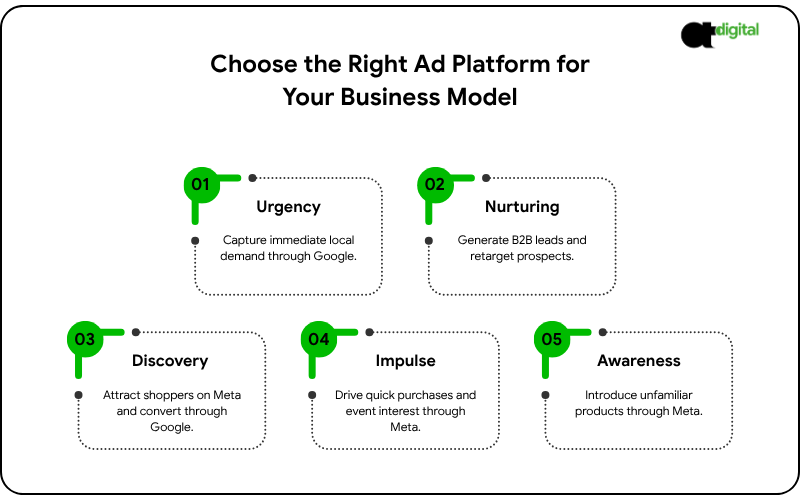
Local and Emergency Services: Start With Google
Sam runs an emergency HVAC company, and his customers search from a cold house. Home services cost about $90.92 per lead on Google, so $3,000 buys roughly 33 calls and form fills. Meta can support him later with reviews and reminders, but the first dollar belongs where the urgency is. Strong local visibility helps too: see our guide to local search dominance.
B2B and High-Ticket Services: Google to Capture, Meta to Nurture
Omar sells B2B software with a 60-day sales cycle. Buyers search for solutions on Google, so that’s where he captures demand. But most visitors won’t convert on the first visit, and that’s where Meta (or LinkedIn) earns its place: retargeting people who’ve already seen his site with a case study or an audit offer.
Ecommerce and Visual Products: Meta to Discover, Google to Close
Lena sells handmade candles. Nobody searches for “candle that smells like a rainy forest” until they’ve seen one. Meta puts the product in front of people who didn’t know they wanted it, and Google Shopping plus branded search then capture those who go looking afterward. If you also sell through large retail sites, marketplace advertising is a separate channel with its own economics. See our eCommerce marketing services for how to connect them.
Low-Consideration Purchases and Events: Meta
For restaurants, events and impulse buys, attention is cheap and decisions are quick. WordStream’s data shows restaurants pay $2.05 per click on Google but $0.45 on Meta traffic campaigns. When the customer doesn’t need to think long, paying four times as much for a search click rarely makes sense.
New Categories Nobody Searches For: Meta
If people don’t yet search for what you sell, Google has no demand to capture, no matter how much you spend. That is a Meta problem, and it often needs a strong offer to work.
Three Tests Before You Spend a Dollar
1. The demand test. Search your main service terms in Google’s Keyword Planner. Steady monthly searches mean Google can scale you. Almost none means Google can’t create demand. Then look at your competitors: the Meta Ad Library and Google’s Ads Transparency Center show which ads they’re running and for how long. An ad that has run for months is a decent (not perfect) signal that it pays for itself. Neither tool shows their spend or results.
2. The economics test. Work backward from what a customer is worth. Illustration: you can spend $400 to win a customer and you close 20% of leads, so you can afford $80 per lead. At Google’s 8.18% average conversion rate, your maximum affordable click is about $6.54. The average $5.42 works. Legal advertisers paying $9.87 per click would lose money at those numbers.
3. The capacity test. Google rewards keyword discipline and a strong landing page. Meta rewards a steady supply of fresh creative and enough volume: Meta’s own guidance points to roughly 50 optimization events in a 7-day window for an ad set to leave its learning phase. At $27.39 per lead, that is about $1,370 a week per ad set. On a small budget, that means one focused ad set, not five.
What Good Ads Look Like on Each Platform
A few Google Ads examples and Meta contrasts make the difference concrete.
Google search ad: matches the query directly.
Emergency HVAC Repair in [City] | 24/7 Same-Day Service | Licensed and Insured | Call Now for a Free Quote
The searcher wants a fast solution, so the ad answers immediately.
Meta ad: earns attention first, then makes an offer.
A 20-second video: “3 signs your furnace will fail this winter.” Below it: “Book a free pre-season inspection.”
The viewer wasn’t looking for an HVAC company. The ad gives them a reason to care.
Running Ads Without Wasting the Budget: How to Sequence Your Spend
The most common budget mistake is spreading a small budget across every platform. Try this:
- Start with one platform that matches your business model.
- Get to steady conversions before adding anything.
- Add the second platform in a supporting role, usually retargeting people who visited from the first.
- Judge both by cost per customer, and connect ads and sales data so you know which platform actually closes deals. Conversion tracking (including Meta’s Conversions API and server-side tracking) is covered in our pillar guide.
Then plug the leaks:
- On Google, the leak is irrelevant searches. Build a negative keyword list on day one and review your search terms weekly.
- On Meta, the leaks are creative fatigue and constant edits that keep restarting the learning phase. Refresh creative on a schedule, and test one change at a time.
- On both, the leak is a landing page that doesn’t match the ad. A great advertisement of your business sent to a generic homepage wastes the click. If yours is slow or vague, our website design and development services can fix it.
Want Specialists to Run This for You?
We choose the platform, build the campaigns, track cost per customer and cut the waste, so your budget goes where buyers are.
How to Choose Google PPC Management and Ad Management Services
If you hire help, whether Google PPC management or a firm offering professional search engine marketing services, ask before you sign:
- Do they build a strategy per platform, or copy one approach across all of them? Copy-paste strategy is a red flag.
- Who owns the ad accounts and data? It should be you.
- How do they report? Look for leads, customers and cost per customer, not just clicks and impressions.
- What do Google ad management services fees cover, and does ad spend come out of the same budget?
Be cautious of anyone who guarantees a specific return before looking at your economics. To handle Google and Meta as one system, see our PPC management services and social media marketing services.
The Verdict: Pick Your Platform in 60 Seconds
Answer three questions honestly:
- Do people already search for what you sell? (Try it. Check the Keyword Planner.)
- Is your product visual, impulse-friendly or new to the market?
- Does your economics work? Divide your category’s cost per lead by your close rate. That is your cost per customer. Can a customer’s profit cover it?
Now read your result:
- Yes to 1: start with Google. Put most of your budget into search ads on your best buyer keywords. Add Meta retargeting once you have steady site traffic.
- No to 1, yes to 2: start with Meta. Lead with a strong offer and fresh creative on one focused ad set. Add Google for branded and shopping searches once demand appears.
- Yes to both (typical for ecommerce): Meta to discover, Google to close. Start with Meta for reach, then capture the people who search for you afterward.
- Long sales cycle (typical for B2B): Google to capture, Meta or LinkedIn to nurture. Retarget site visitors with proof, not the same ad.
- No to 3: don’t start with ads yet. Fix your offer, margins or landing page first. Ads make a broken funnel expensive faster.
One line covers all of it: Google harvests demand that already exists. Meta creates demand that doesn’t yet. Pick the one that matches how your customers buy, and judge it on cost per customer, not cost per click.
Every week you run the wrong platform, you are paying to reach the right people in the wrong mindset. Our ad platform audit compares your market, competitors and margins, and shows exactly which platform to fund first and what a customer should cost you. Book it before you spend the next dollar, and put your budget where buyers actually are.
Which Platform Should Get Your Next Dollar?
Engineering-grade account analysis. Pure mathematics. Zero sales scripts.