Build Your Growth Stack

Confirm or adjust your services and enter your details.

Please select at least one service.
First name is required.
Last name is required.
Please enter a valid email address.

Tag: Digital Marketing

  • The Landing Page Trap: How a Bad Page Turns Your Best Ad Into a Wasted Click

    The Landing Page Trap: How a Bad Page Turns Your Best Ad Into a Wasted Click

    Then the visitor lands, and they bounce in four seconds flat. Not because your ad lied. Because the page it sent them to had nothing to do with what they just clicked.

    This is the landing page trap, and it’s one of the most expensive, least-diagnosed leaks in paid advertising. Agencies love to report on impressions and click-through rate because those numbers almost always look good. What they rarely show you is the page those clicks landed on, and whether it was built to close or just built to exist. This guide shows you exactly what separates a page that converts from one that quietly burns your ad budget. It’s the practical companion to our pillar guide, The Ad Waste Audit, which covers the full system behind wasted spend.

    What Is the Landing Page Trap, and Why Do Great Ads Fail on Bad Pages?

    The landing page trap is sending paid traffic to a generic page instead of a dedicated one built for that exact ad. A visitor who clicks a specific offer expects a page that continues that exact message. Send them to your homepage instead, and they have to hunt for what they came for, so most just leave.

    The rest of this guide breaks down exactly what a page needs to finish that job, and how to know if yours is failing.

    Is Your Landing Page Losing the Clicks You’re Paying For?

    We audit your current landing pages against message match, load time and conversion best practices, and show you exactly what’s costing you.

    Get My Landing Page Audit →

    The Homepage Mistake: Why “Just Send Them to Our Site” Fails

    Here’s the scenario that plays out thousands of times a day. Meridian Cybersecurity runs an ad for “Enterprise Cybersecurity Audits.” It’s a good ad, tightly targeted at IT directors with real budget authority, and it’s getting clicks. But every one of those clicks lands on Meridian’s homepage: a navigation bar, a mission statement, a careers link, and a generic “Our Services” dropdown somewhere in the mix. The visitor has a singular, high-urgency intent, and the homepage is answering a completely different question.

    Your homepage is built to orient a stranger to your whole business. A landing page is built to finish one specific conversation your ad already started. Conflating the two is the single most common reason conversion rate optimization best practices always start with the same instruction: never send paid traffic to your homepage. Meridian’s conversion rate on that campaign was sitting at 1.8%, well below what the keyword’s intent should have produced, and the team had no idea why until someone checked where the clicks were actually landing.

    Anatomy of a High-Converting Landing Page

    So what does a page that actually finishes the job look like? The anatomy of a landing page that converts comes down to a short list of non-negotiables, not clever design tricks.

    Message Match: The Rule Most Pages Break

    If your ad promises “Free 2026 Tax Planning Guide,” your headline needs to deliver exactly that, in roughly the same words, the instant the page loads. Any gap between what the ad promised and what the headline says creates a half-second of doubt, and doubt is where bounces come from. This single fix, matching your headline to your ad copy word for word, is consistently one of the highest-leverage changes you can make to landing pages that convert, and it’s a core finding behind the Nielsen Norman Group’s usability research on why visitors judge a page’s relevance within seconds of arrival.

    One Goal, One Page, No Exit Ramps

    A high converting landing page asks for exactly one action. Not “call us, download this, or follow us on social,” three competing calls to action that each dilute the others. Pick the single next step you want, and remove everything that offers an alternative path, including your main site navigation. Every link you leave on the page is an exit ramp away from the conversion you paid for.

    Bounce Rate vs. Exit Rate: What These Numbers Are Actually Telling You

    Before you can fix a landing page, you need to read its numbers correctly, and this is where most people mix up two different metrics.

    What is the bounce rate in SEO and analytics terms? It’s the percentage of visitors who land on a page and leave without taking any further action, viewing no other page, clicking nothing. For a landing page, a high bounce rate usually means a message match or relevance problem: people arrived expecting something the page didn’t deliver.

    Exit rate vs. bounce rate is the distinction worth knowing: exit rate measures how often a page is the last one in a session, regardless of how many pages the visitor viewed before that. A high exit rate on your “thank you” confirmation page is normal and expected. A high bounce rate on your landing page is a warning sign.

    What counts as a concerning number? There’s no single universal bounce rate benchmark or landing page bounce rate benchmark that applies everywhere, it varies by industry and traffic source, but a landing page bouncing well above 60-70% on paid traffic is usually telling you something is broken in message match, load speed, or mobile usability, not that your offer is bad. Meridian’s homepage, for what it’s worth, was bouncing paid visitors at 74%.

    How to improve bounce rate (and how to reduce bounce rate) on a paid landing page, in priority order:

    1. Fix message match between ad and headline first. This is almost always the biggest lever.
    2. Check your mobile experience specifically, since most paid traffic arrives on phones.
    3. Cut your page load time. Every extra second of waiting pushes more visitors to leave before they see anything.
    4. Remove navigation links and competing calls to action.

    Is Your Bounce Rate Telling You Something?

    We diagnose exactly why visitors are leaving, message match, speed or mobile friction, instead of guessing at a redesign.

    Diagnose My Bounce Rate →

    Conversion Rate Optimization Best Practices: The CPA Multiplier

    Our pillar guide makes a specific claim worth putting real numbers against: that lifting a landing page’s conversion rate from 2% to 4% cuts your cost per acquisition in half, without spending another dollar on ads. That math is simply true, and it’s why conversion rate optimization is often the highest-leverage lever available to a business already running ads, more reliable than trying to find cheaper clicks.

    For context on what you’re actually working against, Unbounce’s Conversion Benchmark Report, drawn from 57 million conversions across more than 41,000 landing pages, puts the median landing page conversion rate at 6.6% across all industries, though it varies sharply by sector: financial services pages convert at a median of 8.4%, while SaaS pages trail at 3.8%. If your page is sitting well below your industry’s median, that gap is where your CPA is quietly bleeding out.

    Here’s what that gap looked like for Meridian once the team built a dedicated page, matched the headline to the ad word for word, and stripped the navigation: conversion rate went from 1.8% to 5.1% on the same ad spend, same targeting, same bids. Same dollars in, nearly three times the qualified leads out.

    To increase website conversion rate and improve website conversion rate on a specific page, work through these in order of typical impact:

    • Tighten message match (covered above)
    • Shorten your form to the fewest fields that still qualify the lead
    • Add a single, clear, risk-reducing proof point (a guarantee, a specific result, a credible number)
    • Make your one call-to-action impossible to miss above the fold
    • Fix load speed, especially on mobile

    PPC Landing Pages vs. SEO Landing Pages: Do They Need to Be Different?

    Yes, and understanding why changes how you build each one.

    PPC landing page optimization and pages built for landing pages for Google ads specifically are built for one audience arriving in one mindset, often with a time-limited offer, and they’re allowed to be aggressively narrow and single-purpose, since every visitor arrives via the exact ad you control.

    Do landing pages help SEO? Generally, not much, and that’s by design. A true PPC landing page is usually set to no index, stripped of navigation, and built purely for conversion, none of which helps organic rankings. Google’s own guidance on thin content favors substantial, people-first pages for ranking purposes, which a tightly stripped PPC page deliberately isn’t built to be. If you want a page to rank organically, it needs internal links, broader on-page SEO structure, and content depth, elements that actively work against a tight, single-purpose PPC page. Trying to make one page serve both jobs well is how you end up with a page that does neither.

    Want a Page Built to Convert, Not Just Exist?

    We design, build and test dedicated landing pages matched to each campaign, so your ad spend doesn’t leak out through a generic page.

    Book My Landing Page Build →

    How to Test and Improve: A/B Testing, Tools and Analytics

    You shouldn’t be guessing which version of a page performs better. Landing page testing, specifically A/B testing for landing pages, is how you replace opinion with data.

    The basics of landing page split testing:

    • Test one variable at a time, a headline, a CTA button, a hero image, not a full redesign all at once, or you won’t know which change actually moved the needle.
    • Run the test long enough to reach a meaningful sample size before declaring a winner.
    • Start with the elements most likely to move conversion: headline and message match first, form length second, visual proof third.

    For landing page analytics and landing page analysis, track beyond the raw conversion rate: time on page, scroll depth, and where in the page people stop engaging all tell you where attention is being lost. Most major landing page optimization tools (your ad platform’s own landing page reports, your analytics suite, and dedicated page builders with built-in testing) surface these metrics without custom development.

    Dynamic landing pages, pages that automatically swap headlines or offer text to match the specific ad, keyword or audience that sent the visitor, take message match from a one-time fix to a systemized one. They’re worth the setup once you’re running more than a handful of campaigns at once, since manually building a unique page per ad doesn’t scale.

    Landing Page Copywriting: Say the One Thing They Came For

    Good landing page copywriting isn’t about clever lines. It’s about ruthless clarity. The visitor arrived with one question in mind, “can this solve my specific problem,” and every sentence on the page should move them closer to a confident yes.

    A simple structure that holds up across industries:

    1. Headline: restates exactly what the ad promised.
    2. Subheadline: adds the one detail that makes the offer credible (a number, a timeframe, a guarantee).
    3. Three to five benefit points: what changes for them, not a list of your features.
    4. One proof element: a testimonial, a stat, a case result.
    5. One call to action, repeated at the top and bottom of the page, worded identically both times.

    Cut anything that doesn’t serve one of those five jobs. A landing page is not the place for your company history.

    Common Landing Page Mistakes (That Are Easy to Fix)

    The recurring list of landing page mistakes we see most often, roughly in order of how much damage they do:
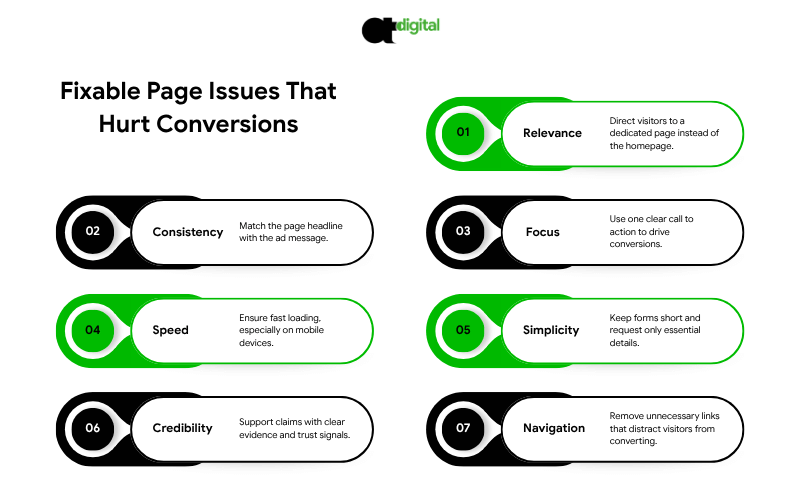
    • Sending traffic to the homepage instead of a dedicated page.
    • The headline doesn’t match the ad that drove the click.
    • Multiple competing calls to action diluting the one conversion you actually want.
    • Slow load time, especially on mobile, where most paid traffic lands first.
    • Forms with too many fields, asking for information you don’t actually need yet.
    • No proof element, nothing specific backing up the claim being made.
    • Full site navigation left in place, giving visitors an easy way to wander off before converting.

    Most pages have two or three of these at once, which compounds the damage rather than adding to it. Meridian had four.

    DIY vs. Hiring a Landing Page Optimization Agency

    You can fix the basics above yourself with a page builder and some discipline. Consider bringing in a landing page optimization agency, landing page optimization company, or an independent landing page optimization expert when:

    • You’re running multiple simultaneous campaigns and need dedicated pages for each, fast
    • You’ve fixed the obvious issues and conversion is still below your industry benchmark
    • You need proper A/B testing infrastructure, not guesswork
    • Your team doesn’t have the design or copywriting bandwidth to iterate quickly

    If you’re comparing landing page optimization services, ask any landing page optimizer you’re evaluating three things before signing: how they’ll measure success (conversion rate and cost per acquisition, not just “engagement”), whether they build dedicated pages per campaign or one reusable template, and how quickly they can turn around a new page when you launch a new ad. For a team that handles the ad account and the landing pages it feeds as one connected system, see our PPC management services.

    The Verdict: Your Ad Already Did the Hard Part

    Here’s the frustrating truth about the landing page trap: by the time a visitor clicks your ad, the expensive work is already done. You paid for the click, won the auction, and earned their attention for a few seconds. A broken landing page throws all of that away in the final step, the one that should have been the easiest to control.

    Meridian’s fix took a few weeks to build and test. It didn’t touch targeting, didn’t touch bids, didn’t add a dollar to the budget. It took the same traffic they were already paying for and nearly tripled what it produced. That’s the entire case for fixing this before anything else: run the math on your own numbers, and if lifting your conversion rate from 2% to 4% cuts your cost per acquisition in half, every dollar spent fixing the landing page makes every future ad dollar worth twice as much. Compare that to chasing cheaper clicks, which only ever buys you the same conversion rate at a slightly lower price.

    You don’t need a bigger ad budget to fix this. You need the page at the end of the click to finish the conversation your ad started. Our landing page audit checks your message match, load speed, mobile experience and form friction against what your industry actually converts at, and tells you exactly where your current pages are leaking budget. Book it before your next campaign sends another round of paid clicks to a page that isn’t ready for them.

    Stop Paying for Clicks Your Page Can’t Convert

    Engineering-grade account analysis. Pure mathematics. Zero sales scripts.
    Initiate My Forensic Ad Audit →

  • One Video, 20 Assets: The Content Repurposing Workflow That Saves Your Best Expert’s Time

    One Video, 20 Assets: The Content Repurposing Workflow That Saves Your Best Expert’s Time

    Not because they don’t care. Because writing isn’t their job, and every hour they spend drafting LinkedIn posts is an hour not spent closing the deal that actually pays the bills.

    Meanwhile, your content calendar has a hole in it again.

    There’s a better way to run this, and it doesn’t involve nagging your expert for “just one more blog post.” Record one strong conversation, then mine it for everything your channels need. This guide is the practical companion to our pillar guide, The Pre-Sold Prospect, which explains why founder-led authority shortens the sales cycle. Here we cover the mechanics: a repeatable content repurposing workflow, mapped out asset by asset.

    What Is a Content Repurposing Workflow, and How Does One Video Become 20 Assets?

    A content repurposing workflow turns one source recording into many formats for different channels. Record one 20-minute video, then extract: 1 article, 1 podcast, 3 short clips, 5 LinkedIn posts, 1 slide carousel, 3 quote graphics, 2 emails, 1 FAQ page, 1 lead-gen PDF and 1 sales one-pager. That’s 20 assets from 20 minutes of your expert’s time.

    The rest of this guide shows you how to record the source well, extract from it properly, and avoid the one mistake that turns repurposing into an SEO liability.

    Want This Workflow Built for You?

    We handle the extraction, formatting and distribution, so your expert only has to show up for 20 minutes.

    Get My Content Audit →

    Why This Works: The Case for Repurposing Over Constant Creation

    Two numbers explain why this approach is winning right now. Content Marketing Institute research found that 61% of B2B marketers plan to increase their video investment, and Wyzowl’s 2026 State of Video report puts video adoption among businesses at 91%. Everyone agrees video matters. Almost nobody’s founder has time to produce twenty pieces of it a month from scratch.

    Repurposing solves that gap. It works because different buyers consume differently: one reads a long article, another watches a 90-second clip, a third only sees the LinkedIn post before a sales call. Repurposing also respects something researchers keep confirming about attention. Vidyard’s analysis of nearly a million B2B videos found that clips under one minute hit a 65% completion rate, while videos over 20 minutes dropped to just 20%. And that pattern is shaping how B2B content gets made: the average B2B video length has compressed from 168 seconds in 2024 to about 76 seconds in 2026. Your one long source recording is exactly the raw material that trend rewards, once you cut it down.

    There is a limit worth naming honestly: repurposing multiplies whatever you start with. A vague recording produces 20 vague assets. Everything below depends on getting the source right first.

    Step 1: Record One Source Asset With a Real Point of View

    Skip “our company story.” Record your expert answering one question your buyers actually ask: why do most ad accounts leak money? or what should a small firm check before hiring an agency?

    A simple structure, not a script:

    • One core problem your audience recognizes
    • One clear position on how to solve it
    • Three to five key points, each with a specific example, number or story
    • One or two objections, answered directly

    Twenty minutes is enough. Longer recordings are harder to mine, not richer, and the completion-rate data above is exactly why: buyers reward density.

    Step 2: Transcribe and Extract

    Turn the recording into a transcript, then mark what’s reusable:

    • Strong claims that could stand alone as a post
    • Stories and examples that make a point memorable
    • Numbers and frameworks that translate into graphics or checklists
    • Questions and objections that become FAQ entries
    • Quotable sentences, short and self-contained

    This pass is where all 20 assets come from. You’re not rewriting the video; you’re mining it.

    Step 3: Map It Into 20 Assets

    Here’s a working breakdown from one 20-minute video.

    Asset Count Job it does
    Full video 1 Home base on your site and YouTube
    Podcast or audio version 1 Reaches people who listen instead of watch
    Long-form article 1 Captures search traffic, builds authority
    Downloadable checklist or diagnostic PDF 1 Captures leads for your CRM
    Short video clips (under 90 seconds) 3 Social reach and sales follow-up
    LinkedIn text posts 5 Daily visibility with your best ideas
    Slide carousel 1 Skimmable format for LinkedIn
    Quote graphics 3 Fast, shareable reinforcement
    Email newsletter issues 2 Reaches your existing list directly
    FAQ section or page 1 Answers questions for search and sales
    Sales one-pager or follow-up snippet 1 Arms your team before and after calls
    Total 20

    Not every business needs every asset. If your priority is pipeline, prioritize the PDF, clips and one-pager. If it’s search visibility, prioritize the article and FAQ.

    Repurposing Content for Social Media: Adapt, Don’t Copy

    Pasting identical text everywhere is spam with extra steps, not repurposing. Each platform rewards a different shape:

    • LinkedIn: a strong opening line, one idea per post, plain language. Carousels work well for frameworks and checklists.
    • Short-form video: vertical format, captions and a hook in the first three seconds. Cut clips around a single point, and keep them under 90 seconds if you want the completion-rate advantage the data above shows.
    • Email: one idea per issue, written as if to one person, with one clear next step.
    • Blog and site: structured headings, search-friendly wording and internal links.

    Keep the idea, change the shape. Someone who sees you on three platforms should feel reinforced, not repeated.

    Content Repurposing Examples

    A B2B consultancy founder records a 20-minute talk on why ad budgets leak. It becomes an article, five LinkedIn posts, three clips, a “10-point audit” PDF and two emails.

    A law firm partner answers the five questions clients ask most, on camera. Each answer becomes a short clip and an FAQ entry, and the full recording becomes a guide.

    A SaaS company turns a customer webinar into an article, a case study one-pager, a slide carousel and a follow-up email sequence.

    In each case, the expert spends the same 20 minutes. The output multiplies.

    Avoid Content Cannibalisation and Duplicate Content

    This is where repurposing efforts backfire, and it’s worth getting right. Google’s own guidance is reassuring here: there is no duplicate content penalty. Google’s own engineers estimate that roughly 60% of the web is some form of duplicate content, and its systems simply choose one version to show in search results, consolidating ranking signals onto it. The real risk of duplicate content and cannibalisation isn’t punishment: it’s that you lose control of which page shows up, and it’s rarely your best one.

    To keep control:

    • Give each topic one home page. Everything else supports it and links to it.
    • Rewrite, don’t paste. An article built from a transcript should be edited into a proper article. A raw transcript is thin content.
    • Use canonical tags if you republish a piece elsewhere or across multiple URLs. Google treats a canonical tag as a strong hint for which version to index, not a guarantee, so keep your internal links and sitemap pointing at the same URL you want ranked.
    • Target different intentions. If your article covers a broad topic, use the FAQ to capture specific question searches instead of duplicating the article.
    • When republishing elsewhere, use a canonical link if the platform supports it, or publish an adapted version that links back to the original.

    Build a Content Distribution Strategy, Not a Dump

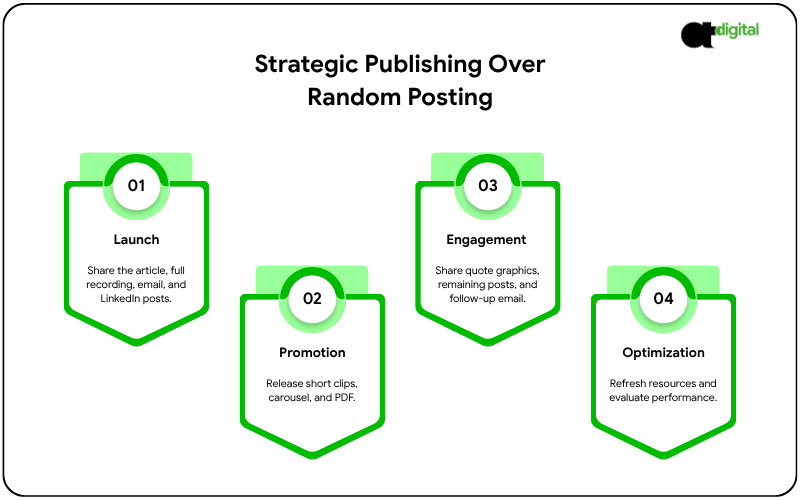
    Twenty assets published in one day is a burst. Spread across a month, it’s a content distribution strategy.

    A simple pattern:

    • Week 1: Publish the article and full video. Send the first email. Post the first LinkedIn text posts.
    • Week 2: Release the short clips and carousel. Share the PDF.
    • Week 3: Post quote graphics and remaining text posts. Send the second email.
    • Week 4: Update the FAQ, refresh the sales one-pager, and review what performed.

    Also keep a simple content marketing distribution checklist for each piece: where it lives, where it’s shared and what links to it internally. Link your clips and posts back to the main article so authority builds in one place, not twenty.

    Ready to Turn One Recording Into a Month of Content?

    We build the extraction map, adapt each asset to its channel, and schedule the rollout, so nothing sits unused in a folder.

    Book My Repurposing Strategy Call →

    Measure What Matters

    Views are easy to count and easy to misread. Track the signals tied to revenue:

    • Which assets lead to booked calls or form fills
    • Which pieces prospects mention in sales conversations
    • Organic traffic and rankings for the main article
    • Downloads and sign-ups from the PDF
    • Whether sales conversations start further along than before

    Then double down on the topics and formats that move real buyers, not just the ones with the highest view count.

    DIY, Hire, or Hybrid?

    You can run this workflow in-house. If you look at content repurposing services, be clear about who does what:

    • Keep with the expert: the source recording and the opinions in it.
    • Delegate: transcription, editing, formatting, scheduling and distribution.
    • Ask any provider: how they preserve the expert’s voice, how they avoid duplicate content, and how they report on results. If your team needs a stronger site foundation for all this content to live on, our website design and development services and content marketing services work together on exactly this.

    Be wary of any service that promises volume without asking what your buyers actually need to know.

    The Verdict: Stop Creating From Scratch. Start Extracting.

    You don’t need more content. You need better use of the expertise you already have sitting in one conversation.

    Here’s the math that makes the case: one 20-minute recording, extracted properly, becomes 20 assets covering search, social, email and sales enablement for an entire month. The alternative, creating 20 separate pieces from scratch, would cost your expert 20 separate interruptions. Repurposing isn’t a shortcut. It’s the only version of this that actually gets done.

    Record one strong source this month. Extract what matters. Adapt it for each channel. Distribute it on a schedule that keeps you visible for four weeks, not four days. Then do it again next month, because the workflow, once built, runs on autopilot.

    Your expert already has the next 20 assets in their head. The only question is whether you extract them this month, or lose another month to a blank content calendar. Our content audit shows exactly which source recording to start with and maps the full 20-asset plan before you record a single minute. Book it now, and stop starting from a blank page.

    Get Your 20-Asset Content Map

    Engineering-grade analysis. Pure mathematics. Zero sales scripts.
    Get My Content Audit Now →

  • Google vs Meta Ads: Pick the Wrong Advertising Platform and Your Budget Pays the Price

    Google vs Meta Ads: Pick the Wrong Advertising Platform and Your Budget Pays the Price

    Swap their platforms and both lose money, and neither will understand why. The plumber’s customer was searching. The candle buyer was scrolling. Google and Meta are built for two completely different moments, and most wasted ad spend starts with treating them as interchangeable.

    This guide is for owners and marketing leads deciding where their first (or next) ad dollars should go. You’ll get 2026 benchmark data from both platforms, a cost-per-customer test that changes the answer for some industries, and a 60-second decision at the end. For the deeper strategy behind wasted spend, read our pillar guide, The Ad Waste Audit.

    Google Ads or Meta Ads: Which Advertising Platform Fits Your Business?

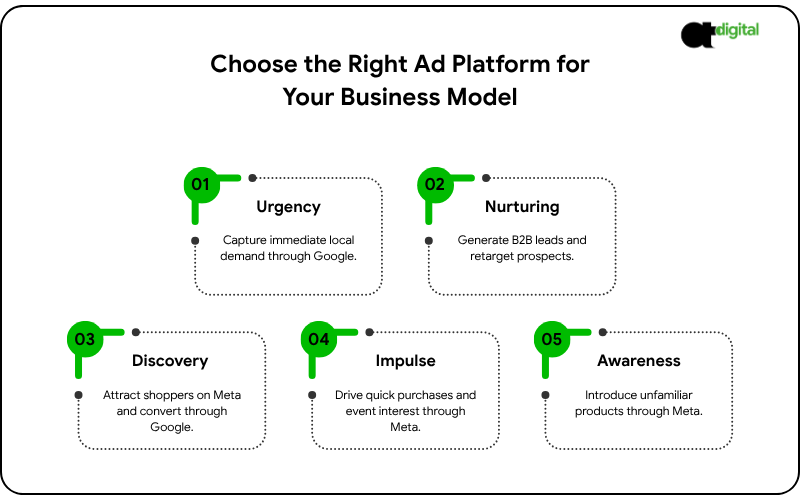
    Choose Google Ads when people already search for what you sell, like emergency repairs, legal help or B2B software. Choose Meta Ads when your product is visual, impulse-friendly or new, so nobody is searching yet. Most businesses start with one of these advertising platforms, then add the other for retargeting.

    Not sure which camp you’re in? The next few sections show you how to tell, using real numbers.

    Not Sure Which Platform Deserves Your Budget?

    We review your market, competitors and margins, then tell you which platform to fund first and what to expect.

    Get My Ad Platform Audit →

    Intent vs Interruption: The Core Difference Between These Advertising Platforms

    Google Ads meets people who are already searching. Someone types “emergency HVAC repair near me” or “project management software for agencies” and you pay to appear at that moment. Meta Ads (Facebook and Instagram) meet people who are scrolling. Nobody opens Instagram planning to hire an accountant. You interrupt the feed with something interesting enough to earn attention.

    Here is how the two compare in 2026, using median figures from WordStream’s benchmark reports:

    Google Ads (Search) Meta Ads (leads campaigns)
    Buyer mindset Actively looking Passively browsing
    You target Keywords and search intent Audiences and creative
    Average cost per click $5.42 $1.80 (traffic campaigns: $0.60)
    Average conversion rate 8.18% 8.54%
    Average cost per lead $66.69 $27.39
    What makes it work Keywords, ad relevance, landing page Creative, offer, audience testing
    Main risk Paying for irrelevant searches Creative fatigue and low-intent leads

    Source: WordStream’s 2026 Google Ads benchmarks (13,474 US search campaigns) and 2026 Facebook Ads benchmarks (452 leads campaigns, so treat Meta figures as directional).

    On paper, Meta wins on cost: less than half the price per lead. So why doesn’t everyone just use Meta?

    Why a Cheaper Lead Isn’t Always a Cheaper Customer

    Because a lead from a search and a lead from a feed are not the same lead. Someone who searched “dentist near me” has a problem today. Someone who tapped a lead form while scrolling might be curious. That difference shows up in your close rate.

    Here is an illustration. Suppose Google leads close at 20% and Meta leads at 10%. The close rates are my assumptions, so replace them with yours. Using WordStream’s 2026 cost per lead by category:

    Category Google cost per lead Meta cost per lead Cost per customer: Google (20% close) Cost per customer: Meta (10% close) Winner
    Dentists $72.97 $61.56 about $365 about $616 Google
    Home services $90.92 $42.95 about $455 about $430 Toss-up
    Real estate $102.51 $13.74 about $513 about $137 Meta

    Same two platforms, three different answers. That is the point: compare cost per customer, not cost per click or cost per lead. Run this math with your own close rates before you spend a dollar

    Match the Advertising Platform to Your Business Model

    Local and Emergency Services: Start With Google

    Sam runs an emergency HVAC company, and his customers search from a cold house. Home services cost about $90.92 per lead on Google, so $3,000 buys roughly 33 calls and form fills. Meta can support him later with reviews and reminders, but the first dollar belongs where the urgency is. Strong local visibility helps too: see our guide to local search dominance.

    B2B and High-Ticket Services: Google to Capture, Meta to Nurture

    Omar sells B2B software with a 60-day sales cycle. Buyers search for solutions on Google, so that’s where he captures demand. But most visitors won’t convert on the first visit, and that’s where Meta (or LinkedIn) earns its place: retargeting people who’ve already seen his site with a case study or an audit offer.

    Ecommerce and Visual Products: Meta to Discover, Google to Close

    Lena sells handmade candles. Nobody searches for “candle that smells like a rainy forest” until they’ve seen one. Meta puts the product in front of people who didn’t know they wanted it, and Google Shopping plus branded search then capture those who go looking afterward. If you also sell through large retail sites, marketplace advertising is a separate channel with its own economics. See our eCommerce marketing services for how to connect them.

    Low-Consideration Purchases and Events: Meta

    For restaurants, events and impulse buys, attention is cheap and decisions are quick. WordStream’s data shows restaurants pay $2.05 per click on Google but $0.45 on Meta traffic campaigns. When the customer doesn’t need to think long, paying four times as much for a search click rarely makes sense.

    New Categories Nobody Searches For: Meta

    If people don’t yet search for what you sell, Google has no demand to capture, no matter how much you spend. That is a Meta problem, and it often needs a strong offer to work.

    Three Tests Before You Spend a Dollar

    1. The demand test. Search your main service terms in Google’s Keyword Planner. Steady monthly searches mean Google can scale you. Almost none means Google can’t create demand. Then look at your competitors: the Meta Ad Library and Google’s Ads Transparency Center show which ads they’re running and for how long. An ad that has run for months is a decent (not perfect) signal that it pays for itself. Neither tool shows their spend or results.

    2. The economics test. Work backward from what a customer is worth. Illustration: you can spend $400 to win a customer and you close 20% of leads, so you can afford $80 per lead. At Google’s 8.18% average conversion rate, your maximum affordable click is about $6.54. The average $5.42 works. Legal advertisers paying $9.87 per click would lose money at those numbers.

    3. The capacity test. Google rewards keyword discipline and a strong landing page. Meta rewards a steady supply of fresh creative and enough volume: Meta’s own guidance points to roughly 50 optimization events in a 7-day window for an ad set to leave its learning phase. At $27.39 per lead, that is about $1,370 a week per ad set. On a small budget, that means one focused ad set, not five.

    What Good Ads Look Like on Each Platform

    A few Google Ads examples and Meta contrasts make the difference concrete.

    Google search ad: matches the query directly.

    Emergency HVAC Repair in [City] | 24/7 Same-Day Service | Licensed and Insured | Call Now for a Free Quote

    The searcher wants a fast solution, so the ad answers immediately.

    Meta ad: earns attention first, then makes an offer.

    A 20-second video: “3 signs your furnace will fail this winter.” Below it: “Book a free pre-season inspection.”

    The viewer wasn’t looking for an HVAC company. The ad gives them a reason to care.

    Running Ads Without Wasting the Budget: How to Sequence Your Spend

    The most common budget mistake is spreading a small budget across every platform. Try this:

    • Start with one platform that matches your business model.
    • Get to steady conversions before adding anything.
    • Add the second platform in a supporting role, usually retargeting people who visited from the first.
    • Judge both by cost per customer, and connect ads and sales data so you know which platform actually closes deals. Conversion tracking (including Meta’s Conversions API and server-side tracking) is covered in our pillar guide.

    Then plug the leaks:

    • On Google, the leak is irrelevant searches. Build a negative keyword list on day one and review your search terms weekly.
    • On Meta, the leaks are creative fatigue and constant edits that keep restarting the learning phase. Refresh creative on a schedule, and test one change at a time.
    • On both, the leak is a landing page that doesn’t match the ad. A great advertisement of your business sent to a generic homepage wastes the click. If yours is slow or vague, our website design and development services can fix it.

    Want Specialists to Run This for You?

    We choose the platform, build the campaigns, track cost per customer and cut the waste, so your budget goes where buyers are.

    Book My Ad Strategy Call →

    How to Choose Google PPC Management and Ad Management Services

    If you hire help, whether Google PPC management or a firm offering professional search engine marketing services, ask before you sign:

    • Do they build a strategy per platform, or copy one approach across all of them? Copy-paste strategy is a red flag.
    • Who owns the ad accounts and data? It should be you.
    • How do they report? Look for leads, customers and cost per customer, not just clicks and impressions.
    • What do Google ad management services fees cover, and does ad spend come out of the same budget?

    Be cautious of anyone who guarantees a specific return before looking at your economics. To handle Google and Meta as one system, see our PPC management services and social media marketing services.

    The Verdict: Pick Your Platform in 60 Seconds

    Answer three questions honestly:

    • Do people already search for what you sell? (Try it. Check the Keyword Planner.)
    • Is your product visual, impulse-friendly or new to the market?
    • Does your economics work? Divide your category’s cost per lead by your close rate. That is your cost per customer. Can a customer’s profit cover it?

    Now read your result:

    • Yes to 1: start with Google. Put most of your budget into search ads on your best buyer keywords. Add Meta retargeting once you have steady site traffic.
    • No to 1, yes to 2: start with Meta. Lead with a strong offer and fresh creative on one focused ad set. Add Google for branded and shopping searches once demand appears.
    • Yes to both (typical for ecommerce): Meta to discover, Google to close. Start with Meta for reach, then capture the people who search for you afterward.
    • Long sales cycle (typical for B2B): Google to capture, Meta or LinkedIn to nurture. Retarget site visitors with proof, not the same ad.
    • No to 3: don’t start with ads yet. Fix your offer, margins or landing page first. Ads make a broken funnel expensive faster.

    One line covers all of it: Google harvests demand that already exists. Meta creates demand that doesn’t yet. Pick the one that matches how your customers buy, and judge it on cost per customer, not cost per click.

    Every week you run the wrong platform, you are paying to reach the right people in the wrong mindset. Our ad platform audit compares your market, competitors and margins, and shows exactly which platform to fund first and what a customer should cost you. Book it before you spend the next dollar, and put your budget where buyers actually are.

    Which Platform Should Get Your Next Dollar?

    Engineering-grade account analysis. Pure mathematics. Zero sales scripts.
    Get My Ad Platform Audit Now →

  • Small Business Reputation Management: Why Reviews Decide Who Gets the Call

    Small Business Reputation Management: Why Reviews Decide Who Gets the Call

    They don’t read your website. They don’t compare pricing. They look at the stars, skim a few reviews, and call one number. The whole decision takes under a minute, and you either won it or lost it long before the phone rang.

    That is what small business reputation management really is: winning the decision that happens before the conversation. According to BrightLocal’s 2026 Local Consumer Review Survey, 97% of consumers read reviews when choosing a local business. This guide shows you how to earn the reviews, answer them well and put them to work, without a single fake star. It builds on our pillar guide, The Architecture of Local Dominance.

    What Is Small Business Reputation Management, and How Does It Turn Reviews Into Sales?

    Small business reputation management is earning, monitoring and answering online reviews so buyers choose you. It turns reviews into sales in four steps: ask every customer for a review, reply to every review within a day, keep listings accurate everywhere, and show your best reviews where buyers decide. Never gate, buy or incentivize reviews.

    The rest of this guide shows you how to run each step, and which numbers to hit.

    How Does Your Review Profile Stack Up?

    We benchmark your reviews, replies and listings against the competitors taking your calls, then give you a fix-first list.

    Get My Reputation Audit →

    The Review Scorecard: What Buyers Check Before They Call

    Buyers run a fast mental checklist: how many reviews, what rating, how recent, and did the owner reply. Here is how two hypothetical dentists on the same street look through that lens.

    Dr. Lee Dr. Ortiz
    Rating 4.7 4.3
    Number of reviews 212 18
    Newest review 4 days ago 5 months ago
    Owner replies Every review, within a day None

    Dr. Ortiz is a fine dentist. She is also invisible, because she fails every filter buyers actually use. Here are the numbers behind each one, all from BrightLocal’s 2026 survey of 1,002 US adults.

    Volume: The 20-Review Floor

    47% of consumers won’t use a business with fewer than 20 reviews, and only 9% will use one with five or fewer. Reviews are a credibility threshold. Until you cross it, you are competing with one hand tied.

    Rating: 4.5 Is the New Line, and Perfect Is Not Required

    31% of consumers will only use a business rated 4.5 stars or higher, up from 17% a year earlier. And 68% want 4 stars or better. But only 10% insist on a perfect 5.0. Research from Northwestern University’s Spiegel Research Center on online retail found that purchase likelihood peaked between 4.2 and 4.5 stars and dropped as ratings approached a flawless 5.0, because shoppers read perfection as “too good to be true.” Google’s own guidance agrees: a mix of positive and negative feedback often feels more trustworthy.

    Recency: Reviews Expire

    74% of consumers only care about reviews from the last three months, and 32% want reviews from the last two weeks. A wall of five-star reviews from 2023 reassures almost no one. Review collection is a habit, not a campaign.

    Replies: Silence Costs You Customers

    80% of consumers say they’re likely to use a business that responds to all its reviews, while 42% are unlikely to use one that never replies. Even the most patient buyer notices when the owner has gone quiet.

    How to Get More Reviews (Without Breaking the Rules)

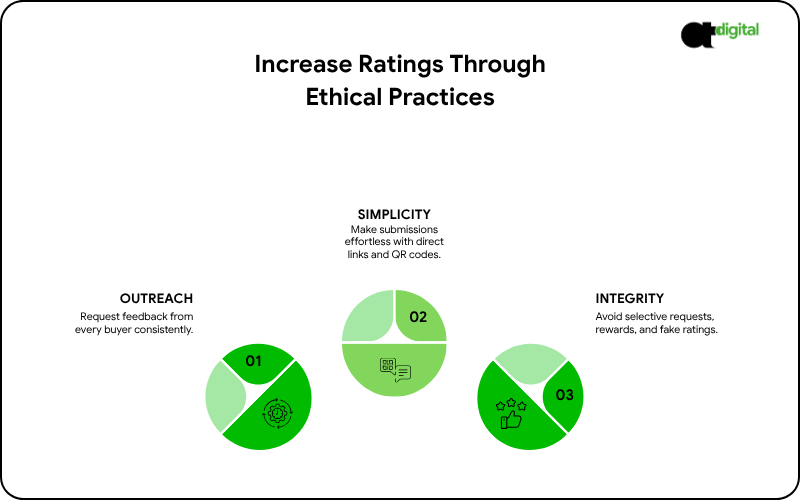
    Ask Every Customer, Every Time

    Here is the part most owners get wrong: they assume customers who are happy will review on their own. They mostly don’t. But when asked, they do. In BrightLocal’s survey, 78% of consumers were asked for a review in the past year, and 83% of those who were asked went on to leave one.

    Here is illustrative math. Send 30 review requests a month, and even if only a third turn into reviews, that is about 10 new reviews a month. From a standing start, that is 20 reviews in two months: right at the floor, and every one of them recent.

    Make It a One-Tap Task

    Google lets you create a review link and QR code from your Business Profile. Put it in the thank-you email, the text message after the job, the receipt and the counter. Every extra step costs you reviews.

    A script that works: “Thanks for choosing us. If we did a good job, would you mind sharing a quick review? It helps other local customers find us. Here’s the link.”

    Never Gate, Buy or Incentivize

    This is where businesses get burned. Google prohibits offering discounts or gifts in exchange for reviews, and its policies also prohibit review gating: selectively asking only your happiest customers. Ask everyone and accept the honest result.

    The legal risk is now real, too. The FTC’s final rule on fake reviews and testimonials, effective since October 2024, bans buying or selling fake reviews (including AI-generated ones), prohibits compensation tied to a particular sentiment, and lets the agency seek civil penalties. BrightLocal found that 11% of consumers were offered an incentive to write a positive review. Don’t be that business.

    How to Respond to Google Reviews (With Templates That Don’t Sound Like Templates)

    How you respond to Google reviews is public sales copy. Future customers read your replies to see how you treat people. And 50% of consumers are put off by generic, templated responses, so use the structures below as starting points and add one real detail every time.

    Positive review: thank them by name, mention something specific, keep it short.

    “Thank you, Maria. Glad we could get your kitchen running again before the weekend. We appreciate you trusting our team.”

    Mixed review (3 stars): acknowledge the fair point, say what you’ll change, invite them to continue offline.

    “Thanks for the honest feedback, David. You’re right that scheduling ran longer than promised. We’ve changed how we confirm appointments. Please call [phone] so we can make it right.”

    Negative review (1-2 stars): this is your best chance to earn the trust of the people reading. Stay calm, don’t argue, never reveal private details, and take the conversation offline.

    “We’re sorry your experience fell short. We’d like to understand what happened and fix it. Please contact [name] at [phone or email] so we can resolve this directly.”

    Fake or policy-violating review: flag it to Google, reply once and professionally, and don’t expect removal just because a review is unfair. Removal generally requires a policy violation.

    How fast? 19% of consumers expect a reply the same day and 32% expect one by the next day. Aim for 24 hours on every review. Never stuff keywords into replies: readers notice, and it reads as fake.

    Brand Monitoring: Catch It Before Buyers Do

    Reviews on Google are only part of your brand perception. The average consumer checks about six review sites, and 45% now use AI tools like ChatGPT for local recommendations. What people say about you across the web shapes what those tools repeat.

    A workable brand monitoring setup costs almost nothing:

    • Turn on review notifications on Google Business Profile and every platform you appear on, including Facebook, Yelp and Apple Maps.
    • Set alerts for your business name, owner name and common misspellings.
    • Track social mentions with each platform’s search and notifications. For higher volumes, media monitoring social media tools help you catch conversations across channels. Our social media marketing services include this.
    • Assign one owner and one rule for who replies to what.

    A workable brand Speed matters. A complaint caught on day one is a service problem. The same complaint found a month later is a reputation problem.monitoring setup costs almost nothing:

    Fix Your Local Listings First

    Reviews sit on top of your listings, and shaky listings undermine everything above them. Search engines and AI tools cross-check your name, address and phone number across sources. When “Suite 100” appears in one place and “Ste. 100” in another, you create doubt.

    Good business listings management means:

    • Choosing one official version of your business details and using it everywhere.
    • Auditing your main local listings: Google, Apple Maps (its usage among review readers nearly doubled in a year, from 14% to 27%), Bing, Yelp and your industry directories.
    • Claiming or merging duplicates, and rechecking after any move, rebrand or phone change.

    Every accurate listing is another place a buyer, or an AI tool, can find and trust you. If you’d rather hand this to specialists, see our local SEO services.

    Want Someone Else to Run This?

    We build the review engine, clean up your listings and monitor your brand, so you get the calls without the busywork.

    Book My Reputation Strategy Call →

    Turn Reviews Into Sales: Put Them Where Buyers Decide

    Collecting reviews isn’t the finish line. Here is what happens next: after reading positive reviews, 54% of consumers visit the business’s website. Put your proof there.

    • Service and location pages: two or three relevant reviews near the call-to-action. If your site needs a refresh to do this well, see our website design and development services.
    • Google Business Profile: photos, services and posts that echo what reviewers say.
    • Proposals and sales calls: send prospects reviews from customers with similar problems.
    • Ads and follow-up emails: a strong quote reassures a hesitant lead.
    • Press and mentions: PR in SEO works best when it points to a business whose reviews and listings are already clean.

    Track the outcome: calls, direction requests and form fills from your profile, plus a simple “how did you hear about us, and did reviews help?” question for new customers.

    Here is the math on why this matters. If your average job is $450 and a stronger review profile wins you just 3 extra jobs a month, that is $16,200 a year. That is an illustration, not a benchmark, but it shows why a 30-minute weekly habit can beat a big ad budget.

    How to Choose a Reputation Management Company or Consultant

    If you are comparing the best reputation management companies, or talking to reputation management consultants, use the same standards you’d apply to any vendor:

    • Red flag: guarantees of 5-star ratings, purchased reviews, or removal of legitimate negative reviews. With the FTC rule in force, those promises put your business at risk.
    • Ask: how will you generate reviews from real customers, and what will you report?
    • Ask: who owns the profiles and data? It should be you.
    • Look for: integration with your local SEO, so reviews, listings and rankings work as one system.

    The best reputation management is boring, consistent and honest. If a pitch sounds like a shortcut, it is one.

    The Verdict: Fix, Ask, Reply

    You don’t need a big budget or a big team. You need three habits, run every week. Find your starting point:

    Your situation Your first move
    Fewer than 20 reviews Ask. Start the review request habit today and target 20+
    Rating below 4.3 with plenty of reviews Fix and reply. Find the recurring complaint, fix it, then answer every negative review
    Owner never replies Reply. Clear the backlog this week, then stay within 24 hours
    Inconsistent listings Clean up. Standardize your name, address and phone everywhere
    Strong profile already Showcase and monitor. Put reviews on your site, ads and proposals, and watch for new mentions

    Then run the 30-day sprint:

    • Week 1: Audit reviews and listings. Reply to every existing review.
    • Week 2: Create your review link and QR code, write your ask script, turn on alerts.
    • Week 3: Start asking every customer. Fix the listings that don’t match.
    • Week 4: Measure new reviews, average rating, reply time and calls. Then repeat.

    If you remember one thing: buyers don’t choose the best business. They choose the one that looks safest in 60 seconds. Reviews are how you look safe.

    Right now, someone in your area is comparing you to the business down the street. They will decide before you ever hear about it, and every week without a system is a week of calls going somewhere else. Our reputation audit shows exactly where your reviews, replies and listings stand against the competitors taking your customers, and gives you a fix-first list you can start on tomorrow. Book it now, and turn your next 20 reviews into your next 20 customers.

    Ready to Win the 60-Second Decision?

    Strategic geo-grid analysis. Pure mathematics. No sales scripts.

    Get My Reputation Audit Now →

  • SEO vs Paid Search: Where Your First $5,000 Works Hardest

    SEO vs Paid Search: Where Your First $5,000 Works Hardest

    A friend swears by Google Ads. A podcast says SEO is “the only marketing that compounds.” Both are right, for different businesses, and following advice written for somebody else is how first budgets get wasted.

    This guide is for owners and founders of B2B, service and local businesses. You’ll get real 2026 numbers, three worked examples and a 60-second test that tells you which lane you’re in. For the bigger capital-allocation argument, read our pillar guide, Paid Ads Buy Speed, SEO Buys Wealth.

    How Should You Split $5,000 Between SEO and Paid Search?

    Split your first $5,000 by how fast you need leads. Need customers within 60 days: put about 70% into paid search and 30% into SEO foundations. Have 9+ months of runway: reverse it, 30% paid and 70% SEO. Either way, fix tracking and your landing page first.

    Not sure which side you’re on? Keep reading. One 2026 statistic also changes how you should spend the SEO half.

    Not Sure Which Side You’re On?

    We review your keywords, competitors and margins, then tell you exactly how to split your budget.

    Get My Budget Split Audit →

    SEO vs Paid Search: What Each Channel Actually Buys

    Paid search is renting a storefront on the busiest street in town: customers arrive the day you sign the lease, and the lights go off the day you stop paying. SEO is buying the building: slower, more work up front, and yours.

    Search engine optimization (SEO) earns unpaid organic traffic by making your pages the best answer to a search. Paid search, or PPC (pay-per-click), buys ad placements above and around those results. It is the most measurable form of internet advertising, while SEO is the slowest to start and the cheapest to keep.

    Paid search (PPC) SEO
    Time to first lead Days Early indicators in months 3-4
    Cost behavior Linear: stop paying, traffic stops Front-loaded: cost per lead falls over time
    Control High: budget, targeting, message Lower: depends on the algorithm
    What you keep Data and learnings Rankings, content and authority
    Best for Fast pipeline, testing offers Durable, lower-cost acquisition

    SEO vs Paid Search: What Each Channel Actually Buys

    Search engine marketing (SEM) is the umbrella for everything you do to win search visibility. People who search “search engine marketing vs SEO” usually mean paid vs organic. The tradeoff is the same: speed against compounding.

    Does Google Ads Help SEO?

    Not directly. Google states that advertising with Google has no effect on your presence in organic search results. The benefit of running both is indirect: ads cover a different part of the page and give you keyword and conversion data that sharpen your organic targets.

    The Zero-Click Twist: Why 2026 Changes the SEO Math

    Here is the statistic most “SEO vs PPC” articles skip. According to SparkToro’s 2026 study using Similarweb data, 68.01% of US Google searches from January to April 2026 ended without a click, up from 60.45% in 2024. Two out of three searches never send anyone to a website, and AI Overviews (now on 20%+ of searches, per SparkToro) are a big reason.

    For your $5,000, that means broad “what is” blog posts are the most exposed. But SparkToro says SEO still earns its keep for three kinds of searches: branded, local, and high-intent transactional queries. That is where buyers search, and where your SEO dollars should go.

    Paid costs are moving the other way. WordStream’s 2026 benchmarks put the average Google Ads cost per click at $5.42, more than double the $2.32 it measured in 2016. Neither channel is a bargain anymore, and both reward businesses that aim at buyers instead of traffic.

    The Three Variables That Decide PPC vs SEO

    1. Time to Cash

    How long can you operate before this channel must pay back? Under 90 days favors ads. Nine to twelve months of runway makes SEO viable.

    2. Margin and Customer Lifetime Value

    Ads work when a customer’s profit can pay for the click. If a customer is worth $300 and your customer acquisition cost (CAC) through ads is $250, you’re on a treadmill. High-margin businesses can absorb paid acquisition. Thin-margin ones usually cannot.

    3. Keyword Economics

    Check the cost per click (CPC) for your five most valuable keywords. WordStream’s data shows $9.87 per click for legal services, $8.33 for home services and $4.35 for auto repair. Same channel, wildly different math.

    The Zero-Click Twist: Why 2026 Changes the SEO Math

    Here is what $5,000 buys at WordStream’s 2026 median cost per lead in each category. A “lead” is a tracked call or form fill, and the math assumes every dollar goes to ad spend.

    Business type Cost per lead Leads from $5,000 Customers at a 20% close rate*
    Auto repair $29.96 about 167 about 33
    All industries (median) $66.69 about 75 about 15
    Home services $90.92 about 55 about 11
    Business services $93.69 about 53 about 11
    Legal services $131.63 about 38 about 8

    *The 20% close rate is illustrative. Use your own. Cost per lead figures are from WordStream’s 2026 Google Ads benchmarks, median across 13,474 US search campaigns.

    The same $5,000 buys four times as many leads for an auto repair shop as for a law firm. That is why “just run ads” is not a strategy. Now the caveats:

    • The first weeks are tuition. Traffic can start within days, but optimizing for profit typically takes four to six weeks of data.
    • Your landing page is the multiplier. Google groups landing page experience with expected click-through rate and ad relevance as the three components of Quality Score. If your page is slow or vague, fix it first with our website design and development services.
    • Waste is the silent budget killer. Broad matching sends you irrelevant searches. Our Ad Waste Audit guide explains how to stop it.
    • Fees and shutoffs. Agency fees mean less than $5,000 reaches Google, and when the budget stops, the traffic stops.

    Want specialists to run it? See our PPC management services.

    What $5,000 Buys in SEO

    $5,000 does not buy rankings. It buys foundation, and foundation keeps paying after the invoice is settled.

    The Three Types of SEO Your Budget Covers

    • Technical SEO ($1,000-$1,500): crawlability, page speed, indexation and structured data.
    • On-page SEO ($500-$800 for research plus $2,000-$2,500 for content): a keyword and intent map, then four to six commercial-intent pages.
    • Off-page and local SEO (the remainder): Google Business Profile, citations and early authority signals.

    These are illustrative allocations, not quotes. (Paying for SEO, sometimes searched as “paid SEO”, is different from paying for ads: you’re funding assets, not clicks.)

    Build Your SEO Content Strategy From the Bottom of the Funnel

    Given the zero-click numbers, an effective SEO content strategy starts with pages for buyers ready to compare and purchase: pricing pages, “[competitor] alternatives”, service-plus-city pages. For SEO content creation, one page that answers a buying question better than anyone else beats ten thin posts.

    Set SEO Goals You Can Hit in 90 Days

    Revenue is too early. Track leading indicators: pages indexed, impressions in Search Console, rankings for your target terms, and your first organic conversions.

    Build Your SEO Content Strategy From the Bottom of the Funnel

    The formula is simple: SEO ROI = (organic revenue – SEO cost) / SEO cost. The catch is timing. Google notes it can take typically four months to a year to see the benefits of SEO changes, so SEO ROI starts negative.

    An illustrative example: you spend $5,000 on foundation and five buyer-intent pages. Nothing happens for four months. From month five through twelve, the pages bring in just 4 leads a month, or 32 leads. At a 20% close rate that is about 6 customers, and at $1,500 per first order, about $9,600. SEO ROI: (9,600 – 5,000) / 5,000, or roughly 92% in year one, with the pages still working in year two at no extra cost.

    See What SEO Could Earn in Your Market

    We size the opportunity from your keywords, competitors and conversion data before you spend a dollar.

    Size My SEO Opportunity →

    The Decision Framework: Three Businesses, Three Different Answers

    Theory is cheap. Here is how the same $5,000 splits for three hypothetical businesses.

    Dana, Emergency Plumber: Paid First

    Dana runs a two-truck plumbing company, and her phone needs to ring this month. Home services cost about $90.92 per lead, so $5,000 in ads could produce roughly 55 calls and forms, or around 11 jobs at a 20% close rate. Someone searching “burst pipe near me” is ready to buy today, and ads reach them today.

    Her split: $3,500 on search ads with a tight negative keyword list, $1,500 on SEO foundations: her Google Business Profile, a review habit and one service-area page. Local is one of the places SEO still pays, but it isn’t her lead engine yet.

    Marcus, B2B Software Startup: SEO First

    Marcus has 12 months of runway and a long sales cycle. Business services run about $93.69 per lead, and a lead is not a demo. He can’t afford to burn his budget in six weeks.

    His split: $1,500 on ads for five bottom-funnel terms like “[competitor] alternative” and “[category] pricing”, run for four to six weeks to learn which ones convert. $3,500 on SEO: technical fixes, a keyword map and four or five comparison and pricing pages. That is SEO for startups done right: go narrow, pick a small set of buyer-intent keywords you can win, and go deep.

    Priya, Two-Office Law Firm: Local SEO First

    Priya’s clicks cost $9.87 on average and her leads cost $131.63, the highest in WordStream’s data. Her $5,000 buys about 38 leads, and ads alone would eat the budget fast.

    Her split: $1,500 on ads for her most profitable practice area in the busier city, $3,500 on local SEO: a Google Business Profile per office, a review engine and a dedicated page per location. That is SEO for multiple locations in one line: every office needs its own page and profile with genuinely local content, and $5,000 stretches thin across ten, so start with your top one to three. Our guide to local search dominance shows how to expand.

    The payoff can be large: one AtheosTech local client grew inbound phone leads 180% with no increase in ad spend after we fixed their local signals and built a review engine.

    Use Paid Data to Choose Your SEO Targets

    The smartest thing a small budget can do is use ads as research. Every paid keyword produces real conversion data, while keyword tools only estimate. Run a focused campaign for a few weeks, find the terms that produce leads, and build organic pages around those exact terms. That is the real role of PPC in SEO strategy: ads validate, SEO compounds, and you stop guessing which keywords deserve a permanent page.

    Four Mistakes That Burn a $5,000 Budget

    1. Sending ad traffic to a slow or unconvincing page. You pay to lose visitors.
    2. Expecting SEO to pay back in 30 days. Anyone promising page one in a month is targeting terms nobody searches or risking penalties.
    3. Spreading the budget too thin. Five channels at $1,000 each give none of them enough data or momentum.
    4. Spending before tracking is set up. If you can’t connect a lead to its source, you can’t calculate ROI on either channel.

    How to Choose an SEO and PPC Agency

    If you hire an SEO and PPC agency, or a dedicated paid search agency, ask before you sign:

    • Who owns the ad account and the data? It should be you.
    • What exactly is delivered for $5,000, and what is explicitly not?
    • How is success reported? Leads and revenue, not just traffic.
    • Does one team run SEO and PPC management from shared keyword data, or are they separate silos?

    Google itself advises walking away from anyone who guarantees a first-place ranking. To plan both channels as one system, see our SEO services and PPC management services.

    The Verdict: Pick Your Lane in 60 Seconds

    Answer three questions honestly.

    1. Do you need paying customers within 60 days?
    2. Can a customer’s profit cover your cost per customer? Divide your category’s cost per lead by your close rate. At the all-industry median, $66.69 / 0.20 is about $333 per customer. For legal, $131.63 / 0.20 is about $658.
    3. Can you wait 4 to 12 months for payback?

    Now read your result:

    • Yes to 1 and 2: go paid-first. Put about 70% ($3,500) into search ads on your best buyer keywords and 30% ($1,500) into SEO foundations. Fix tracking and your landing page before the first click.
    • Yes to 1, no to 2: do not start with ads. They will lose money at your margins. Put your budget into your offer, your landing page and local or buyer-intent SEO, and test ads only after your page converts.
    • No to 1, yes to 3: go SEO-first. Put about 70% ($3,500) into technical fixes and buyer-intent pages, and 30% ($1,500) into a paid test that shows you which keywords convert.
    • Still torn? Test, then commit. Spend $1,500 on ads for four to six weeks on your five best buyer keywords. Let real conversion data decide where the other $3,500 goes.

    One rule covers everything above: buy speed with ads only when a customer’s profit can pay for the click, and buy assets with SEO when you can afford to wait for them. And never split the budget evenly just because you can’t decide. That is the one option guaranteed to under-fund both.

    Your $5,000 will be spent either way. The only choice is whether it goes to a plan built from your numbers or to a guess dressed up as strategy. Every week you spend guessing is a week a competitor is collecting the leads you’re paying to find. Our budget split audit takes your keywords, competitors and margins, and tells you where the first dollar should go. Book it before you spend another cent on either channel.

    Where Should Your First $5,000 Go?

    Engineering-grade analysis of your site, keyword economics and competitors. Pure strategy. No sales scripts.

    Get My Budget Split Audit Now →

  • Google Business Profile: The Most Underrated Sales Tool

    Google Business Profile: The Most Underrated Sales Tool

    THE PARADIGM SHIFT

    (The “Set and Forget” Delusion)

    As we established in our macro thesis, Digital Darwinism 2026: The Mathematics of Survival in a Revenue Driven Economy, the modern market executes the slow and the static. Let us examine a massive operational failure occurring in boardrooms across the globe regarding this exact survival metric.

    Executives routinely authorize massive budgets for Pay Per Click advertising and custom website development while completely ignoring their hyperlocal digital marketing strategy. Simultaneously, they treat their Google Business Profile like a static digital billboard. They upload a corporate logo, type in their operating hours, and consider the job finished.

    The Zero Moment of Truth

    For hyper local and high intent searches, relying exclusively on your traditional website to do all the heavy lifting is a severe tactical error. When a decision maker faces an immediate crisis, they do not want to dig through complex site menus or wait for a page to render. They execute a ruthless Near Me google search.


    This is the Zero Moment of Truth. Google has fundamentally transformed the Google Business Profile from a passive administrative directory into a frontline Local SEO Service and high performance sales ecosystem.

    • The Intent Capture: It is the most valuable digital real estate for intercepting immediate commercial intent.
    • The Speed Advantage: It accelerates the sales cycle and builds trust before the prospect even reaches your domain.
    • The Legacy Blindspot: Despite its massive conversion power, most legacy founders leave this critical asset completely unoptimized.

    The Spearhead Asset

    At AtheosTech Digital, we treat the Google Business Profile as the absolute spearhead of your hyperlocal digital marketing infrastructure. If your leadership team treats it as a basic IT checklist item, you are actively hemorrhaging regional capital to competitors who simply out engineered your local presence.

    Google Business Profile Optimization

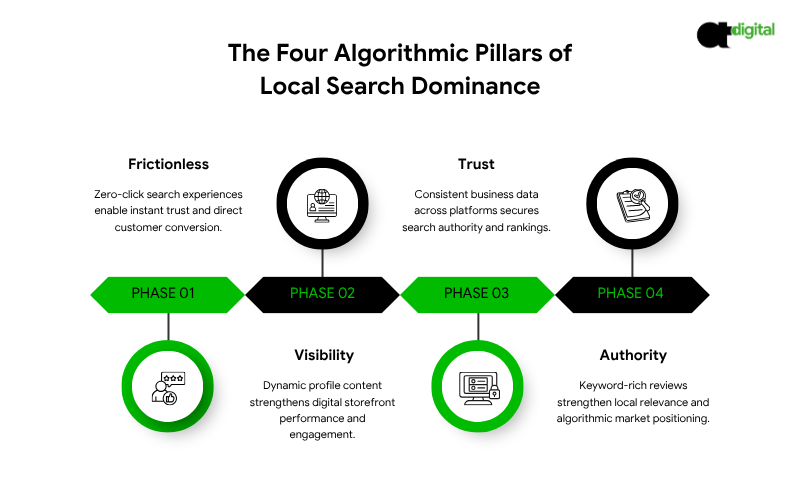
    PHASE 1: THE ZERO CLICK INTERFACE MONOPOLY

    (The Frictionless Transaction)

    We are operating in the era of the Zero Click Reality.

    Google has mathematically engineered the search results to allow critical commercial transactions to happen entirely on its own platform. This architecture is designed to accelerate the sales cycle and build absolute trust before the prospect ever reaches your primary domain.

    The Weaponized Profile

    If your local profile is properly weaponized by elite local SEO experts, a high value prospect can execute a complete due diligence sequence directly from the search engine results page:

    • Verify Proximity: They immediately confirm your physical location, service radius, and operational status.
    • Audit Social Proof: They read your hyper localized reviews to establish baseline corporate trust.
    • View Inventory: They browse your visual service grids and product catalogs.
    • Execute the Conversion: They tap a native “Call” or “Book Now” button to initiate immediate contact.

    The Interception Millisecond

    The conversion happens instantly. In the ruthless game of hyperlocal digital marketing, the Google Business Profile completely eliminates the initial click. It intercepts the buyer at the exact millisecond their wallet opens.

    If your competitor has integrated native direct booking and messaging right on the search results while you force a prospect to click through and hunt for a contact page, you mathematically lose the contract. You were out engineered by convenience.

    PHASE 2: VISUAL MERCHANDISING AND THE DYNAMIC FEED

    (Engineering the Digital Storefront)

    A dominant profile acts as a highly optimized digital storefront. It is mathematically engineered to either seamlessly feed highly qualified traffic directly to your main website or close the transaction on the spot.

    The Conversion Architecture

    o turn this basic directory into a relentless 24/7 sales tool, you must deploy the best local SEO services and advanced conversion architecture:

    • The Preemptive Sales Pitch (Seeded Q&A): Your sales team wastes valuable hours answering the exact same foundational questions from prospects. A dominant profile utilizes the Q&A section to preemptively neutralize these objections. By intentionally seeding and answering the most critical buyer questions directly on the search results, you accelerate the sales cycle before the prospect even initiates contact.
    • The Visual Inventory (Products and Services Grids): Service businesses consistently fail to productize their offerings. By building out a comprehensive and visually appealing Product Grid within your profile, you transform a simple text result into a highly structured digital catalog. This architecture anchors price expectations, highlights your premium offerings, and explicitly defines the deliverables immediately.
    • The Algorithmic Pulse (Google Posts): A static profile mathematically signals a dormant business. Utilizing Google Posts to publish weekly updates, current offers, and localized content proves to both the algorithm and the consumer that your operation is highly active. It demonstrates that you are aggressively competing for their capital.

    PHASE 3: THE ALGORITHMIC CROSS EXAMINATION

    (Data Parity and Trust)

    A dominant profile does not exist in a digital vacuum. It operates as the central node of a massive, highly interconnected hyperlocal digital marketing data network.

    The Trust Metric

    As we established in our foundational master guide, The Architecture of Local Dominance: Intercepting the Near Me Search to Capture Regional Market Share, the algorithm is looking for one single, undeniable metric.
    To achieve this trust, the Name, Address, and Phone Number (NAP) on your Google Business Profile must be mathematically identical across every single platform, directory, and local SEO citations record on the internet.

    The Mathematics of Data Parity

    The machine does not allow for human error or casual formatting. It demands absolute data parity:

    • The Conflict Trigger: If your Google profile explicitly says “Suite 100” but a secondary legal or industry directory says “Ste. 100”, the machine immediately flags a data conflict.
    • The Trust Collapse: In a zero sum economy, a data conflict destroys algorithmic trust. The machine assumes your business data is unstable or outdated.
    • The Invisibility Penalty: When the algorithm loses trust, your ranking immediately plummets. Your profile is stripped from the Map Pack, and your business becomes completely invisible to the high intent buyer.

    PHASE 4: SEMANTIC KEYWORD INJECTION

    (Weaponizing the Reputation Multiplier)

    None of this architecture matters if you do not possess the algorithmic authority to appear in the top three map positions. The absolute fuel for that local engine is Trust Velocity.

    The NLP Advantage

    Google utilizes advanced Natural Language Processing to read, analyze, and categorize the exact text within your reviews. It does not just look at the star rating. It reads the context.

    • The Semantic Trigger: When a high ticket client leaves a review explicitly mentioning a “flawless corporate tax consultation in Austin”, the artificial intelligence processes those exact phrases and maps them directly to your digital entity.
    • The Recency Bias: A business resting on two hundred generic reviews from three years ago will routinely lose to a competitor generating five hyper local, keyword rich reviews every single week.
    • The Territorial Award: We engineer systematic review generation not for corporate vanity, but because it feeds the algorithm the exact contextual data it craves to award you that regional territory.

    THE OPERATIONAL INTERROGATION

    Before your leadership team signs off on another marketing budget, you must stop asking the wrong administrative questions. Executives waste entirely too much time asking how to delete google business profile duplicates, or panicking when a google business profile suspended notice arrives due to structural data conflicts.

    They rely on basic forums to read and improve your local ranking on google business profile help threads instead of engineering a permanent mathematical solution. The only strategic questions your boardroom should be asking right now are how to weaponize your google business profile for local SEO dominance, and which elite google business profile optimization services are required to completely capture your regional market share.

    THE BOARDROOM DIRECTIVE: CAPITAL ASSESSMENT

    (The Final Interception Audit)

    Executives routinely misunderstand the true financial benefits of local SEO. Your Google Business Profile is either a high velocity Lead Interception Engine, or it is a static digital tombstone. There is no middle ground in local search.

    It is time to audit the friction in your local sales cycle and weaponize the exact platform that your buyers actually use to initiate contact.

    Assess Your Interception Rate

    Take out your smartphone, stand in your office lobby, and search for your most profitable service category without using your brand name. You must answer these clinical diagnostic questions with absolute transparency:

    • The Map Pack Test: Did your profile actually appear in the top three local results, or are you completely invisible?
    • The Friction Test: Can a high intent buyer initiate a transaction seamlessly directly from the search results?
    • The Authority Test: Does your digital profile look like a dominant market leader, or an abandoned corporate outpost?

    If your executive team is unsatisfied with the mathematics of that search, it is time to reengineer your local presence.

    INITIATE YOUR GEO GRID AUDIT

    (A technical breakdown of your Map Pack architecture and the exact geographical blind spots costing you regional revenue.)

  • The 0.78% Trap in SEO Service: The Brutal Mathematics of the Page Two Graveyard

    The 0.78% Trap in SEO Service: The Brutal Mathematics of the Page Two Graveyard

    THE VISIBILITY CRISIS

    [THE TRAFFIC AUDIT]

    Metric
    Mathematical Reality
    Financial Impact
    The Power Law
    The Power Law of organic traffic dictates that Position #1 mathematically captures 31.7% of all user clicks.
    Absolute market dominance and the lowest possible Customer Acquisition Cost.
    The GraveyardExactly 0.78% of users click on a second page result within the organic results pages.Total digital invisibility and a near zero return on your website investment.
    The Wealth TransferHigh intent traffic bypasses unranked domains and landing pages.They steal your pipeline through featured snippets and top page dominance, creating a direct capital injection into your highest ranking competitor’s balance sheet.

    The Legacy Founder Hallucination

    As we established in our overarching thesis, Digital Darwinism 2026: The Mathematics of Survival in a Revenue Driven Economy, the modern market is completely unforgiving. Building a premium website without an organic ranking strategy is the corporate equivalent of constructing a flagship storefront in the middle of a desert and waiting for foot traffic.

    Many legacy founders operate under a dangerous and expensive corporate hallucination. They approve a massive budget for a digital marketing overhaul, launch a beautifully coded platform into the ecosystem, and assume the market will naturally gravitate toward their brand.

    They fundamentally fail to distinguish between two radically different states of business:

    • Being Present: Having a live URL that looks professional.
    • Being Profitable: Dominating the exact algorithmic intersection of consumer intent and capital.

    In the ruthless mathematics of 2026 and AI driven search, simply existing is a rounding error. You must be visible at the exact millisecond a highly qualified prospect decides to spend money. If your digital infrastructure is not mathematically engineered to command the search engines and their algorithms, you are operating in a total vacuum.

    The Equity Metric

    At AtheosTech Digital, our SEO consultant services do not treat organic rankings as a soft marketing metric.

    If you are missing from the first ten results, your website is silently leaking conversions. This briefing outlines the catastrophic financial consequences of the Page Two Graveyard and the architectural shifts required to stop the bleeding.

    THE PAGE TWO GRAVEYARD

    (The Illusion of Digital Presence)

    Your beautiful website is entirely worthless if it sits in a measurement void. You can invest massive amounts of capital into high end design and flawless copywriting, but without visibility, that corporate investment produces a zero percent return.

    Most executives judge the success of their business solely by the contracts they close, remaining completely blind to the capital they silently leak. It is the corporate equivalent of judging a leaky bucket only by the water it still holds.

    The Algorithm of Intent

    When a highly qualified buyer searches for your exact service, they are not casually browsing. For thousands of high intent google searches happening today, your brand does not exist. They are deploying immediate financial intent. Search is no longer just ten blue links. You must dominate the entire digital screen. They have a specific problem, an approved budget, and a mandate to execute a transaction today. Because the modern consumer is highly conditioned by digital convenience, they implicitly trust the algorithm. This is exactly why securing elite SEO consultant services is required to intercept the transaction.

    As established by the Power Law of search traffic, if your digital infrastructure is buried on the second page, you do not actually participate in the modern economy.Capturing only 0.78% of the market means you are a digital ghost. You are operating an invisible storefront on a dead end street while your competitors process the transactions on the main avenue.

    The Silent Hemorrhage

    The most dangerous aspect of this invisibility is the absolute silence. The true cost is realized when users find your competitor first. The prospects who fail to find you will never complain to your sales team. They will not fill out a contact form to tell you your website is unranked. They simply disappear into the pipeline of a competitor.

    The psychological fallout of missing the top ten results is absolute:

    • The Irrelevance Tax: If you are not in that elite group on Page 1, the consumer automatically assumes your business is an irrelevant player in the industry.
    • The Inferiority Bias: They perceive your brand and your services as fundamentally inferior to the companies that rank above you.
    • The Preemptive Loss: You lose the lucrative contract before your sales team ever gets the chance to make a pitch.

    THE BOARDROOM INTERROGATION

    Most executives fail to understand the true architecture of digital capital. They sit in the boardroom and ask, “what is search engine result page dominance actually worth in raw dollars?” They look at failing metrics and ask, “what are SEO consulting services going to do that our web developer cannot?”

    These are the wrong questions. The only question your leadership team must ask today is how to improve search engine results page rankings before the fiscal quarter ends and your competitors entirely absorb your market share.

    THE ZERO SUM REALITY

    (Funding Your Own Demise)

    Invisibility is never a neutral state of operations. It is an active and continuous financial hemorrhage. From local market capture to dominating international SEO services, search traffic operates in a strict zero sum reality. If your website fails to win the click, that transaction does not simply vanish; it guarantees your enemy will acquire the capital.

    When a highly qualified prospect searches for the exact solution you provide and fails to see your brand, their budget remains entirely intact. It is immediately and silently transferred to the competitor who engineered their way to the top of Page 1.

    The Overhead Imbalance

    Whether you require global enterprise architecture or precise small business SEO services, you are essentially absorbing the physical overhead, payroll, and daily operational friction to maintain a business while your digitally optimized rivals effortlessly harvest all the ready buyers from the ecosystem. They are operating with the lowest possible acquisition costs while your firm struggles with continuous margin compression.

    The Death Spiral Mechanism

    This is the exact “Death Spiral” mechanism we outlined in our foundational master guide, Paid Ads Buy Speed, SEO Buys Wealth: How to Build a Customer Acquisition System That Lowers Your CAC Every Year.

    The competitors who own the organic search results are not just getting leads. They are building permanent corporate wealth because they intercept your potential clients for absolutely free. Every click they secure is a lucrative contract you lost, creating a compounding deficit for your business:

    • The Cash Flow Injection: Your competitors receive the immediate revenue your brand was mathematically entitled to capture.
    • The Reinvestment Advantage: They actively use your lost capital to fund further digital dominance, dominate the knowledge graph, and secure absolute authority.
    • The Final Burial: They systematically widen the competitive gap until they possess the sheer financial leverage to eventually bury your market share entirely.

    THE ACQUISITION TRAP

    (The Tax on Invisibility)

    Without structural SEO consultant services in place, your executive team is forced into a desperate operational corner. To generate any predictable revenue, you must artificially buy your way to the top of the search results using paid ads or rely heavily on the unpredictable algorithms of social media platforms.

    Missing Page 1 forces your company to pay a permanent, compounding “Invisible Tax” on every single customer you acquire. You are permanently renting your market share from digital landlords instead of owning your own digital real estate.

    The Rental Economy

    While traditional organic visibility takes time, relying exclusively on paid ads and social channels for immediate velocity is a catastrophic financial model. Social platforms and ad networks are strictly rented spaces where algorithms fluctuate violently and organic reach is continually restricted by the host.


    Every time you turn off the ad spend or a platform radically updates its underlying code, your sales pipeline violently collapses. You have no structural foundation to fall back on. When revenue drops, executives panic and search for a generic SEO service near me instead of partnering with a structural engineering firm.

    The Structural Weakness

    By failing to engineer your organic infrastructure, or falling for the trap of cheap, affordable SEO services, this dependency triggers a severe and permanent weakness in your balance sheet:

    • The Margin Squeeze: Buying every single lead drastically inflates your overall Customer Acquisition Cost and systematically destroys your long term profit margins.
    • The Inflation Trap: You are constantly subjected to the annual inflation of auction density where your cost to acquire a client rises year over year regardless of your internal efficiency.
    • The Zero Equity Reality: You may spend millions to generate short term cash flow, but you build absolutely zero corporate equity in the digital ecosystem.

    CONCLUSION: THE VISIBILITY MANDATE

    (The Strategic Shift to Ownership)

    At AtheosTech Digital, we fundamentally reject the idea that a professional SEO Service is a soft marketing tactic. We engineer it as a strict, revenue-generating corporate asset. Your organic ranking is not a vanity metric; it is the ultimate, undeniable measure of your digital authority in the marketplace.

    It is time to stop hiding your premium infrastructure and stop asking what SEO consulting services are going to cost, and start asking what your invisibility is currently costing you. You must deploy aggressive organic SEO services to eliminate the invisible tax of paid acquisition and start aggressively extracting the capital that mathematically belongs to your business

    [INTERNAL DIAGNOSTIC: THE PAGE 1 TEST]

    Before your leadership team signs off on another quarterly marketing budget, your executives must sit down and answer these clinical diagnostic questions with absolute transparency. Evasion is not an option.

    • The Position Audit: When a high-intent buyer searches for your most profitable service today, does your company appear in the top three organic results, or are you completely invisible?
    • The Capital Leak: Exactly how much capital are you actively hemorrhaging to your competitors this quarter simply because their digital footprint outranks yours?
    • The Rent Penalty: Are you forced to pay continuous “rent” to ad platforms for every single lead because your website completely fails to generate organic, zero cost equity?

    If your leadership team cannot confidently claim Page 1 dominance, your digital presence is a liability. You are funding the enemy. Let us look at the mathematics of absolute visibility and reclaim your market share.

    REQUEST YOUR VISIBILITY AUDIT

    (Deploy our forensic SEO audit services for a technical review of your current search positioning and the precise engineering sequence required to claim Page 1)

  • Paid Ads Buy Speed, SEO Buys Wealth: How to Build a Customer Acquisition System That Lowers Your CAC Every Year

    Paid Ads Buy Speed, SEO Buys Wealth: How to Build a Customer Acquisition System That Lowers Your CAC Every Year

    The “Perfect Employee” Paradox

    Imagine you are in a boardroom meeting to hire a new Vice President of Revenue Generation to lead your expansion in the US market.

    You sit down with your HR Director and hand them the following requirements document. You aren’t asking for a person; you are asking for a miracle:

    Job Title: VP of Revenue Generation

    The Requirements:

    1. Availability: Must work 24/7/365. No holidays. No sleep. No sick leave. No coffee breaks.
    2. Capacity: Must be able to conduct 5,000 sales consultations simultaneously without a single script error or delay.
    3. Compensation: $0 Base Salary. $0 Commission.
    4. Performance: Must have total recall of our entire product catalog, answer every customer objection instantly, and never ask for a raise.
    5. Growth: Must get smarter, faster, and cheaper to employ the longer they stay with the company.

    In the physical world, this employee is a fantasy. If you posted this on LinkedIn, you would be laughed out of the room. In the digital economy, this employee exists. It is called Organic Search Infrastructure.

    The Economic Reality: The “CAC Inflation” Trap

    Most US businesses are addicted to “Paid Traffic” (PPC). They are addicted to speed. You pay Google $50, and you get a visitor today. It feels like growth.

    But if you look at the P&L (Profit & Loss) statement of the average growth-stage company in 2026, a frightening trend emerges:

    • CAC Explosion: According to B2B industry benchmarks, Customer Acquisition Costs (CAC) have risen by approximately 60% over the last five years.
    • Auction Density: The digital ad market is a closed auction. As more competitors (and Venture Capital dollars) enter the auction, the price of a click rises.
    • The “Rent” Problem: Every year you rely solely on Ads, your business gets more expensive to run. You are renting your existence from a landlord (Google) who raises the rent every single January.

    The Strategic Shift: Expense vs. Asset

    This article is not about “getting more clicks”. It is about Capital Allocation.

    A business that relies 100% on Paid Ads has a valuation of Zero the moment the ad budget stops.

    A business that dominates Organic Search has a valuation that compounds, because the traffic belongs to the domain, not the budget.

    This guide explains why SEO (Search Engine Optimization) is not a marketing expense; it is the only digital channel that lowers your CAC over time and builds permanent Asset Value on your balance sheet.

    Ready to stop renting? Let’s look at the engineering.

    THE ASSET CLASS

    (Renting vs. Owning: The Balance Sheet Argument)

    In the United States economy, we understand the physics of Real Estate implicitly. You face a binary choice: You either pay a Landlord forever (Expense), or you pay a Mortgage to build Equity (Asset).

    Digital Traffic works on the exact same financial physics.

    Most businesses make the fatal error of treating Google as a vending machine (insert coin, get lead). We engineer Google as Commercial Real Estate. You are either a tenant paying rent to a platform, or you are an owner collecting dividends from your content.

    “SEO vs. Ads: Where to Invest Your First $5,000”

    PPC is Renting (The Liability of Speed)

    When you run Google Ads (PPC) or Facebook Ads, you are leasing visibility from Big Tech. It is a strictly transactional relationship: Operating Expense (OPEX).

    The Sugar Rush (Linear Growth):

    It is fast. You pay $50, and you get a visitor today. It feels like growth because the graph goes up immediately. But it is linear – to get double the leads, you must pay double the money.

    The Eviction (Zero Equity):

    The most dangerous metric in PPC is Residual Value. It is exactly $0. The second you stop paying the landlord (Google), your traffic drops to zero. You could spend $1M over five years, but on the day you stop paying, you own nothing. Your business has no “Digital Memory”.

    The Inflation Risk (CAC Explosion):

    In the US market, the average Cost-Per-Click (CPC) rises by 15% annually due to auction density.

    The Math: The lead that cost you $50 in 2024 will cost you $65 in 2026 to acquire the exact same customer. Your margins are being slowly eaten by the platform.

    The Compound Interest (Exponential Growth): SEO is the only channel that defies the “Law of Linear Cost”. A high-ranking “Pillar Page” you engineer in 2026 can still generate revenue in 2030 without you spending another dime on it.

    The Mechanism: As your Domain Authority rises, every new piece of content you publish ranks faster and higher. You do less work to get more traffic.

    Zero Marginal Cost: Once you rank #1 for a term like “Enterprise SaaS Consultant”, the cost to acquire the 1st customer might be high ($1,000 in content costs). But the cost to acquire the 1,000th customer is $0.

    The Result: This is the only channel where your Customer Acquisition Cost (CAC) mathematically trends toward zero over time.

    The Exit Value (Valuation Multiplier): This is the critical number for Founders looking to exit. If you sell your business, a buyer will apply a 3x-5x Revenue Multiplier to your Organic Traffic because it is a predictable, owned asset.

    The Brutal Truth: Buyers pay $0 for your Google Ads account. They treat ad spend as a liability that reduces EBITDA. They only pay for what you own.

    The Engineering Protocol: PPC is a tax on your lack of authority. Smart businesses use Ads to survive the quarter. They use SEO to dominate the decade.

    THE “SLOG” (THE J-CURVE)

    (Radical Honesty About Investment Timelines)

    Most digital agencies will lie to you. They will sit in your boardroom and promise “Page 1 Rankings in 30 Days”.

    They are selling you a fantasy. To achieve that speed, they are likely using “Black Hat” tactics that will get your domain penalized, or they are ranking you for irrelevant keywords with zero search volume.

    We are Engineers, not magicians. We deal in physics, not fantasy.

    The physics of Organic Search follow a J-Curve.

    Just like building a skyscraper, you must dig a deep hole (foundation) before you can build upward. For the first few months, it looks like nothing is happening. In reality, the most critical work is being done underground.

    The 3 Phases of the SEO Lifecycle

    Phase 1:

    The Construction Phase (Months 1-6)

    The Activity:

    This is “Heavy Lifting”. We are fixing broken code, optimizing Core Web Vitals, restructuring site architecture, and publishing “Pillar Content”.

    The Metric:

    Traffic is Flat. In fact, it might even dip slightly as we clean up low-quality pages.

    Psychology:

    This is the “Valley of Disappointment”. You are writing checks, but you aren’t seeing revenue. This is the Negative Cash Flow stage of the investment.

    The Google Reality:

    Google’s algorithm puts new or unoptimized sites in a “Sandbox”. It is stress-testing your site to see if you are a legitimate business or a “churn-and-burn” affiliate site. Trust takes time to earn.

    Phase 2:

    The Inflection Point (Months 7-12)

    The Activity:

    The foundation is set. We shift to “Authority Building” (Backlinks) and “Content Velocity”.

    The Metric:

    Leading Indicators Spike. You might not see a flood of leads yet, but we see “Impressions” skyrocketing in Search Console. Your rankings move from Page 5 (Invisible) to Page 2 (The Waiting Room).

    The Result:

    Traffic starts to trickle in. The “Salesman” is learning the script.

    Phase 3:

    The Compound Growth (Month 12+)

    The Activity:

    Optimization and Scaling.

    The Metric:

    The “Hockey Stick”. This is where the magic happens. A keyword moves from Position #5 to Position #1.

    The Math:

    Moving from #5 to #1 doesn’t double your traffic; it quintuples it (CTR jumps from ~4% to ~30%).

    The Economics:

    Your traffic spikes, but your cost remains flat. Your Cost-Per-Acquisition (CAC) drops precipitously toward zero. You have officially decoupled revenue from spend.

    The Strategic Lesson: The “Slog” is the Moat

    Most business owners look at the “Slog” as a problem.

    Smart CEOs view the “Slog” as a barrier to entry.

    If SEO were easy – if you could rank #1 in 30 days – everyone would do it. Your competitors would do it. The value would be arbitraged away instantly.

    The fact that it takes 6-12 months of disciplined engineering is exactly why it is valuable.

    • 90% of businesses quit in the “Valley of Disappointment” (Month 4).
    • The Top 10% who survive the construction phase enter a market position where they are virtually untouchable.

    You aren’t just paying for rankings; you are paying to build a wall that your competitors are too impatient to climb.

    THE VISIBILITY EQUATION

    (The Mathematics of Market Share)

    In the hyper-competitive United States market, there is no participation trophy for “Being Found”. There is only a prize for Being First.

    “The Cost of Invisibility: How Missing Page 1 Kills Revenue”
    The difference between ranking #1 and ranking #11 (the top of Page 2) is not a gradual decline in traffic. It is a mathematical cliff.

    The “Power Law” of Search Traffic

    Search Engine results follow a Power Law Distribution (similar to wealth distribution in economics). The winner takes almost everything.

    According to data from Backlinko and Sistrix, analyzing billions of search results:

    • Position #1: Captures approximately 31.7% of all clicks.
    • Position #10 (Bottom of Page 1): Captures roughly 3.1% of clicks.
    • Page 2 (The Graveyard): Captures less than 0.78% of total traffic.

    The “Zero-Sum” Reality:

    If 1,000 qualified prospects search for “Enterprise Cloud Migration” every month:

    • The company at #1 gets 317 highly qualified leads.
    • The company at #10 gets 31 leads.
    • The company on Page 2 gets 0 leads.

    You can have a better product, better pricing, and a better sales team than the #1 company. But mathematically, they are 10x larger than you simply because of their digital position.

    The Invisible Tax: Subsidizing Your Competitors

    This brings us to the most painful concept in SEO: The Opportunity Cost of Invisibility.

    Every day your website fails to rank for your core commercial keywords, you are not just “losing traffic”. You are actively funding your enemy.

    • The Scenario: A prospect searches for your exact service. They don’t find you. They find your competitor. They pay your competitor $50,000.
    • The Consequence: Your competitor now has $50,000 more cash flow to reinvest in their content, their ads, and their technology.

    The Death Spiral:

    By staying invisible, you are giving the market leader the resources to widen the gap. You are subsidizing the very company that is trying to put you out of business.The Lesson: Ranking on Page 1 is not “vanity”. It is Market Defense. If you do not occupy that digital real estate, someone else will – and they will use the revenue from your potential customers to bury you.

    THE ANATOMY OF THE SALESMAN

    (The Technical Argument)

    A salesman is only as good as his ability to articulate value. If your “24/7 Salesman” (your website) has a brilliant script (Content) but suffers from a speech impediment (Technical Failure), he will not close the deal.

    “Technical Health: Why Broken Code Loses Customers”

    You can write the most persuasive, insightful content in your industry. You can have the best product. But if your website’s Technical Foundation is broken, Google will silence you.

    The “Broken Code” Penalty

    Core Web Vitals Failure (The “Slow” Salesman)

    The Metric: Largest Contentful Paint (LCP).

    The Threshold: If your main content takes longer than 2.5 seconds to load, you fail.

    The Consequence: In the mobile-first economy, speed is trust. Amazon found that every 100ms of latency cost them 1% in sales. If your site is slow, users bounce back to the search results before they even see your headline. Google sees this “Pogo-Sticking” behavior and assumes your site is low quality.

    Schema Blindness (The “Mumbling” Salesman)

    The Mechanic: Structured Data (Schema Markup).

    The Function: Schema is the language we use to speak directly to the algorithm. It tells Google, “This is a Review”, “This is a Price”, “This is a Video”.

    The Failure: Without Schema, Google has to “guess” what your page is about. In a competitive market, ambiguity is death. If you don’t speak the algorithm’s native language, you get ignored.

    Crawl Errors (The “Dead End”)

    The Mechanic: Indexability.

    The Failure: 404 Errors, Broken Redirect Chains, and Orphan Pages.

    The Consequence: If Googlebot hits a dead end, it stops crawling. If it can’t crawl your page, it cannot index it. If it’s not indexed, it doesn’t exist. You are paying for content that is invisible to the search engine.

    The Engineering Reality: Infrastructure First

    Most business owners treat Technical SEO as “IT Support” – a ticket to be filed when something breaks.

    This is a strategic error.

    Technical SEO is Commercial Infrastructure.

    It is the foundation upon which your entire revenue model rests.

    • A fast site lowers your Cost-Per-Click (CPC) in Ads (via Quality Score).
    • A clean architecture helps your new content rank faster.
    • A mobile-optimized experience captures the 60% of B2B buyers who research on their phones.

    If the code breaks, the revenue stops. Do not build a mansion on a swamp.

    CONCLUSION: THE BEST TIME TO PLANT A TREE

    There is an ancient proverb often cited in the investment world: “The best time to plant a tree was 20 years ago. The second best time is today”.


    Search Engine Optimization is exactly the same. In the digital economy, time is not just a variable – it is a multiplier. Every day you delay the implementation of a rigorous SEO strategy, the “Barrier to Entry” for your industry rises. You are not just standing still; you are falling behind an ever-accelerating curve.

    The Compounding Deficit: Why Delay is a Tax

    The “Cost of Inaction” is the most expensive line item in your marketing budget. Here is why the price of entry increases every 24 hours:

    • Keyword Inflation: As more Venture Capital-backed competitors enter the US market, the search results become more crowded. What takes 12 months to achieve today may take 24 months to achieve three years from now.
    • The Backlink Moat: Your competitors are currently building “Authority Equity”. Every high-quality backlink they earn is a brick in a wall that you will eventually have to climb. The higher their wall, the more capital you will need to spend to surpass them.
    • The Slog Extension: Google’s “Trust Signals” are built over time. You cannot “rush” age. The sooner you start the “SEO Slog”, the sooner you reach the Inflection Point where traffic becomes a free, self-sustaining asset.

    The Final Strategic Choice

    You have two distinct paths forward for your 2026 revenue strategy:

    • The Tenant Path: Continue to lease your visibility from the Landlord (Google). Pay the market rate for every click, watch your margins shrink as ad costs rise, and accept that you own Zero Equity in your traffic.
    • The Owner Path: Treat your digital presence as Commercial Infrastructure. Build the asset. Own the data. Dominate the search results. Move your marketing spend from the “Expense” column to the “Asset” column.

    Stop Renting. Start Owning.

    INTERNAL DIAGNOSTIC

    What is your “Digital Asset Value”?

    Most businesses are sitting on a gold mine of “Latent Authority” – technical gaps and keyword opportunities that, if fixed, would unlock immediate revenue growth.

    We don’t do “Marketing Reports”. We perform Infrastructure Audits. We will analyze your current organic footprint, technical health, and competitor gaps to see exactly where you are bleeding equity.

    (Engineering-Grade Analysis. Pure Strategy. No Sales Scripts.)