Somewhere in your company, a founder or senior expert has knowledge that could fill a month of content, and they will never sit down and write it.
Not because they don’t care. Because writing isn’t their job, and every hour they spend drafting LinkedIn posts is an hour not spent closing the deal that actually pays the bills.
Meanwhile, your content calendar has a hole in it again.
There’s a better way to run this, and it doesn’t involve nagging your expert for “just one more blog post.” Record one strong conversation, then mine it for everything your channels need. This guide is the practical companion to our pillar guide, The Pre-Sold Prospect, which explains why founder-led authority shortens the sales cycle. Here we cover the mechanics: a repeatable content repurposing workflow, mapped out asset by asset.
What Is a Content Repurposing Workflow, and How Does One Video Become 20 Assets?
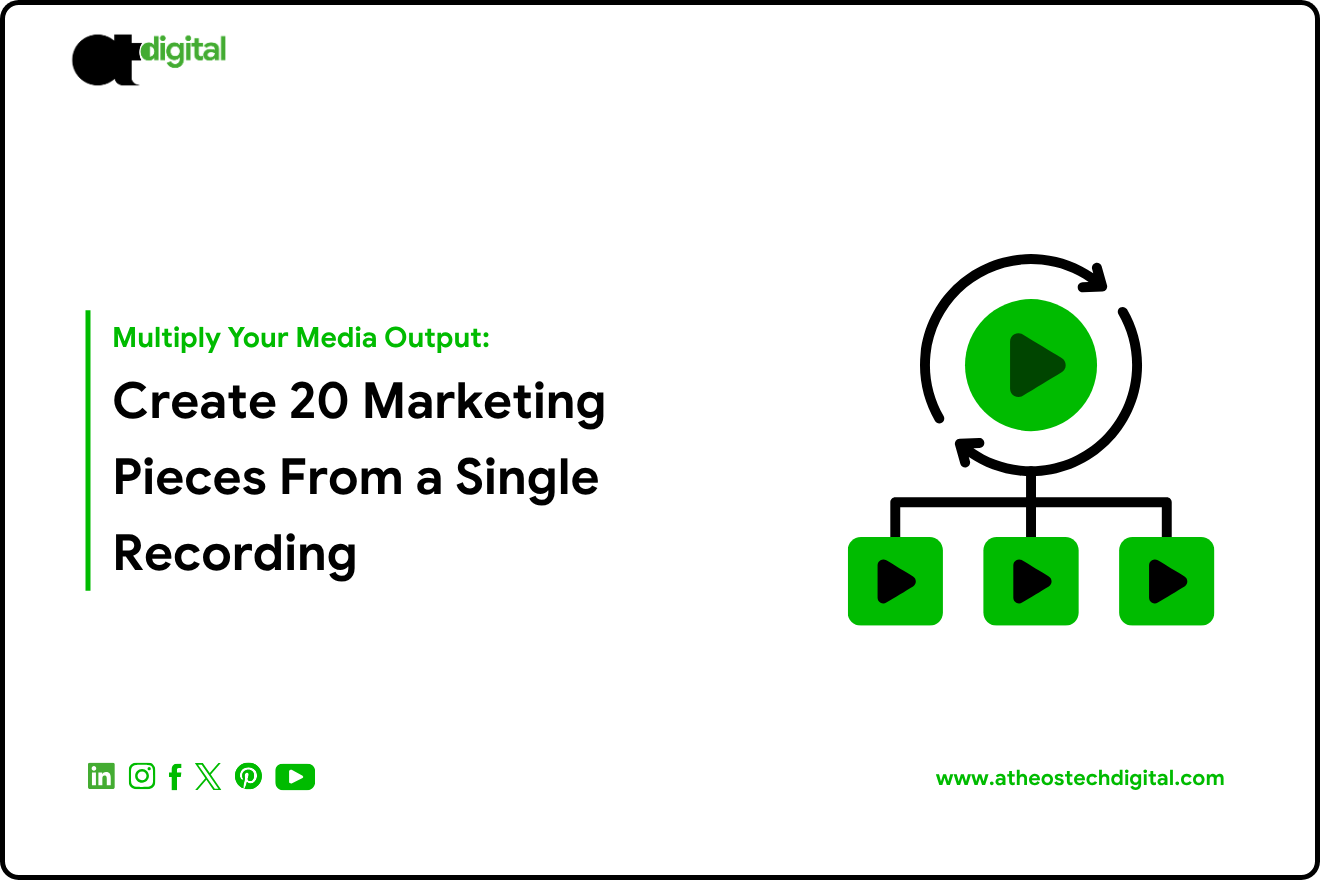
A content repurposing workflow turns one source recording into many formats for different channels. Record one 20-minute video, then extract: 1 article, 1 podcast, 3 short clips, 5 LinkedIn posts, 1 slide carousel, 3 quote graphics, 2 emails, 1 FAQ page, 1 lead-gen PDF and 1 sales one-pager. That’s 20 assets from 20 minutes of your expert’s time.
The rest of this guide shows you how to record the source well, extract from it properly, and avoid the one mistake that turns repurposing into an SEO liability.
Want This Workflow Built for You?
We handle the extraction, formatting and distribution, so your expert only has to show up for 20 minutes.
Why This Works: The Case for Repurposing Over Constant Creation
Two numbers explain why this approach is winning right now. Content Marketing Institute research found that 61% of B2B marketers plan to increase their video investment, and Wyzowl’s 2026 State of Video report puts video adoption among businesses at 91%. Everyone agrees video matters. Almost nobody’s founder has time to produce twenty pieces of it a month from scratch.
Repurposing solves that gap. It works because different buyers consume differently: one reads a long article, another watches a 90-second clip, a third only sees the LinkedIn post before a sales call. Repurposing also respects something researchers keep confirming about attention. Vidyard’s analysis of nearly a million B2B videos found that clips under one minute hit a 65% completion rate, while videos over 20 minutes dropped to just 20%. And that pattern is shaping how B2B content gets made: the average B2B video length has compressed from 168 seconds in 2024 to about 76 seconds in 2026. Your one long source recording is exactly the raw material that trend rewards, once you cut it down.
There is a limit worth naming honestly: repurposing multiplies whatever you start with. A vague recording produces 20 vague assets. Everything below depends on getting the source right first.
Step 1: Record One Source Asset With a Real Point of View
Skip “our company story.” Record your expert answering one question your buyers actually ask: why do most ad accounts leak money? or what should a small firm check before hiring an agency?
A simple structure, not a script:
- One core problem your audience recognizes
- One clear position on how to solve it
- Three to five key points, each with a specific example, number or story
- One or two objections, answered directly
Twenty minutes is enough. Longer recordings are harder to mine, not richer, and the completion-rate data above is exactly why: buyers reward density.
Step 2: Transcribe and Extract
Turn the recording into a transcript, then mark what’s reusable:
- Strong claims that could stand alone as a post
- Stories and examples that make a point memorable
- Numbers and frameworks that translate into graphics or checklists
- Questions and objections that become FAQ entries
- Quotable sentences, short and self-contained
This pass is where all 20 assets come from. You’re not rewriting the video; you’re mining it.
Step 3: Map It Into 20 Assets
Here’s a working breakdown from one 20-minute video.
| Asset | Count | Job it does |
|---|---|---|
| Full video | 1 | Home base on your site and YouTube |
| Podcast or audio version | 1 | Reaches people who listen instead of watch |
| Long-form article | 1 | Captures search traffic, builds authority |
| Downloadable checklist or diagnostic PDF | 1 | Captures leads for your CRM |
| Short video clips (under 90 seconds) | 3 | Social reach and sales follow-up |
| LinkedIn text posts | 5 | Daily visibility with your best ideas |
| Slide carousel | 1 | Skimmable format for LinkedIn |
| Quote graphics | 3 | Fast, shareable reinforcement |
| Email newsletter issues | 2 | Reaches your existing list directly |
| FAQ section or page | 1 | Answers questions for search and sales |
| Sales one-pager or follow-up snippet | 1 | Arms your team before and after calls |
| Total | 20 |
Not every business needs every asset. If your priority is pipeline, prioritize the PDF, clips and one-pager. If it’s search visibility, prioritize the article and FAQ.
Repurposing Content for Social Media: Adapt, Don’t Copy
Pasting identical text everywhere is spam with extra steps, not repurposing. Each platform rewards a different shape:
- LinkedIn: a strong opening line, one idea per post, plain language. Carousels work well for frameworks and checklists.
- Short-form video: vertical format, captions and a hook in the first three seconds. Cut clips around a single point, and keep them under 90 seconds if you want the completion-rate advantage the data above shows.
- Email: one idea per issue, written as if to one person, with one clear next step.
- Blog and site: structured headings, search-friendly wording and internal links.
Keep the idea, change the shape. Someone who sees you on three platforms should feel reinforced, not repeated.
Content Repurposing Examples
A B2B consultancy founder records a 20-minute talk on why ad budgets leak. It becomes an article, five LinkedIn posts, three clips, a “10-point audit” PDF and two emails.
A law firm partner answers the five questions clients ask most, on camera. Each answer becomes a short clip and an FAQ entry, and the full recording becomes a guide.
A SaaS company turns a customer webinar into an article, a case study one-pager, a slide carousel and a follow-up email sequence.
In each case, the expert spends the same 20 minutes. The output multiplies.
Avoid Content Cannibalisation and Duplicate Content
This is where repurposing efforts backfire, and it’s worth getting right. Google’s own guidance is reassuring here: there is no duplicate content penalty. Google’s own engineers estimate that roughly 60% of the web is some form of duplicate content, and its systems simply choose one version to show in search results, consolidating ranking signals onto it. The real risk of duplicate content and cannibalisation isn’t punishment: it’s that you lose control of which page shows up, and it’s rarely your best one.
To keep control:
- Give each topic one home page. Everything else supports it and links to it.
- Rewrite, don’t paste. An article built from a transcript should be edited into a proper article. A raw transcript is thin content.
- Use canonical tags if you republish a piece elsewhere or across multiple URLs. Google treats a canonical tag as a strong hint for which version to index, not a guarantee, so keep your internal links and sitemap pointing at the same URL you want ranked.
- Target different intentions. If your article covers a broad topic, use the FAQ to capture specific question searches instead of duplicating the article.
- When republishing elsewhere, use a canonical link if the platform supports it, or publish an adapted version that links back to the original.
Build a Content Distribution Strategy, Not a Dump
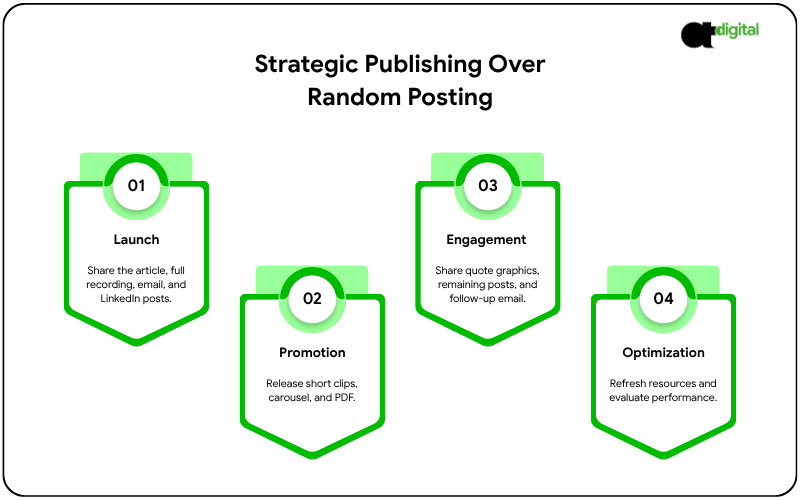
Twenty assets published in one day is a burst. Spread across a month, it’s a content distribution strategy.
A simple pattern:
- Week 1: Publish the article and full video. Send the first email. Post the first LinkedIn text posts.
- Week 2: Release the short clips and carousel. Share the PDF.
- Week 3: Post quote graphics and remaining text posts. Send the second email.
- Week 4: Update the FAQ, refresh the sales one-pager, and review what performed.
Also keep a simple content marketing distribution checklist for each piece: where it lives, where it’s shared and what links to it internally. Link your clips and posts back to the main article so authority builds in one place, not twenty.
Ready to Turn One Recording Into a Month of Content?
We build the extraction map, adapt each asset to its channel, and schedule the rollout, so nothing sits unused in a folder.
Measure What Matters
Views are easy to count and easy to misread. Track the signals tied to revenue:
- Which assets lead to booked calls or form fills
- Which pieces prospects mention in sales conversations
- Organic traffic and rankings for the main article
- Downloads and sign-ups from the PDF
- Whether sales conversations start further along than before
Then double down on the topics and formats that move real buyers, not just the ones with the highest view count.
DIY, Hire, or Hybrid?
You can run this workflow in-house. If you look at content repurposing services, be clear about who does what:
- Keep with the expert: the source recording and the opinions in it.
- Delegate: transcription, editing, formatting, scheduling and distribution.
- Ask any provider: how they preserve the expert’s voice, how they avoid duplicate content, and how they report on results. If your team needs a stronger site foundation for all this content to live on, our website design and development services and content marketing services work together on exactly this.
Be wary of any service that promises volume without asking what your buyers actually need to know.
The Verdict: Stop Creating From Scratch. Start Extracting.
You don’t need more content. You need better use of the expertise you already have sitting in one conversation.
Here’s the math that makes the case: one 20-minute recording, extracted properly, becomes 20 assets covering search, social, email and sales enablement for an entire month. The alternative, creating 20 separate pieces from scratch, would cost your expert 20 separate interruptions. Repurposing isn’t a shortcut. It’s the only version of this that actually gets done.
Record one strong source this month. Extract what matters. Adapt it for each channel. Distribute it on a schedule that keeps you visible for four weeks, not four days. Then do it again next month, because the workflow, once built, runs on autopilot.
Your expert already has the next 20 assets in their head. The only question is whether you extract them this month, or lose another month to a blank content calendar. Our content audit shows exactly which source recording to start with and maps the full 20-asset plan before you record a single minute. Book it now, and stop starting from a blank page.
Get Your 20-Asset Content Map
Engineering-grade analysis. Pure mathematics. Zero sales scripts.