

Teresa and Raj run competing consultancies, and they’re both pitching the same enterprise buyer, in the same week.
Teresa has spent the last year publishing sharp, specific takes on the exact problem this buyer is facing: pricing-model breakdowns, a contrarian take on a popular framework, real numbers from real engagements. Raj has a polished website and nothing else. The buyer who found Teresa’s writing walks into her call already convinced. The buyer evaluating Raj walks in asking, “so, why you and not your competitor?”
That question is the tax Raj pays for staying silent, and it’s a real, measurable one. This guide explains what the research actually shows about executive publishing, what separates real thought leadership from LinkedIn noise, and how to build it without turning your CEO into a full-time writer. It’s the practical companion to our pillar guide, The Pre-Sold Prospect, which explains why buyers who’ve read your thinking arrive at the call already sold.
What Is Thought Leadership, and Why Do CEOs Need to Publish It?
Thought leadership is published insight, backed by data or experience, that demonstrates genuine expertise rather than describing a product. CEOs need to publish it because buyers trust it more than marketing materials when judging capability. Per the Edelman-LinkedIn B2B Thought Leadership Impact Report, 73% of decision-makers call it a more trustworthy basis for assessing competence than product sheets.
The rest of this guide breaks down what that trust actually converts into, and what separates thought leadership that works from the generic content that doesn’t.
Is Your Executive Team’s Content Doing Any Real Work?
We run a forensic audit of your current content and show you exactly where it’s failing to pre-sell your prospects.
The Trust Gap: What B2B Buyers Actually Do With Thought Leadership
This isn’t a soft, feel-good marketing claim. The Edelman-LinkedIn research, drawn from surveys of thousands of B2B decision-makers and C-suite executives, ties executive publishing directly to pipeline behavior:
- 86% of decision-makers say they’d be moderately or very likely to invite an organization that consistently produces high-quality thought leadership into the RFP process, meaning you get considered for deals you’d otherwise never see. That’s precisely the mechanism that put Teresa in the room and left Raj fighting to get noticed.
- 54% of decision-makers and 52% of C-level executives spend an hour or more every week reading thought leadership content, according to LinkedIn’s own research summary. Your prospects are already reading. The only question is whether they’re reading yours or a competitor’s.
- 60% of decision-makers say strong thought leadership makes them willing to pay a premium for a vendor’s product or service.
- 70% of C-suite leaders say a piece of thought leadership has at least occasionally led them to question whether they should keep working with an existing supplier, which cuts both ways: it’s a threat to vendors staying silent, and an opportunity for the one who speaks up.
Here’s the honest caveat, and it matters: only 15% of decision-makers describe the overall quality of the thought leadership they currently read as very good or excellent. Most of what’s published is forgettable. That’s not a reason to skip publishing. It’s the actual opportunity: the bar for standing out is lower than most executives assume, because almost nobody is clearing it.
Thought Leadership vs. Content Marketing: Why the Distinction Matters
What is thought leadership content, exactly, and how is it different from the blog posts your marketing team already produces? Content marketing, broadly, is any content built to attract and engage an audience. Thought leadership is a specific, narrower category within that: content that stakes out a genuine, often contrarian position, backed by direct expertise or data, that only someone with real authority on the topic could credibly write.
Thought leadership vs. content marketing, in practice:
| Content marketing | Thought leadership |
|---|---|
| “5 Tips for Better Email Open Rates” | “Why Your Open Rate Metric Is Lying to You, and What to Track Instead” |
| Summarizes known best practices | Takes a specific, defensible position |
| Can be written by anyone on the team | Requires the expertise of the person whose name is on it |
| Optimizes for search volume | Optimizes for credibility and trust |
Both have a role. But only one of them is what moves a skeptical decision-maker, because only one of them proves you understand their problem better than the vendor they’re currently using.
CEO Positioning: Why It Has to Come From the Top
CEO positioning and executive branding aren’t vanity exercises. They’re a direct answer to a specific buyer behavior: decision-makers evaluating a vendor look for a credible individual behind the claims, not just a company logo.
The Delegation Problem: Why Ghostwritten Fluff Gets Ignored
Here’s where most executive thought leadership efforts quietly fail. A CEO hands the task to a junior marketer or an agency with no direct access to the executive’s actual thinking, and the result reads exactly like what it is: generic, safe, and interchangeable with a hundred other posts saying the same thing. Raj actually tried this route a year earlier, a freelancer producing two posts a month in his name, and quietly stopped after three months because nobody engaged with any of it. Experienced buyers can tell the difference between a founder’s real opinion and a ghostwriter’s guess at one, and the generic version does more damage than publishing nothing at all, because it signals the executive’s time is too valuable for the people reading it.
The fix isn’t that the CEO has to write every word personally. It’s that the ideas, the specific position, the real experience, have to originate from them. A skilled writer can shape that into a published piece. No writer can manufacture a genuine opinion the executive doesn’t actually hold.
How to Become a Thought Leader Without Becoming a Full-Time Writer
How to become a thought leader starts with a reframe: you’re not becoming a content creator. You’re extracting knowledge you already have, in a format you’re already comfortable with. Teresa’s actual process is almost embarrassingly simple: a 20-minute recorded call once a month with someone who turns it into a published piece. That’s the entire time investment behind a year of content a competitor’s buyer found convincing enough to pre-sell the deal.
- Talk, don’t type. A 20-minute recorded conversation about a problem you’ve solved produces more usable material than staring at a blank document.
- Start from a real opinion, not a safe one. “Here are five trends” is forgettable. “Most companies are measuring this wrong, and here’s what to track instead” gets read.
- Use your existing work as raw material. Client conversations, internal strategy debates, and problems you’ve personally solved are the actual source of thought leadership, not a brainstorm for blog topics.
- Publish consistently, not constantly. One sharp, well-reasoned piece a month beats five generic posts a week.
How Much Time Would Real Thought Leadership Actually Cost Your CEO?
Less than you think. We scope the process around a single monthly conversation, not a content calendar nobody has time for.
What Separates Real Thought Leadership From Noise
Given that 85% of current thought leadership fails to impress the people reading it, what does the other 15% actually do differently? The Edelman-LinkedIn data is specific about this: 55% of decision-makers cite strong, verifiable research and data as the top characteristic of high-quality thought leadership, and 62% say credibility comes from a prominent, genuinely expert individual being behind the content.
In practice, that means every strong piece of thought leadership content needs three things working together:
- A specific, defensible position, not a survey of five options with no recommendation.
- Real evidence: a number, a case result, a pattern you’ve actually observed, not a borrowed statistic everyone else is already citing.
- A named, credible voice behind it, ideally the executive whose actual experience the piece draws from.
Thought leadership examples that follow this pattern tend to share a structure: they name a specific, expensive problem the reader recognizes, explain exactly why the common approach to it fails, and back that explanation with something concrete the reader can verify, rather than take on faith. The piece that got Teresa into that RFP wasn’t a trend roundup. It was 900 words arguing that a popular pricing model in her industry quietly punishes the clients who need the most help, with her own engagement data to back it up.
Want Your Executive’s Expertise Turned Into Published Assets?
We extract your real expertise through short interviews and turn it into the data-backed, credible content buyers actually trust.
Thought Leadership Content Marketing: Building the System, Not Just the Post
One strong article doesn’t move the pipeline on its own. Thought leadership marketing that actually compounds needs a system behind it, not a one-off push:
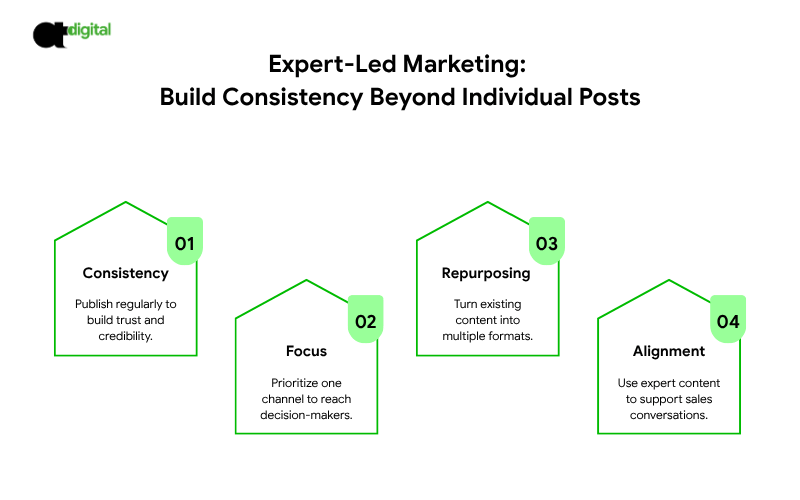
- A consistent cadence. Sporadic publishing (one strong piece, then silence for four months) doesn’t build the trust the data above describes. Monthly, sustained output does.
- One primary channel, built out properly. For most B2B companies, that’s a long-form piece on your own site paired with LinkedIn distribution, since that’s where the research shows decision-makers are actually reading.
- Repurposing, not reinvention. A single strong interview or article can become several LinkedIn posts, a short video, and a sales-enablement one-pager, without demanding new executive time for each format.
- A direct line to sales. The strongest b2b thought leadership programs feed directly into what sales teams send prospects before and after calls, not just what sits on a blog nobody on the sales team reads.
Measuring Thought Leadership: The Honest Numbers
Before you commit a budget here, it’s worth being straight about measurement, because the industry itself is honest about this being imperfect. Fewer than one in three decision-makers and marketers can cleanly trace a specific sale back to a specific piece of thought leadership. That’s not a reason to skip measurement. It’s a reason to track the right signals instead of expecting a clean, single-touch attribution line.
What to actually track for thought leadership business impact:
- Sales cycle length on deals where the prospect mentions having read your content before the call
- RFP invitations or inbound requests to pitch, which the 86% figure above suggests should rise with consistent publishing
- Direct prospect mentions of specific pieces during sales conversations, which your sales team should be logging
- Engagement from the right people, not just volume: are decision-makers and executives engaging, or just your own industry peers
DIY vs. Hiring a Content Strategy Agency
You can run a lean version of this in-house if your executive has even an hour a month and someone to extract and shape that thinking into finished pieces. Consider bringing in outside help, whether a content strategy agency, a content marketing company, or a dedicated thought leadership agency, when:
- Your executive has the expertise but genuinely no time to shape it into finished content
- You need a consistent monthly cadence and nobody internally owns that process
- Your current content reads generic and isn’t moving the trust and RFP-invitation numbers above
If you’re comparing a content marketing service, content marketing consulting, or thought leadership consulting, ask three questions before signing anything: how do they extract your actual expertise (interviews and conversations, not a generic brief template), how do they maintain your specific voice instead of a generic agency tone, and how do they tie the content back to sales conversations rather than just publishing volume. For a team that handles the writing, formatting and distribution as one connected system, see our content creation services.
The Verdict: Your Silence Is a Competitive Advantage, for Someone Else
Here’s the math that should change how you think about this: 73% of your buyers trust published thinking over your marketing materials, 86% say they’d invite a consistent publisher into deals they’d otherwise never see, and only 15% think the content they’re currently reading is actually good. That’s not a crowded field you’re late to. It’s an open lane with almost nobody running in it well.
Go back to Teresa and Raj. The difference between them wasn’t talent, price, or even track record, both were genuinely qualified for that deal. It was one recorded conversation a month, going back a year, that Raj never had. Every month your executive team stays silent, a competitor is building that exact gap, one RFP invitation at a time. The buyer who reads their thinking walks into the call already leaning their way. The buyer who’s only seen your homepage walks in asking you to justify your existence from zero.
You don’t need your CEO to become a full-time writer. You need their real expertise extracted, shaped and published consistently enough to compound. Our thought leadership audit looks at what your executives are currently publishing, if anything, and shows you exactly where the gap between your silence and your competitor’s visibility is costing you deals. Book it before your next RFP goes to the vendor who showed up in the buyer’s reading list first.
Stop Losing Deals to Executives Who Publish
Engineering-grade analysis. Pure mathematics. Zero sales scripts.


