
Cobalt Fitness Equipment and a close competitor spend the exact same amount on traffic this month.
Cobalt gets 100 visitors and converts 2 into leads. The competitor gets the same 100 visitors and converts 4. Same budget, same ad spend, same market, double the pipeline for the competitor. They didn’t find a secret traffic source. They just fixed what happens after someone arrives, something Cobalt’s team hadn’t touched since the site launched two years earlier.
That’s the entire premise of conversion rate optimization, and it’s consistently the most underused lever in digital marketing, because it’s less exciting than a new ad campaign and takes more discipline than a redesign. This guide covers the real basics: what CRO actually means, what a realistic baseline looks like, and the specific tweaks that move the needle without costing you a dollar in new traffic. It’s the practical companion to our pillar guide, The Silent Closer, which explains why your website should perform like your best salesperson.
What Is CRO, and How Can It Double Your Leads?
Conversion rate optimization (CRO) is the systematic process of increasing the percentage of visitors who complete a desired action, without increasing traffic. It works because most websites lose visitors to fixable friction, not disinterest. Lifting your conversion rate from 2% to 4% doubles your leads from the same ad spend.
The rest of this guide breaks down a real CRO process, the mistakes that quietly sink it, and the specific fixes worth prioritizing first.
What’s Your Site’s Real Conversion Rate?
We benchmark your current conversion rate against your industry and show you exactly where visitors are dropping off.
What Does CRO Mean in Marketing?
What does CRO mean in marketing, beyond the acronym? It’s the discipline of treating your website as a system you can measurably improve, rather than a finished asset you launch once and leave alone. CRO (sometimes written as CRO conversion rate optimization) isn’t a single tactic like A/B testing or button colors; it’s a repeating process of research, hypothesis and testing.
The benefits of conversion rate optimization compound in a way paid traffic doesn’t: a landing page converting at 4% instead of 2% keeps that advantage on every future visitor, paid or organic, for as long as the page exists. You’re not renting a temporary lift. You’re fixing the foundation.
What’s a Good Conversion Rate? Setting a Real Baseline
Before optimizing anything, you need an honest baseline. Unbounce’s Conversion Benchmark Report, drawn from 57 million conversions across more than 41,000 landing pages, puts the median landing page conversion rate at 6.6% overall, with wide variation by industry, financial services median around 8.4%, SaaS trailing at 3.8%.
For broader site-wide and B2B conversion rates specifically, figures in the 2% to 3% range are commonly cited as typical. If you’re sitting well below your industry’s benchmark, that gap is where the opportunity lives. If you’re already above it, the smaller, incremental gains from ongoing testing still compound over time. Cobalt, at 2%, wasn’t failing by any obvious measure. They were simply sitting exactly at the point where the opportunity was largest and nobody had looked.
What Are the Steps of Conversion Optimization?
A real CRO process isn’t a grab bag of tips. The widely used framework, documented extensively by CRO research firm CXL, runs in a repeating loop:
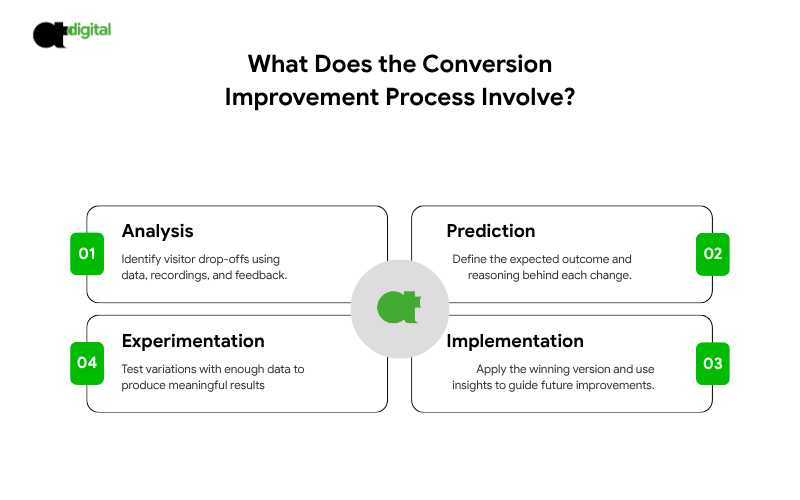
- Research: understand where visitors actually drop off and why, using analytics, heatmaps, session recordings and direct user feedback, not assumptions.
- Hypothesis: form a specific prediction with three parts: the change you’ll make, the effect you expect, and the reasoning behind it. “We think shortening the form will increase submissions because analytics show high abandonment after field 4” is a hypothesis. “Let’s try a different headline” is a guess.
- Test: run the change, typically through A/B testing, long enough to reach a meaningful sample size before declaring a result.
- Ship: implement the winning version, and feed what you learned back into the next round of research.
This is also where a conversion rate optimization audit earns its keep: a structured review of your current site against this framework, identifying where the biggest, most provable leaks actually are, rather than guessing at fixes.
Conversion rate optimization testing and A/B testing landing pages specifically require patience most teams underestimate: a test ended too early, or run on too little traffic, produces results you can’t trust. Resist the urge to call a winner after three days.
Factors That Negatively Affect CRO
Before adding anything, it’s worth knowing what actively sabotages conversion rate optimization efforts in the first place. Cobalt’s original audit found three of these happening at once:
- Testing too many things at once. Change the headline, the image and the button color simultaneously, and you’ll never know which one moved the number.
- Ending tests early. A test that looks like it’s winning after two days often reverses by day ten once you have enough data.
- Optimizing for the wrong metric. A change that increases form submissions but fills your pipeline with unqualified leads isn’t really a win.
- Ignoring mobile entirely. Cobalt had never once reviewed their form on an actual phone; it required pinch-zooming to read the field labels.
- Slow page speed. No amount of copy or button testing overcomes a page that takes too long to load; visitors leave before they see what you changed.
- Executive opinion overriding data. Cobalt’s 11-field quote request form existed because a sales director insisted on it two years earlier, “to pre-qualify leads,” and nobody had ever tested whether it was actually costing more leads than it qualified.
CRO Basics: Simple Tweaks That Move the Needle
You don’t need a full testing program to start. These are the conversion rate optimization techniques and conversion rate optimization best practices that reliably produce results, in roughly the order of expected impact:
- Cut form fields to the minimum. Every unnecessary field is a reason to abandon it. Ask only what you need for the next step, not everything you’ll eventually want. Cobalt cut their form from 11 fields to 4.
- Match your headline to how the visitor arrived. If they clicked an ad for a specific offer, the page they landed on should say exactly that, immediately.
- Add one specific proof point above the fold. A number, a result, a real testimonial, not vague claims of quality.
- Make your primary call to action singular and obvious. One clear next step beats three competing ones every time.
- Fix your page speed first, before testing anything else. It’s the one factor that undermines every other improvement if left unaddressed.
Homepage-Specific Fixes
Your homepage carries a different job than a landing page: it has to orient a visitor who might not know exactly what they’re looking for yet. Strong website homepage design states your value proposition in one sentence, above the fold, and gives visitors a small number of clear paths forward rather than a dozen competing links.
Mobile-Specific Fixes
Mobile website design needs its own testing pass, not an assumption that desktop results transfer. Thumb-friendly buttons, forms that don’t require pinch-zooming, and load speed tested on an actual mobile connection (not office Wi-Fi) all affect conversion independently of anything happening on desktop. Fixing the pinch-zoom problem alone accounted for roughly a third of Cobalt’s eventual lift.
Want These Tweaks Implemented Properly?
We run the research, build the tests, and implement the fixes that are statistically proven to work on your site, not guesses.
Website Design as the Foundation of CRO
CRO doesn’t happen in isolation from the site it’s optimizing. Strong business website design, whether that’s modern website design, a from-scratch custom website design and development project, or a refresh of an existing company website design, sets the ceiling for what optimization can achieve. You can test button copy endlessly, but no test overcomes a fundamentally confusing page structure or a slow, bloated build.
This applies whether you’re running corporate website development for an enterprise brand, a leaner service website design for a small business, or specialized tech website design for a SaaS product. The underlying principle holds across all of them: a clean, fast, purpose-built foundation makes every subsequent optimization effort more effective.
eCommerce CRO: A Different Game
Ecommerce conversion rate optimization deserves its own mention, because the funnel, and the stakes, differ from a lead-generation site. Instead of one form, there’s a full path: product page, cart, checkout, each with its own abandonment points. An ecommerce cro agency or specialist typically focuses heavily on checkout friction specifically, since even small reductions in steps or required fields there tend to produce outsized gains given how many visitors already have their wallet out.
Turning Conversions Into Leads: The Bigger Picture
A higher conversion rate only matters if what you’re converting visitors into actually feeds your pipeline. If you’re focused on how to generate sales leads or broader lead generation marketing strategies, CRO is the multiplier sitting underneath all of them: every channel, SEO, paid, email, social, sends traffic to the same site, so a conversion rate improvement compounds across every one of them simultaneously, rather than requiring a separate fix per channel.
To genuinely increase website leads, track the full picture, not just conversion rate: inbound marketing leads quality matters as much as volume, since a higher conversion rate feeding unqualified leads into your CRM isn’t actually progress. Cobalt’s sales team, worried the shorter form would hurt lead quality, tracked this closely for the first month. Close rate on the new leads held steady. They were simply getting twice as many shots at the same quality of prospect.
Worried a Shorter Form Means Worse Leads?
We test for lead quality alongside conversion rate, so you’re not trading volume for noise.
Hiring a CRO Agency or Web Development Partner
If you’re evaluating conversion rate optimization services, comparing a conversion rate optimization agency against a dedicated cro agency, or researching conversion optimization services pricing, a few things are worth knowing first.
On pricing: conversion rate optimization services pricing varies enormously based on your traffic volume (testing requires a meaningful sample size to produce trustworthy results) and the scope of what’s being optimized, a single landing page versus a full site. Be skeptical of flat pricing quoted before anyone’s reviewed your actual traffic and conversion data.
What to ask any conversion rate optimization consultant or agency before signing:
- Do they follow a research-first process, or jump straight to testing opinions?
- Can they show a real conversion rate optimization case study, with before-and-after numbers, not just screenshots?
- How do they handle statistical significance in testing, and will they show you the math?
- Who owns the testing data and insights once the engagement ends?
If you’re earlier in the process and researching how websites are made, weighing web design or web development as separate needs, or trying to find a website designer for a ground-up build, the practical question to settle first is whether you need a new site, a redesign, or ongoing optimization of what you already have. For the website development process itself, whether you’re comparing websites development company options or evaluating web development usa providers against international teams, ask about their agency web development process specifically: how they scope, build, test and hand off, not just their portfolio. For a team that handles both the build and the ongoing optimization as one connected system, see our custom web development services.
The Verdict: The Cheapest Growth Lever You’re Not Pulling
Here’s the math that should change how you prioritize this quarter: doubling your conversion rate has the exact same effect on your pipeline as doubling your ad budget, except one of those costs money every single month and the other is a one-time fix that keeps paying.
Cobalt never found the competitor’s secret. There wasn’t one. A shorter form, a matched headline, a mobile fix that took an afternoon, applied with the same discipline their competitor had been quietly using all along. Most teams chase the exciting lever first: a new campaign, a new channel, more spend. CRO is less exciting. It’s form fields and headline tests and page speed, unglamorous work that rarely gets a case study written about it internally. But it’s also the lever sitting right under traffic you’re already paying for, which makes it the cheapest growth you’ll find this year.
You don’t need more visitors to grow your pipeline. You need more of the visitors you already have to take the next step. Our CRO audit benchmarks your current conversion rate, identifies your specific friction points, and shows you exactly which fix to run first. Book it before your next dollar of traffic goes to a page that’s still losing half the leads it could be capturing.
Stop Buying More Traffic. Start Converting More of It.
Engineering-grade analysis. Pure mathematics. Zero sales scripts.