Build Your Growth Stack

Confirm or adjust your services and enter your details.

Please select at least one service.
First name is required.
Last name is required.
Please enter a valid email address.

Category: Digital Marketing

  • The Referral Illusion: Why Word of Mouth Cannot Scale a Business in 2026

    The Referral Illusion: Why Word of Mouth Cannot Scale a Business in 2026

    THE FRAGILITY OF THE NETWORK

    [THE SCALABILITY AUDIT]

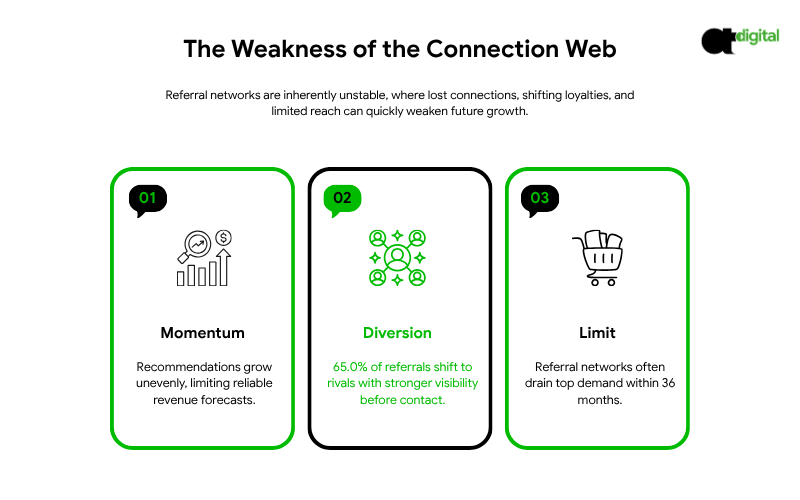
    • The Velocity Deficit: Word of mouth operates on an unpredictable timeline that completely prevents accurate revenue forecasting.
    • The Interception Rate: 65.0% of verbal referrals are actively hijacked by competitors with superior search visibility before the prospect ever makes contact.
    • The Network Ceiling: An organic referral network statistically exhausts its high intent capital within the first 36 months of operation.

    Let us examine the most dangerous phrase in modern commerce.

    “We do not need marketing because we run entirely on word of mouth.”

    Founders state this with immense pride. They wear it as a corporate badge of honor. They believe it proves the absolute superiority of their product and the fierce loyalty of their client base.

    In reality, it is a boardroom confession that their digital infrastructure is fundamentally broken. It proves they have absolutely zero operational control over their own growth pipeline.

    The Forecasting Nightmare

    Imagine sitting down with your executive team to finalize your revenue projections for the next two quarters. You want to scale. You need to hire premium talent, upgrade your software infrastructure, and expand your market footprint. You need a guaranteed influx of capital to justify the risk.

    But when you audit your acquisition model, you realize a terrifying truth. You cannot mathematically predict your next contract.

    Your entire expansion relies on the chaotic, unpredictable schedules of other people. Your financial future depends entirely on whether a past client happens to remember your name during a random conversation at a networking event. You cannot turn a dial to increase referrals. You cannot optimize a whisper.

    Relying exclusively on network referrals in 2026 places your business in a permanent state of “Hope Mode”. Many founders operate on blind faith, essentially praying, “may the words of my mouth and the loyalty of my past clients keep the lights on.” It is the equivalent of trying to power a massive industrial manufacturing plant by waiting for the wind to blow. It might keep the lights on occasionally, but it will never allow you to mathematically scale.

    The absolute financial penalty of operating in this passive state is quantified in our technical breakdown:

    At AtheosTech Digital, we view traditional word of mouth as a byproduct of exceptional service. It is not a revenue strategy. This briefing dismantles the referral illusion and proves why deploying a high-velocity digital marketing service is the exact architectural shift required to stop waiting for favors and build a predictable growth engine..

    THE VELOCITY DEFICIT

    (The Mathematical Flaw of Word of Mouth)

    [THE PREDICTABILITY AUDIT]

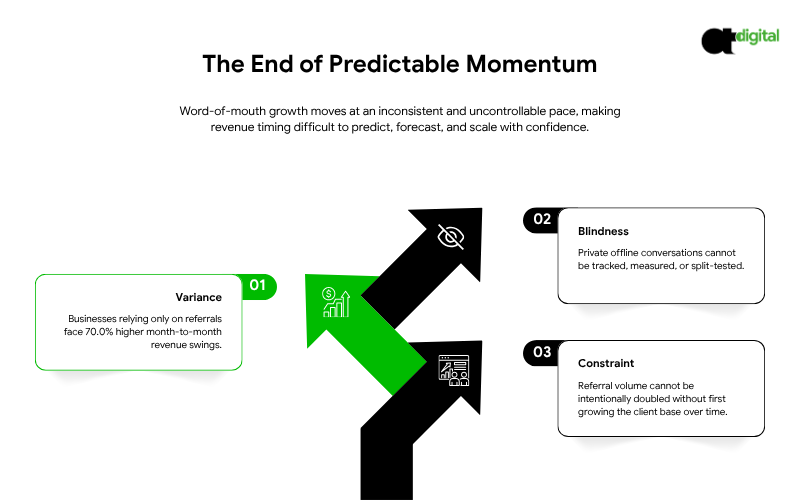
    • The Variance Metric: Businesses relying purely on organic referrals experience a 70.0% higher variance in month-over-month revenue.
    • The Optimization Void: It is mathematically impossible to track, measure, or split-test a private offline conversation.
    • The Scale Limitation: You cannot deliberately double your referral volume without first waiting years to double your client base.

    Whether you are scaling a global enterprise or deploying digital marketing services for small business expansion, an executive team must master two fundamental equations: the Customer Acquisition Cost and the Customer Acquisition Timeline. You must know exactly how much capital and how many days it takes to secure a new contract.

    Executives often ask, what is word of mouth marketing in a strictly mathematical sense? It is simply the surrender of your acquisition timeline to the chaotic schedules of other people. It completely destroys both of these metrics and replaces mathematical certainty with blind luck.

    The Danger of Serendipity

    When you rely on referrals, you surrender your growth pipeline to the chaotic schedules of other people. You are actively waiting for a past client to happen to have a highly specific conversation with a qualified prospect who happens to hold an immediate, approved budget.

    If you look at the operational definition word of mouth relies on, it is entirely passive. Serendipity is a beautiful concept in personal relationships, but it is a terminal disease for a corporate balance sheet.

    In an engineered digital infrastructure, if you need to increase revenue by 20.0% to fund a new department, you simply turn a dial. You scale your search visibility, deploy new targeted assets, and accelerate your extraction mechanism.

    With a referral network, that dial simply does not exist. You cannot force your past clients to mention your brand three more times before the end of the fiscal quarter. This total lack of algorithmic control makes it impossible to sign commercial leases, manage cash flow, or hire premium talent with absolute financial confidence. You are flying blind.

    The Measurement Void

    Furthermore, a referral-only business operates inside a permanent measurement void.

    You cannot optimize the sales pitch of a casual coffee shop conversation the way you can mathematically track search intent or social media conversion metrics. You have zero control over how your brand is being positioned by third parties.
    While you sit by the phone waiting for your offline network to execute your sales strategy for you, your highly visible competitors are looking at hard data. They are aggressively extracting the moving capital from the market every single hour because they deployed high-velocity digital marketing services to engineer a system that does not sleep, does not forget, and never stops pitching.

    PROOF VERSUS VISIBILITY

    (The Algorithmic Hijack)

    [THE INTERCEPTION AUDIT]

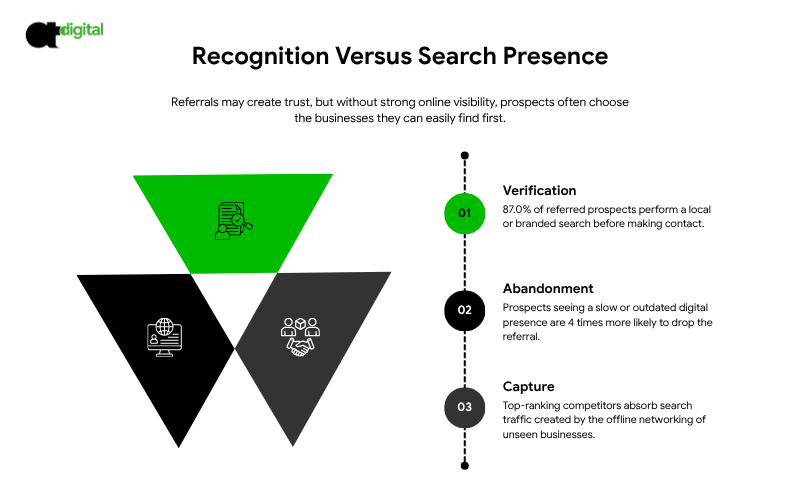
    • The Verification Mandate: 87.0% of referred prospects execute a localized or branded search before ever initiating the commercials.
    • The Deflection Rate: A prospect exposed to a slow or outdated digital footprint is 4 times more likely to abandon the referral entirely.
    • The Hijack Metric: High ranking competitors actively capture the search traffic generated by the offline networking of invisible businesses.

    Many executives fundamentally misunderstand the psychological role of a referral. They treat a verbal recommendation as a guaranteed, closed contract. This is a fatal strategic error. A referral builds trust and acts as a proof mechanism. It is absolutely not a visibility mechanism.

    The Digital Audit

    Even when the perfect verbal recommendation occurs, you are still mathematically likely to lose the deal. It is merely a story typically passed on by word of mouth. As we established in our foundational master guide Digital Darwinism 2026: The Mathematics of Survival in a Revenue-Driven Economy, this recommendation is merely an invitation to be digitally audited. The modern buyer does not operate on blind faith. They require immediate online validation before they deploy their capital.

    When your past client tells a highly qualified prospect to hire you, that prospect does not blindly pick up the phone and initiate the commercials. They immediately take out their smartphone and search for your brand or the specific service category you operate within.

    The Catastrophic Hijack

    This exact moment is where the algorithmic hijack occurs. Even the most successful word of mouth marketing examples share this fatal flaw: if your digital presence is weak, absent, or mathematically buried on the second page of search results, the prospect experiences immediate friction. In their search for your service, your heavily optimized competitor appears first.

    Their digital infrastructure loads instantly. Their Trust Architecture is flawless, presenting verified case studies and five-star online reviews that answer the buyer’s objections before they even ask them. Faced with the friction of locating your invisible business versus the immediate, engineered authority of your competitor, the human brain defaults to the path of least resistance.

    (We mapped the mathematics of this specific wealth transfer in our briefing:

    The prospect immediately forgets your verbal referral and hands their budget to the visible competitor. You did the hard, unscalable work of generating real world trust, and your competitor effortlessly harvested the financial reward.

    THE GEOGRAPHIC PRISON

    (Hitting the Network Ceiling)

    [THE SATURATION AUDIT]

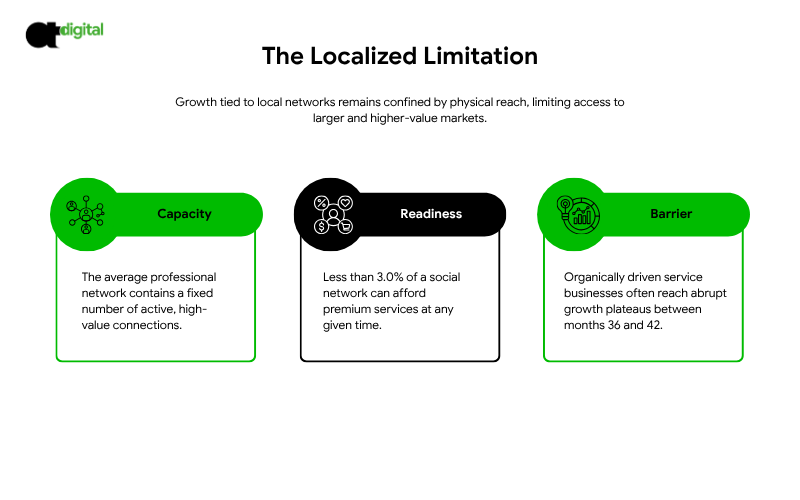
    • The Finite Limit: The average professional network contains a strictly limited number of active, high value connections.
    • The Qualification Drop: Less than 3.0% of any given social ecosystem possesses the immediate capital to hire premium services at any specific time.
    • The Three Year Wall: Statistically, organically driven service businesses plateau violently between month 36 and month 42 of operation.

    Every organic referral network has a strict mathematical limit. This is a terminal reality in digital marketing for professional services, where relying exclusively on word of mouth marketing traps you inside a closed, rapidly depleting ecosystem. Your past clients only know a finite number of people in your target demographic who actually possess the capital required to hire you.

    The Illusion of Infinite Momentum

    In the early stages of a business, this network feels infinite. This false security is exactly why digital marketing services for startups are often completely ignored until the initial momentum collapses and the referrals stop flowing. You look at your growing balance sheet and believe you have achieved absolute market fit.

    This is a dangerous corporate hallucination.

    Market data proves that usually within the first three years, a business will inevitably hit the network ceiling. You will rapidly exhaust all the immediate capital within your localized sphere of influence. Every viable prospect in your network has either already hired you or has already decided they do not need your service. The well runs completely dry.

    The Violent Stagnation

    Once you hit this mathematical ceiling, growth stops violently. Revenue flatlines. The inbound calls completely cease.

    You are no longer experiencing a slow market. You are officially trapped in a geographic and social prison while the digital world continues to move massive amounts of capital without you. You have successfully extracted all the available capital from your immediate ecosystem, and you possess absolutely zero operational infrastructure to reach beyond it.


    To break out of this localized limit, you must engineer a system that actively reaches prospects who have absolutely no connection to your existing network. Whether you are targeting national accounts or capturing the localized intent of buyers searching for digital marketing services near me, you must build an infrastructure capable of extracting cold search traffic at scale.

    CONCLUSION: THE DIGITAL MARKETING SERVICE MANDATE

    At AtheosTech Digital, we engineer predictability. A truly scalable enterprise requires a high velocity digital extraction mechanism that operates entirely independently of human memory, chaotic schedules, and casual offline conversations.

    When a localized network is completely exhausted, founders inevitably ask, what is the digital version of word of mouth marketing? The answer is a high velocity extraction mechanism. Engineered digital visibility is a strict corporate asset, whereas a verbal referral is just a professional compliment. You cannot build a financial empire on compliments. It is time to stop waiting for localized favors, step out of the geographic prison, and start controlling your absolute market share.

    This extraction mandate is the core thesis of our ultimate survival architecture, detailed in

    [INTERNAL DIAGNOSTIC: THE PREDICTABILITY TEST]

    Before we map out the commercials for a scalable digital infrastructure, your executive team must answer these strict diagnostic questions.

    • Can you mathematically guarantee exactly how many qualified leads your business will generate next Tuesday?
    • How much capital are you actively losing to competitors who intercept your verbal referrals online before the prospect ever calls you?
    • Have you already hit the financial ceiling of your immediate localized referral network?

    If your revenue generation relies on unpredictable offline conversations, your business is an operational liability. Let us look at the mathematics of absolute control

    Schedule A Diagnostic Review

    Let us analyze your digital infrastructure and map out the exact sequence required to capture your market share.

  • Your Store is Open, But is Anyone Watching? The Cost of Digital Invisibility

    Your Store is Open, But is Anyone Watching? The Cost of Digital Invisibility

    THE ARCHITECTURAL SABOTAGE

    [THE VISIBILITY AUDIT]

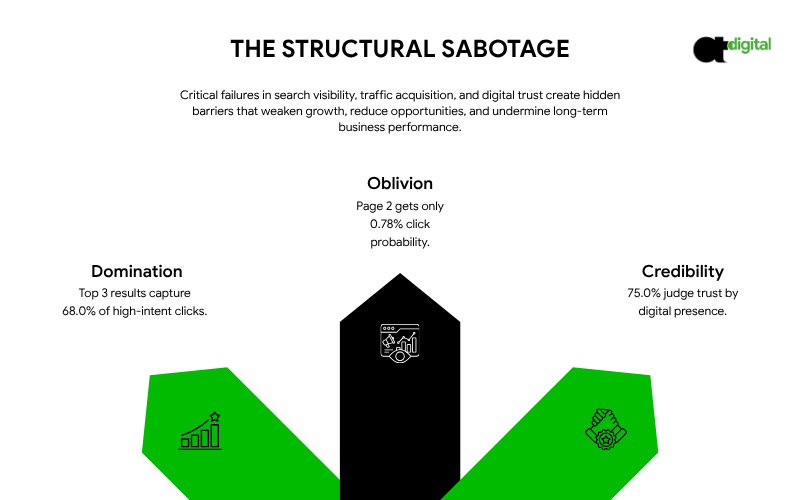
    • The Market Capture: The top 3 organic search results capture over 68.0% of all high intent clicks.
    • The Graveyard Metric: Results on Page 2 receive a catastrophic 0.78% click probability.
    • The Trust Penalty: 75.0% of all modern buyers judge a company’s operational credibility based purely on its digital presence.

    Let us examine a common boardroom delusion.

    It is the end of the fiscal quarter. You are auditing your balance sheet. Inbound leads have flatlined. Revenue is stagnant. You gather your core team and collectively agree that the market is simply “slow”. You blame economic uncertainty. You convince yourself that consumer and corporate budgets have temporarily frozen.

    Then, you look at your direct competitor.

    • They are actively expanding. They are launching new locations, hiring premium talent, and scaling their operations.
    • They exist in the exact same economy as you. They target the exact same demographic. Their product is not superior to yours. In many cases, it is fundamentally worse. So why are they absorbing all the capital while your pipeline dries up?
    • They are not outperforming you on quality. They are outperforming you on visibility.

    While you waited for traditional referrals to generate momentum, they deployed high-performance digital marketing services to intercept every high intent query in your sector. They did not steal your potential customers. They simply stood directly in front of the moving capital while you remained completely hidden. To your balance sheet, the market feels dead. To your competitor, the market has never been more lucrative.

    To your balance sheet, the market feels dead. To your competitor, the market has never been more lucrative.

    The Brick Wall Fallacy

    Imagine opening a flagship retail location or a premium service office. You invest heavily in the physical infrastructure. You hire elite staff. You engineer a flawless product. Then, you build a solid brick wall directly over the front door and remove your address from the public map.

    This sounds like intentional corporate sabotage. Yet, this is exactly how the majority of founders manage their digital infrastructure.

    Many business owners look at a flatlining balance sheet and assume their product is failing or the economy is tight. They assume they are broke. In reality, they are simply invisible. They build a website, launch it into the digital void, and rely on passive hope in an era where algorithms dictate market share. In the modern economy, foot traffic does not exist. If you are not aggressively capturing search traffic, you are actively bleeding capital.

    At AtheosTech Digital, we do not tolerate passive marketing. We view visibility as critical operational infrastructure. This briefing exposes the exact mathematical cost of your current obscurity and the architectural shifts required to escape the graveyard and capture your sector.

    This briefing is an expansion of the visibility crisis outlined in our foundational master guide:

    THE “NOT BROKE, JUST INVISIBLE” FALLACY

    (The Myth of the Slow Market)

    [THE INTENT AUDIT]

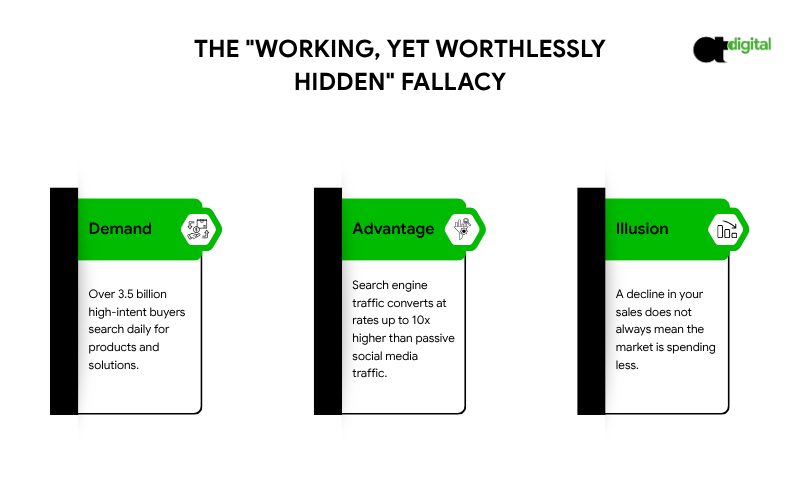
    • Active Demand: There are over 3.5 billion high intent, solution-seeking searches processed every single day.
    • The Conversion Delta: Search engine traffic converts at a rate 10 times higher than passive social media traffic.
    • The Revenue Illusion: A drop in your specific sales does not equal a drop in overall market spending.

    Every quarter, thousands of business owners sit in meeting rooms and blame external factors for their flatlining revenue. They blame a “slow market”. They blame economic downturns. They convince themselves that consumer and corporate budgets have simply dried up.

    They assume the market is broken. In reality, the business is just invisible.
    The capital did not dry up. It simply bypassed your digital storefront and flowed directly into the bank account of your highest ranking competitor. Whether you are looking for digital marketing services for startups to ignite early growth or digital marketing services for small business to stabilize a local market, the requirement is the same: you must be seen.

    The Mathematics of Search Intent

    Let us look at the cold, unforgiving mathematics of search intent. It is the most misunderstood metric in modern commerce.

    Whether a homeowner frantically searches for an “Emergency Plumber Near Me” or a procurement director searches for an “Industrial Valve Supplier,” they are not browsing for casual entertainment. They are not scrolling through an algorithmic feed looking for distraction.

    They are holding capital. They have an immediate, painful problem. They are actively looking for a vendor to write a check to.

    This is the fundamental difference between passive disruption and active extraction. Social media advertising interrupts a user who is trying to do something else. Search visibility intercepts a user who is actively trying to give you their money.

    The Page Two Ghost Town

    The market is never completely slow. The capital is moving every single day.

    However, if your business is sitting on Page 2 of the search results, you simply do not exist to receive that capital. You are a ghost in your own industry. You are competing for less than one percent of the total market attention. You cannot build a scaling enterprise, or even a local dominant firm, on a fraction of a percent of visibility.


    The Extraction Mandate: You do not need a better product. You do not need to drastically lower your prices or offer desperate discounts. You need a digital extraction mechanism that places your existing product directly in front of the moving capital exactly when the prospect is ready to buy.

    THE INVISIBLE TAX

    (Calculating the Cost of Digital Invisibility)

    [THE WEALTH TRANSFER AUDIT]

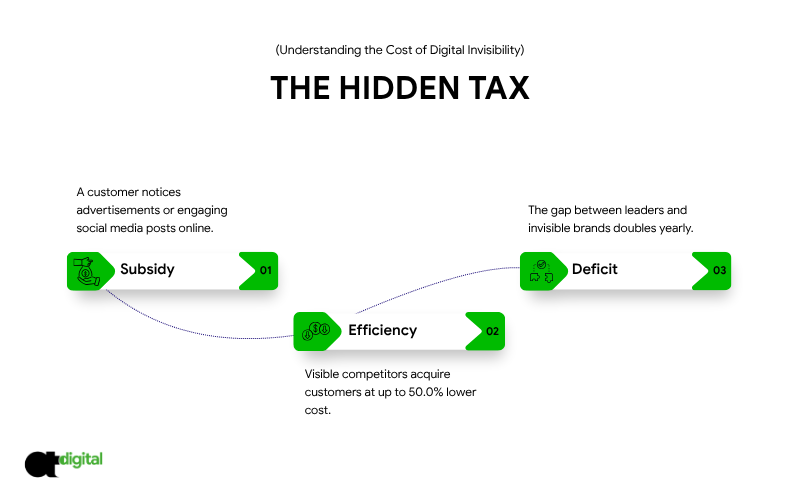
    • The Competitor Subsidy: 100.0% of your forfeited search traffic directly funds a rival operation.
    • The Acquisition Multiplier: A highly visible competitor acquires customers at a 50.0% lower cost than a business relying purely on outbound sales.
    • The Compounding Deficit: The financial gap between the digital market leader and the invisible business doubles every 12 months.

    Many business owners operate under a dangerous corporate delusion. They believe that a lack of digital visibility is a neutral state. They assume that if they are not actively winning new business online, they are simply maintaining their current position.

    The mathematical reality is far more brutal. Obscurity is never neutral. It is an active, heavy tax levied against your gross margin every single hour of the working day.

    The Direct Subsidy of Your Rivals

    The digital economy operates as a strict zero sum environment. The demand exists, and the capital will be spent.

    Every time a premium prospect searches for your exact service and clicks your competitor, you do not just lose a sale. You actively subsidize your competition. You just handed them the exact transaction they will use to destroy your market positioning.


    They will take that $50,000 or $150,000 contract and weaponize it. They will use your lost revenue to hire elite talent, deploy aggressive paid media campaigns, and strengthen their own digital architecture. By capturing the capital that should have been yours, they widen the operational moat around their own business.

    The Compounding Deficit

    We call this the Invisible Tax.

    You are literally paying for your competitor to grow through your own digital negligence. They are using your forfeited capital to buy the very market share you desperately need to survive.

    Every single day you delay engineering your search visibility, the cost of staying invisible compounds until your market share is unrecoverable.

    The Neutrality Myth: You are never simply “standing still”. If you are not actively capturing digital market share, you are hemorrhaging capital to the exact people trying to put you out of business.

    THE TRUST EVAPORATION

    (When Silence Breeds Suspicion)

    [THE CREDIBILITY AUDIT]

    • The Validation Metric: 87.0% of referred prospects will execute a branded search before initiating contact.
    • The Abandonment Rate: 94.0% of modern buyers will actively avoid a business with negative or non-existent digital proof.
    • The Cognitive Dissonance: Attempting to sell a premium service through a broken or absent digital footprint instantly destroys perceived value.

    Many founders operate under the dangerous assumption that their offline referral network is immune to digital decay. They believe that a strong verbal recommendation bypasses the need for an online presence. This is a fatal miscalculation. The cost of invisibility extends far beyond missed organic search traffic. It actively destroys your real-world pipeline. In the realm of digital marketing for professional services, digital silence is a terminal condition.

    The Psychological Disconnect

    When a past client recommends you to a highly qualified new prospect, that prospect will not blindly pick up the phone and ask for your commercials. The modern buyer requires independent validation. They will immediately search for your brand online to verify the recommendation.

    This is the exact moment where offline trust collides with digital reality.

    If your digital presence is outdated, slow, or completely absent, the transferred trust shatters instantly. The prospect experiences severe cognitive dissonance. Your past client told them you are an elite operator, but your digital footprint suggests you are an amateur.

    Faced with this contradiction, the human brain always defaults to safety. The prospect assumes you are operationally incompetent, financially unstable, or quietly going out of business. They will close the browser and call a visible competitor instead. You will never even know they looked.

    Engineering the Trust Architecture

    In the modern market, digital silence breeds profound suspicion. You cannot rely on past goodwill to secure future revenue. You must build a proactive Trust Architecture.

    If you do not dominate your own branded search results with verifiable case studies, strong authority assets, and a high-velocity website, you are actively sabotaging your own offline network.


    The Validation Mandate: A referral is not a guaranteed closed deal. It is merely an invitation to be evaluated. If your digital infrastructure cannot validate your real-world expertise in under 3.0 seconds, you will kill your most lucrative referrals before they ever pick up the phone.

    THE ALGORITHMIC DEATH CYCLE

    (The Cost of Waiting)

    [THE TIME PENALTY AUDIT]

    • The Saturation Rate: Search Engine Optimization difficulty doubles every 24 months.
    • The Technical Debt Penalty: Remediation of a penalized digital infrastructure costs 3 to 5 times more than proactive engineering.
    • The Compounding Deficit: Delaying digital deployment by a single year permanently reduces your maximum market share capture potential.

    Many executives operate under the illusion that deferring digital investment is a safe, conservative cost saving measure. They decide to wait for the next fiscal year to fix their visibility. This is a fatal miscalculation. Ignoring your digital presence does not pause your market position. It initiates a vicious mathematical cycle that accelerates your irrelevance.

    The Algorithmic Death Cycle is driven by two simultaneous, destructive forces.

    Force 1: External Acceleration

    As established by the Invisible Tax, your competitor takes the revenue you forfeited and aggressively reinvests it into absolute algorithmic dominance.

    They acquire stronger digital PR, publish higher authority assets, and buy up the premium search real estate.

    Every dollar they extract from your obscurity is weaponized to build a digital wall that keeps you permanently locked out of the market.

    Force 2: Internal Technical Debt


    Beyond the loss of immediate revenue, the hidden cost of a neglected digital infrastructure is the massive technical debt that accumulates while you wait.Underlying code deprecates. Security vulnerabilities emerge. Core Web Vitals plummet, and search engines begin actively penalizing your domain for providing a poor user experience. (We break down the exact financial penalties of failing these Core Web Vitals in our master infrastructure thesis, Digital Darwinism 2026). Attempting to fix a broken, unsecured, or algorithmically penalized architecture two years from now will cost exponentially more capital than engineering a high performance system today.

    The Extinction Reality: You are never standing still. You are actively shrinking relative to the market leader. Because algorithmic difficulty doubles every 24 months as sectors become saturated, waiting is not a strategy. By the time you finally realize you must deploy capital to survive, the cost of entry will have quadrupled. You will be mathematically priced out of your own industry.

    CONCLUSION: THE DIGITAL MARKETING SERVICE MANDATE

    (Engineering Your Absolute Visibility)

    At AtheosTech Digital, we do not view Search Engine Optimization as a subjective creative exercise. We view it as a strict engineering requirement. You must build a high velocity digital infrastructure designed to intercept the buyer at the exact moment of financial intent.

    Stop building brick walls over your digital storefront. Hope is not a corporate strategy. It is time to step out of the digital graveyard, stop funding your competition, and claim your absolute market share.From global players to those searching for digital marketing services near me, the demand is immediate and localized. It is time to step out of the digital graveyard.

    [INTERNAL DIAGNOSTIC: THE OBSCURITY TEST]

    Before we discuss the commercials for a full visibility overhaul, you must answer these strict diagnostic questions with your core team.

    • What is the exact monetary value of the search traffic currently being captured by your top three competitors?
    • Are you currently losing highly qualified offline referrals because your digital footprint looks neglected and untrustworthy?
    • What is your mathematical timeline to reclaim the market share you are losing every month before the cost of entry prices you out entirely?

    If you cannot answer these questions with absolute mathematical certainty, you are operating blindly. Let us look at the data.

    (A straightforward technical review of your current search positioning and the steps required to fix it.)

  • Digital Darwinism 2026: The Mathematics of Survival in a Revenue-Driven Economy

    Digital Darwinism 2026: The Mathematics of Survival in a Revenue-Driven Economy

    The Scenario: The $150,000 Ghost

    Let’s start with a scenario that is happening in your market right now, perhaps at this very second.

    Imagine a prospect. Let’s call him The Ideal Client.

    He has the budget. He has an urgent need. He is exactly the type of customer your business was built to serve.

    • At 10:15 AM, he pulls out his phone and types a query into Google related to the product you sell.
    • He clicks the first result. It’s Competitor A.
    • Their site loads instantly. It speaks his language. It answers his objection before he even asks it. It shows him a case study that looks exactly like his problem.
    • At 10:22 AM, he books a consultation with them.

    Here is the horror part of the story:

    You have a better product than Competitor A. You have more experience. Your pricing is fairer.

    But you never got the call. You never got the email. You didn’t even get the chance to quote.
    To you, that $150,000 contract didn’t “fail to close”. It simply never existed. You were not outbid; you were invisible.

    The Era of “Nice-to-Have” is Dead.

    It is 2026. The market has ruthlessly shifted.

    If you are reading this, you probably have a website. You might be present over facebook & instagram too. You may even post on LinkedIn once a week because a consultant told you it was “good for branding”.

    Does it matter?

    For 90% of businesses, the answer is NO.

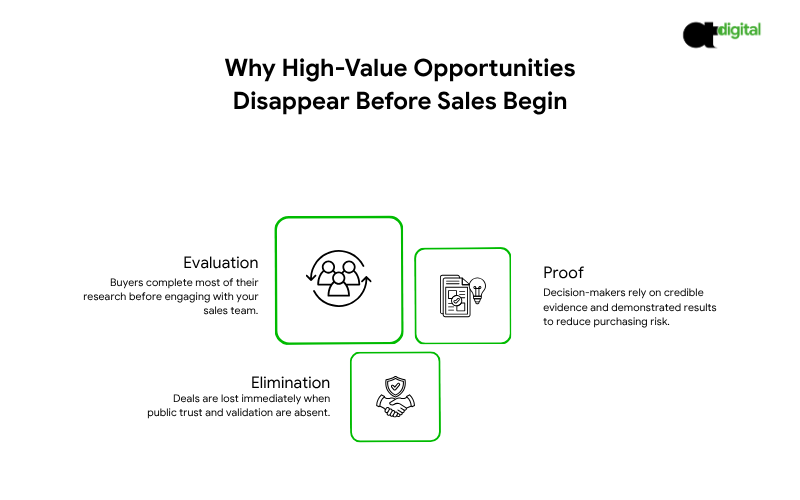
    Industry research shows that over 70% of B2B buyers complete the majority of their evaluation before ever speaking to a sales team. During that silent evaluation phase, your digital ecosystem is doing one of two things:

    • Building trust and pulling buyers toward you
    • Creating friction and pushing them toward your competitors

    Most business owners treat their digital presence like a Digital Brochure – a static, polite place where people can find a phone number and a mission statement. They view it as a “marketing task” to be checked off a list so they can get back to “real work”.

    This is not a strategy; it is a liability.

    Your online presence is no longer just a “face” for your company.

    • It is your primary salesperson who works 24/7/365 without a coffee break.
    • It is the first impression that happens before you even enter the room.
    • It is the only thing standing between you and irrelevance in a search-first economy.

    The Reality Check:

    If your digital presence isn’t engineering revenue, it is actively costing you market share. It is a leak in your hull that gets wider every day your competitor optimizes theirs.

    This guide is not about “getting more likes”. It breaks down the cold mathematics of Digital Darwinism: why businesses die in the shadows, and how the top 1% engineer their way to dominance.

    Are you ready to stop being the “best-kept secret” in your industry?

    Let’s look at the data.

    PART I: THE VISIBILITY CRISIS

    (The Existential Threat)

    The first rule of survival in 2026 is brutally simple: You cannot sell to someone who cannot find you.

    We often comfort ourselves by thinking businesses fail because of “bad products” or “market crashes”.

    The Reality? Most businesses fail because of obscurity.

    You might have a superior product. You might have better service. You might even have stronger experience than your competitors.

    But in the digital economy, the best product doesn’t win. The most visible product wins.

    Google processes over 8.5 billion searches every day.

    More importantly, 68% of all online experiences begin with a search engine (BrightEdge).

    Visibility determines who gets considered. If you are not visible, you are not a player. You are a spectator.

    The Cost of Invisibility: The Tax You Pay Every Day

    Your Store is Open, But is Anyone Watching?

    Imagine opening a flagship retail store. You stock the shelves with premium inventory, hire the best staff, and install marble floors.

    And then… you build a solid brick wall over the front door.

    This sounds insane in the physical world. Yet, this is exactly what happens when you ignore SEO and Search Intent.

    In the digital world, there is no “foot traffic”. There is only Search Traffic. And the mathematics of search are unforgiving:

    • The Top 3 Rule: The first 3 organic results on Google capture 68.7% of all clicks.
    • The Graveyard: Results on Page 2 receive less than 0.78% of clicks.

    The Invisible Tax:

    Every time a potential customer searches for “Industrial Valves Manufacturer” or “SaaS Consultant” and finds your competitor, you don’t just lose a sale. You funded your competitor.

    The Compound Loss:

    Your competitor takes that revenue ($50k, $100k, $1M), reinvests it into better ads, better content, and stronger SEO, pushing you further down the page. This is the Digital Death Spiral. You aren’t just standing still; you are actively shrinking relative to the market leader.

    Why “Word of Mouth” is Too Slow for 2026

    We don’t need marketing; we grow by referrals.

    This was a valid strategy in 2015. In 2026, it is a suicude.
    Referrals are excellent – they close faster and spend more. But they have two fatal flaws: they are unscalable and unpredictable. You cannot “engineer” a referral. You cannot turn a dial and generate 50 more of them when cash flow is tight.

    The Validation Check (The Silent Killer):

    Even if you get a referral, the game isn’t over.

    Data shows that 87% of referral prospects will Google your company before they ever dial your number.

    Scenario A:

    They search your name. They see a fast website, 50+ Google Reviews, and a recent case study. Result: Trust validated. They call.

    Scenario B:

    They search your name. They find a broken link, a Facebook page last updated 2-years back, and zero reviews. Result: Trust broken. They assume you are “out of business” or “not serious”.

    If your digital presence doesn’t match the glowing recommendation, the referral dies instantly. You will never even know they looked.

    The “Near Me” War: The Battle for Local Intent

    Local Dominance: Capturing Customers Walking Past Your Door

    For local businesses – whether you are a Dental Clinic in London or a Real Estate firm in New York – the battle is won or lost in the Google 3-Pack (The Map Pack).

    This is about Micro-Moments.

    When a user searches “Emergency Dentist Near Me” or “Corporate Lawyer”, they are not browsing. They are in pain. They have a credit card in hand.

    The Stat:

    Google data confirms that 76% of people who search on their smartphones for something nearby visit a business within 24 hours. 28% of those searches result in a purchase.

    The Geo-Fence:

    If you are not in that top 3 map results, you are essentially invisible to the people walking past your front door.

    You are a ghost in your own neighborhood. Meanwhile, the business ranked #1 is capturing 28% of all local clicks simply by being present when the intent is highest.
    The Lesson: Local SEO is not about “branding”. It is about interception. If you don’t intercept that customer, someone else will.

    PART II: THE ECONOMICS OF DIGITAL

    (The Financial Argument)

    Most businesses make a fundamental mistake. They treat marketing as an expense.

    • A monthly cost.
    • A budget line.
    • Something to reduce when margins tighten.

    Stop looking at marketing as an “expense” (a cost that vanishes).

    Start treating it as an “investment” (a machine that prints returns).

    Wrong Question: “How much are we spending on marketing?”

    Right Question: “How efficiently are we buying customers?”

    This is where the most important metric in modern growth comes in.

    Customer Acquisition Cost (CAC)

    How much it costs to acquire one paying customer.

    In 2026, you cannot afford to “guess” where your money is going. You need to know – down to the cent – which dollar brought the client and which dollar was set on fire.

    Growth is not determined by effort. It is determined by acquisition economics.

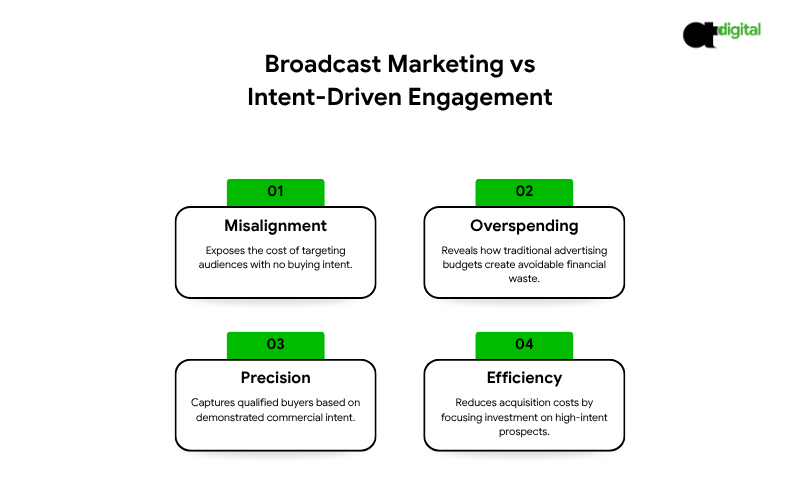
    Digital ROI vs. The “Black Hole” of Traditional Ads

    Why Digital Marketing is Cheaper Than Traditional Ads

    Traditional advertising (Billboards, Print, Radio) operates on “Shotgun Logic”.

    You pay to spray your message to 50,000 people on a highway or in a newspaper, hoping that maybe 0.1% of them need an industrial pump or a divorce lawyer right now.

    You are paying for 99.9% Waste.

    Digital Marketing is a Sniper Rifle.

    It is the only channel where you can eliminate waste before you spend a rupee.

    Surgical Precision:

    You don’t pay to show your ad to “everyone”. You pay to show it only to “CTOs of Manufacturing Companies in Berlin with a turnover above 20 Billion Euro”.

    The Intent Filter:

    With Google Ads, you don’t even pay for the view. You only pay when a prospect proves their interest by clicking.

    The Attribution Revolution:

    The most dangerous aspect of traditional media is the “Black Hole of Data”.

    Billboard Scenario:

    You spend $3000. Sales go up slightly. Was it the billboard? Was it word of mouth? Was it the season? You don’t know.

    Digital Scenario:

    You spend $2500. We track exactly 412 clicks, 38 leads, and 12 closed deals. We know that the keyword “Industrial Valve Supplier” generated a 420% ROAS (Return on Ad Spend), while the keyword “Cheap Valves” lost money.

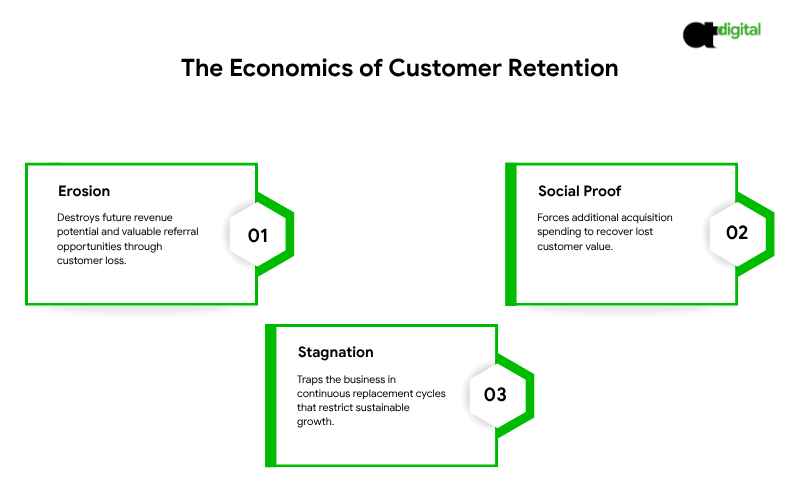
    The $1 vs. $100 Rule: The Math of Retention

    Retention vs Acquisition

    Most business owners are obsessed with the “hunt”. They want New Leads, New Logos, New Revenue.

    But the math proves that the “hunt” is the most expensive way to grow.

    The Economic Reality:

    • Data from Harvard Business Review suggests that acquiring a new customer is anywhere from 5 to 25 times more expensive than retaining an existing one.
    • Increasing customer retention by 5% can increase profits by 25% to 95%
    • Existing customers are 60%-70% more likely to buy again, compared to 5% to 20% for new prospects

    This is the economic logic behind the $1 vs. $100 principle.

    The Rule of Leverage:

    • Acquisition (The $100 Cost): To get a new stranger to trust you, you have to run cold ads, pay for clicks, nurture them, and pay sales commissions. It is heavy lifting.
    • Retention (The $1 Cost): To get an existing client to buy again, you just need to send a well-timed email or show a retargeting ad. The trust is already built.

    The Leak in Your P&L:

    If you don’t have a digital system to nurture your existing clients (Automated Newsletters, Loyalty Loops, Remarketing), you are burning cash.

    You are pouring expensive water into a leaky bucket.

    • The “Scaling” business uses digital to turn one-time buyers into lifetime subscribers.
    • The “Struggling” business is constantly hunting, never farming, and eventually runs out of ammo.

    The Lesson: Your email list and your past customer data are assets on your balance sheet. If you aren’t mining them, you are sitting on a gold mine and complaining about being poor.

    PART III: THE PSYCHOLOGY OF TRUST

    (The Conversion Argument)

    In the digital economy, attention gets you seen. Trust gets you paid.

    Every buyer decision today follows the same silent sequence:

    Research from Gartner shows that 70% to 80% of B2B buyers complete their evaluation before contacting a vendor.

    Studies from Stanford indicate that 75% of users judge a company’s credibility based on its website and online presence. If a customer doesn’t trust you, they will not pay you. And in 2026, they decide whether to trust you in milliseconds, often before you even know they exist.

    You are not selling a product. You are selling Certainty.

    The Zero Moment of Truth (ZMOT)

    Why Reviews Make or Break Your Sales

    Google coined the term “Zero Moment of Truth” (ZMOT).

    It refers to that precise split second when a user researches a product after experiencing a stimulus (a need) but before they buy.

    In the old world, the “First Moment of Truth” was at the store shelf. In 2026, the shelf is digital, and the label is your Star Rating.

    The Jury is Out:

    Your reviews are your jury.

    • A 4.8-star rating is an appreciating asset. It allows you to charge 15-20% more than the market average because you offer “safety”.
    • A 3.2-star rating is a bankruptcy filing waiting to happen. It forces you to compete solely on price because you cannot compete on quality.

    Conversion Engineering:

    You must aggressively engineer your reputation.

    One bad review left unanswered is not just a “complaint” – it is a red flag to the next 100 people who see it.

    • The Data: 94% of consumers say a bad review has convinced them to avoid a business.
    • The Fix: A professional, empathetic, and public response to a bad review can actually increase trust. It shows you solve problems, rather than hiding from them.

    Brand as Authority: Selling Without Selling

    The Power of Thought Leadership

    Why do clients pay – McKinsey, Deloitte, or BCG – $500,000 for advice they could get from a local consultant for $5,000?

    Authority.

    In the B2B and Service sectors, the vendor who educates the market owns the market. Stop being evaluated as a vendor. Start being viewed as a specialist.

    Content is Leverage:

    When you publish insightful whitepapers, detailed case studies, and technical blogs, you stop being a “Vendor” (who competes on price) and start being a “Partner” (who competes on value).

    The Pre-Sale Mechanism:

    Strategic content is not about “blogging”. It is about Objection Handling at Scale.

    • Your articles should answer the questions your sales team hates answering.
    • They should dismantle the prospect’s fears before they ever pick up the phone.

    By the time the prospect contacts you, they shouldn’t be asking, “Why should I hire you?” They should be asking, “When can you start?” They are already sold. You just need to handle the paperwork.

    The Shield: Crisis Management

    How Social Presence Protects Your Reputation

    When something goes wrong (and in business, it eventually will – a shipping delay, a faulty batch, a PR slip-up), your social presence is your Shield.

    The Vacuum Theory:

    If you are silent online, rumors fill the void.

    If a crisis hits and your last Facebook post was in 2023, you look negligent. You have no channel to defend yourself. The narrative is written by your angry customers.

    The Channel of Control:

    A strong, active social presence gives you Deployment Speed.

    It allows you to:

    • Control the narrative instantly.
    • Apologize publicly and transparently.
    • Retain customer loyalty by showing you are present and accountable.

    Reputation Equity:

    Think of your social media followers as a “Bank of Goodwill”. If you have deposited value into that bank for years, your customers will forgive a withdrawal (a mistake). If the account is empty, they will bankrupt you.

    PART IV: THE INFRASTRUCTURE

    (The Technical Argument)

    We have discussed Strategy, Economics, and Psychology. Now, let’s talk about Hardware.

    Your digital presence is not a cloud of ideas; it is a machine made of code. If the machine is slow, broken, or ugly, the strategy fails.

    Your Website: The 24/7 Salesman

    Why Your Ugly Website is Scaring Away Premium Clients

    Every visitor who lands on your website is asking three questions within seconds:

    • Can I trust this company?
    • Do they understand my problem?
    • Are they worth my time and money?

    Let’s reframe what a website actually is. It is the only employee in your company that:

    • Works 24 hours a day, 365 days a year.
    • Can handle 10,000 customers simultaneously without getting stressed.
    • Says exactly the perfect sales pitch every single time.

    So why do you dress this star employee in cheap clothes?

    If your top salesperson walked into a client meeting wearing a ripped t-shirt and smelling like cheap cologne, you would fire them. Yet, business owners allow their websites to look outdated, broken, and amateurish – and then wonder why they attract low-budget clients.

    The “Premium” Filter (Cognitive Dissonance):

    If you sell a premium service (e.g., High-End Architecture, Enterprise SaaS, Luxury Real Estate) but have a budget website, you create Cognitive Dissonance.

    • The Client’s Brain: “They say they are world-class experts, but their website looks like a school project”.
    • The Result: The brain resolves this conflict by assuming you are lying. Trust evaporates. You cannot sell a Rolex out of a plastic bag.

    Technical Debt: The Speed of Revenue

    You could have the best SEO strategy in the world. You could have the most persuasive copy. But if your site loads in 5 seconds, Google will bury you.

    • Core Web Vitals: Google now measures your site based on “User Experience” metrics (LCP, FID, CLS). If you fail these, you are actively penalized in search rankings.
    • The 1-Second Rule: A 1-second delay in page load time yields:
      • 11% fewer page views.
      • 16% decrease in customer satisfaction.
      • 7% loss in conversions. (Source: Aberdeen Group).

    The Search Penalty: Technical Debt and Visibility

    Google uses performance metrics known as Core Web Vitals to evaluate user experience. These include:

    • Loading speed
    • Interactivity
    • Visual stability

    Sites that perform poorly on these metrics face reduced search visibility. This creates a hidden bottleneck. You may invest in:

    • SEO strategy
    • Content creation
    • Link building

    But if your site loads in five seconds, search rankings decline, and traffic potential is limited. This is known as technical debt.

    Over time, small performance issues compound into:

    • Lower rankings
    • Higher bounce rates
    • Reduced conversions
    • Higher acquisition costs

    The Engineering Reality:

    A pretty website that loads slowly is not an asset; it is digital art. A business website must be High-Performance Infrastructure. It must load instantly, navigate intuitively, and convert ruthlessly.

    Anything less is just a vanity project.

    CONCLUSION: THE COST OF INACTION

    The internet is not a magic wand. It is a magnifier.

    If your business is fundamentally good, if you solve real problems and deliver value – a strong digital presence will scale you to the moon.

    If your business processes are broken, a digital presence will just expose your flaws faster.

    But here is the urgency that most CEOs miss: The cost of entry is rising every single day.

    • SEO Difficulty doubles every 24 months as competitors create more content.
    • Ad Costs (CPM) rise 15-20% annually due to platform inflation.
    • Trust Barriers are hardening; customers are becoming more skeptical, not less.

    The “Inaction Tax” is real.

    Waiting another year to fix your digital presence will not just cost you “lost revenue”. It will cost you double the investment to achieve the same result you could get today.

    You have two choices:

    1. The Legacy Path: Continue treating digital as a “marketing task”. Hope word-of-mouth sustains you. Watch your margins shrink as invisible competitors steal your market share.
    2. The Engineering Path: Treat your digital presence as critical infrastructure. Build the machine. Own the data. Dominate the search results.

    Stop guessing. Start Engineering.

    INTERNAL DIAGNOSTIC

    Where is your leak?

    Most businesses are losing 40-60% of their potential revenue through cracks in their digital foundation – SEO invisibility, UX friction, or wasted ad spend.

    Don’t wait for the phone to stop ringing. Let’s look at the data.

    (No Sales Scripts. Just Engineering.)